Light — study notes
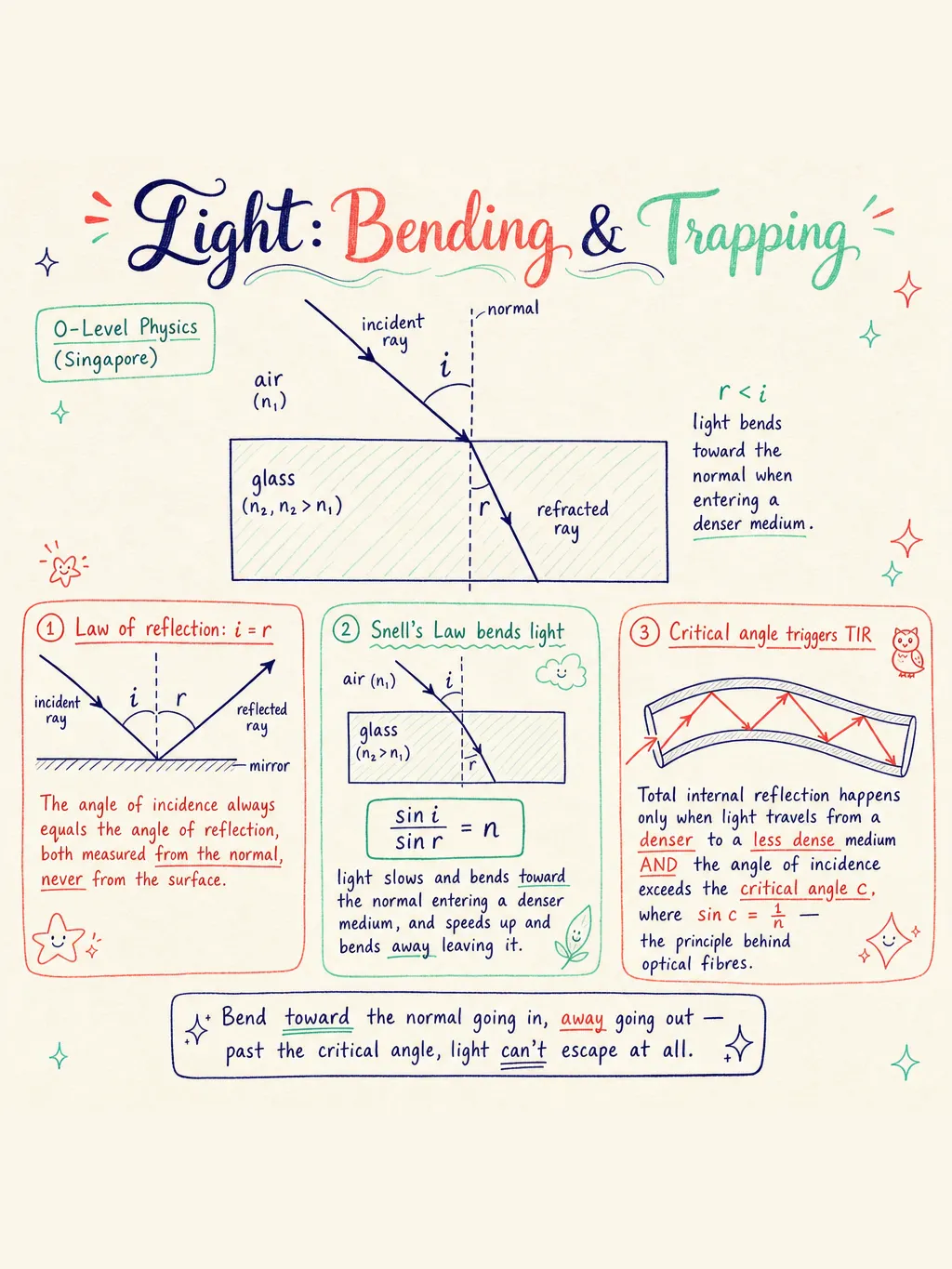
Drop a pencil into a glass of water and the part underwater seems to kink sideways, as though it's been snapped in half. Nothing broke — you're watching light change direction the instant it crosses from one see-through material into another.
Why Light Bends at a Boundary
Light travels at different speeds depending on what it's moving through — faster in air, slower in glass or water — because it keeps interacting with atoms as it passes. Hit a boundary between two materials straight on and that speed change shifts nothing. But strike it at an angle, and one edge of the beam slows down before the rest of it does, so the whole ray swings onto a new heading. That swing is refraction.
To measure it precisely, draw a construction line called the normal: an imaginary line at right angles to the boundary, right at the point the ray crosses. Working from that line, the incoming ray makes an angle of incidence, and the bent ray makes an angle of refraction on the far side. However sharp or gentle the bend, one ratio tying these two angles together stays fixed for a given pair of materials — that fixed number is the refractive index, and it's what O-Level questions are really testing when they hand you two angles and ask for a missing third value.
Worked Example — Light Entering Water
- A ray travels from air into water, striking the surface with an angle of incidence of 40°. Water has a refractive index of 1.33, and the refraction angle is unknown.
- Rearrange the relationship so the unknown sine stands alone: divide the sine of the incoming angle by the refractive index. sin(refraction) = sin 40° ÷ 1.33 = 0.643 ÷ 1.33 ≈ 0.483.
- 0.483 is that sine value, not a degree measure on its own, so finish with an inverse-sine step: refraction angle = sin⁻¹(0.483) ≈ 28.9°. Since water is denser than air, the ray bends in towards the normal, and 28.9° is indeed smaller than the 40° it started at — a useful check that the answer makes physical sense.
That's the core mechanic behind every refraction question on the paper. The full lesson below builds on it with the reflection rules, total internal reflection and optical fibres, converging lenses and ray diagrams — plus a listen-along audio walkthrough, the remaining worked examples, and a practice worksheet.
Keep going — unlock the whole topic
Notes, audio and the worksheet for this topic, plus every other topic in the subject.
Claim a free seat →