Listening Comprehension — Study Notes
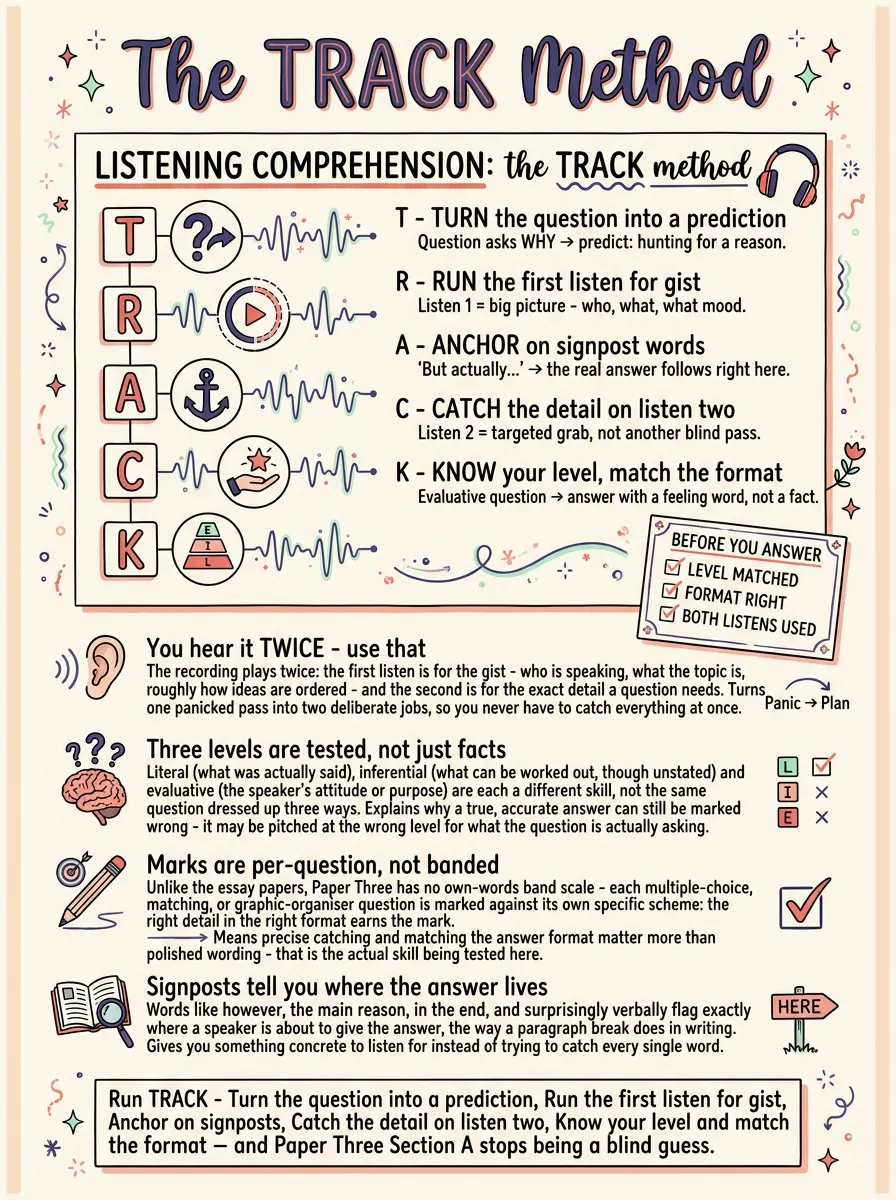
Press play on a listening question and it feels like you get exactly one shot at the answer. Good news: O-Level English Paper 3 doesn't work that way. Every clip plays twice, and most candidates waste the second play repeating the first — chasing every word again instead of hunting for one specific thing.
Turn the Question Into a Target Before the Clip Starts
The single biggest shift in a listening score comes from deciding, before a word of audio has played, exactly what shape of answer you're chasing — a number, a name, a stated cause, or a feeling. Read the question and any options first, then ask what kind of answer would even fit in the space given. "How does the speaker feel" wants an attitude word, not a fact; "what happened first" wants a stated detail, not a guess. Once that target is fixed in your head, play one stops being a scramble for everything and becomes a scan for the general shape of the passage — who is talking, and roughly what about. Play two then becomes a precise grab for the one detail your target named, guided by whatever you noticed in play one. Nothing gets written down early, because an early guess is how a close-but-wrong detail gets swapped in for the exact one the mark scheme wants.
Worked Example — Predicting Before a Postponement Announcement
- The question reads: "Why was the inter-house swimming gala moved to a later date?" Before listening, fix the target: this wants a stated cause, so hunt for a linking word such as "because" or "due to" once the clip begins.
- On the first play, take in only the general shape: a coach addressing a team, sounding apologetic, about an outdoor event being rearranged.
- On the second play, listen past the linking word rather than for it. The coach explains the pool was closed for emergency filter repairs, so the gala shifted to the following Monday.
- Match the exact wording to the target set in step one: the pool was closed for emergency filter repairs. Writing only "pool problems" risks losing the mark, since the scheme wants the stated cause, not a paraphrase of it.
Notice what made this work: the target was fixed before a single word of the clip was heard, so the second play had a job to do rather than just being a repeat of the first.
Predicting the target is one piece of a fuller listening routine — including how to read a speaker's tone and dodge the exam's favourite wrong-answer traps — walked through with audio and a practice worksheet in the full lesson below.
Keep going — unlock the whole topic
Notes, audio and the worksheet for this topic, plus every other topic in the subject.
Claim a free seat →