Maintaining Air Quality — study notes
Splash a little vinegar onto a piece of chalk and it fizzes furiously. That everyday fizz is the exact same chemistry power stations and quarries lean on to fight one of Singapore syllabus chemistry's biggest environmental villains: acid gases in the air.
Neutralising Acid Pollution With a Carbonate
Two pollutant gases, sulfur dioxide and nitrogen dioxide, dissolve into rainwater and turn it acidic. The cheap, widely available fix is a rock most of us walk past daily: calcium carbonate, better known as limestone. It works as a base — but it is not an alkali, because true alkalis must dissolve in water and limestone barely does. That distinction changes the chemistry: pair an acid with an alkali and you only ever get two products, a salt plus water. Pair the same acid with a carbonate instead, and a third product always joins them — a fizzing gas escapes as the reaction proceeds. Spotting which category a substance falls into, base or alkali, tells you instantly how many products to expect on your answer line.
Worked Example — Reacting Dilute Nitric Acid With Calcium Carbonate
- Identify what you're mixing: dilute nitric acid (an acid) and calcium carbonate powder (a carbonate, therefore a base rather than an alkali).
- Recall the rule for this pairing: whenever an acid meets a carbonate, three things form — a salt, water, and a gas that fizzes away.
- Work out the salt's name by combining the metal from the base with the acid's ion: calcium (from calcium carbonate) plus nitrate (from nitric acid) gives calcium nitrate.
- State the full word equation: calcium carbonate + nitric acid → calcium nitrate + water + carbon dioxide.
Notice the fizzing gas is carbon dioxide — always check for it whenever a carbonate is one of your reactants, because leaving it off an answer is one of the easiest marks to drop.
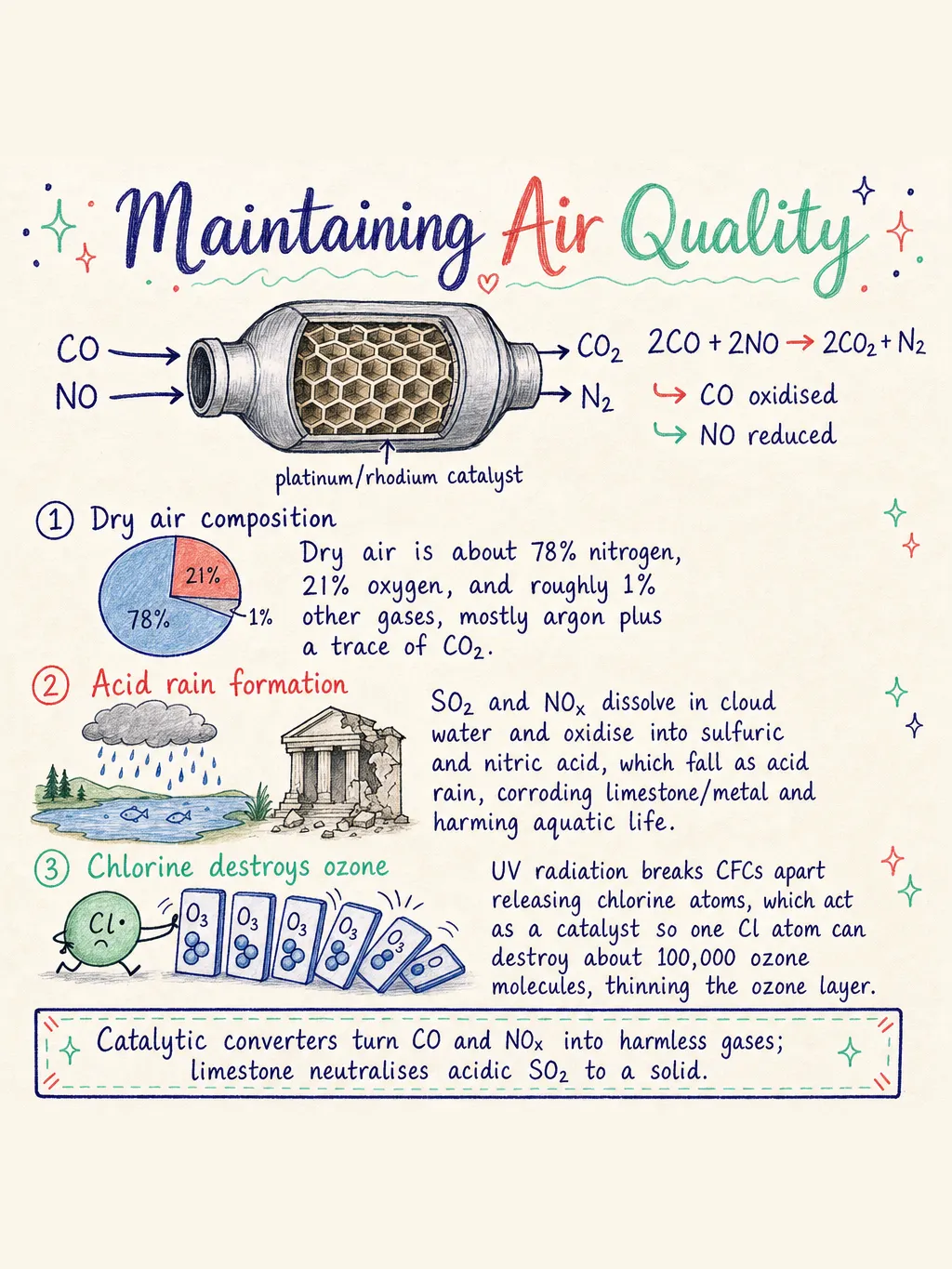
This carbonate trick shows up again and again once you dig into how limestone treats acid lakes versus flue gases, why nitrogen and oxygen normally refuse to react at all, and how a catalytic converter swaps two toxic gases for two harmless ones — plus an audio walkthrough and a practice worksheet, all waiting in the full lesson below.
Keep going — unlock the whole topic
Notes, audio and the worksheet for this topic, plus every other topic in the subject.
Claim a free seat →