Titration Technique & Precision — study notes
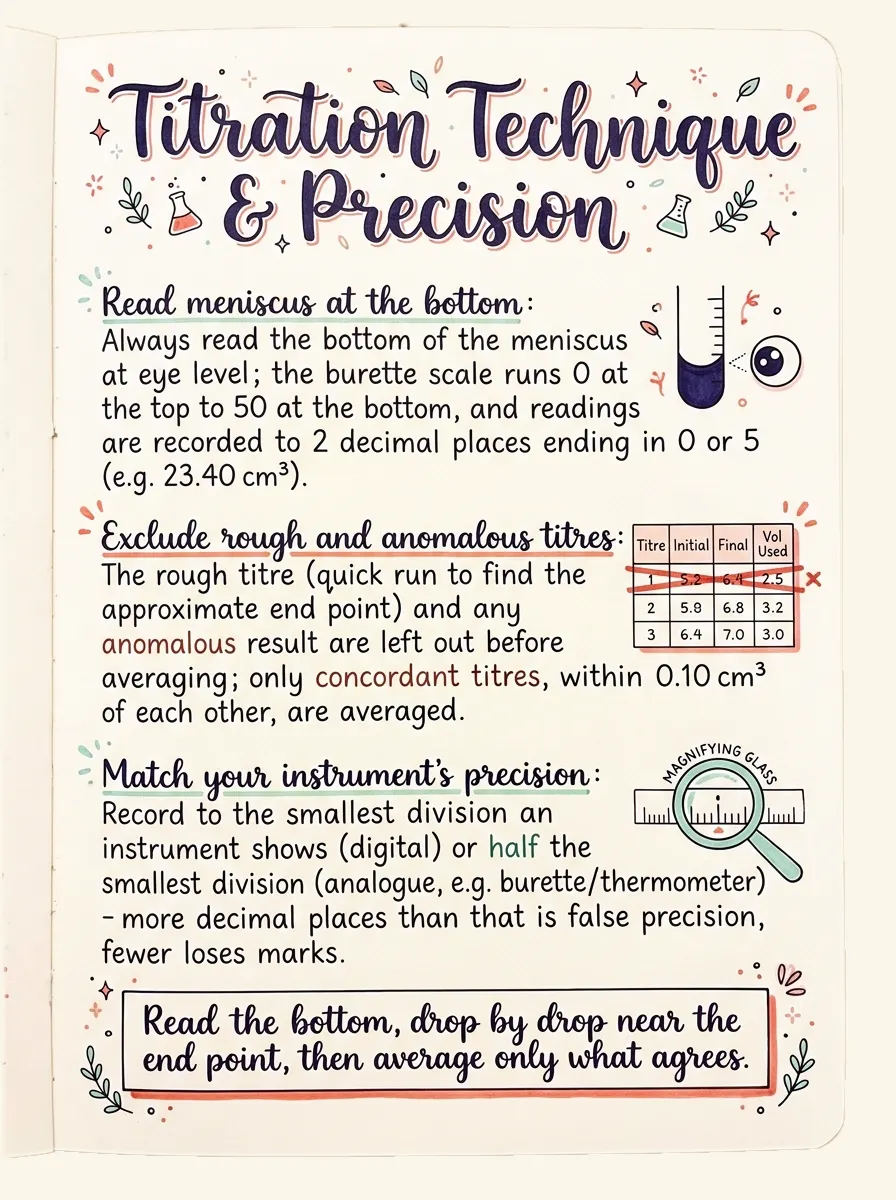
Two students read the same burette. One writes 15.66 cm³. The other writes 15.65 cm³. Only one of them is telling the truth about what the glassware can actually show — and it isn't the one who looks more "scientific."
Match Your Number To What The Instrument Can Really Tell You
Every piece of lab kit only separates values down to a certain fineness, and a good result never claims more detail than that ceiling allows. For an analogue scale — a scale you read by eye against printed lines, like a burette or a thermometer — your judgement can honestly place a level sitting between two neighbouring marks, so the fair limit is half the gap between them. A digital display has performed that same call inside the device itself, so all you do is copy down the figure shown on screen — nothing added, nothing guessed.
Get this backwards and you invent a level of certainty that was never there — examiners call this false precision, and it costs marks even when every earlier step of your working was sound.
Worked Example — Reading Between Two Marks on a Burette
- Check the smallest printed gap on the tube: this burette is marked every 0.10 cm³, so the finest position you can honestly claim by eye is half of that gap, 0.05 cm³.
- Look at where the bottom of the liquid curve actually sits: it rests just past the halfway point between the 15.60 and the 15.70 lines, closer to that midpoint than to either printed line.
- Round to the nearest 0.05 cm³ step available — 15.60, 15.65 or 15.70 — and record 15.65 cm³. Notice the last digit must land on a 0 or a 5: a value like 15.66 cm³ claims your eye split the gap into ten slices rather than two, a fineness no one can honestly judge on this scale.
That's one habit sorted — but a real practical paper tests dozens of these judgement calls across apparatus set-up, technique, safe heating and picking which results to trust. The full lesson below walks through every one of them with an audio narration you can listen to on the move, plus a printable worksheet to lock it in.
Keep going — unlock the whole topic
Notes, audio and the worksheet for this topic, plus every other topic in the subject.
Claim a free seat →