Measurement — study notes
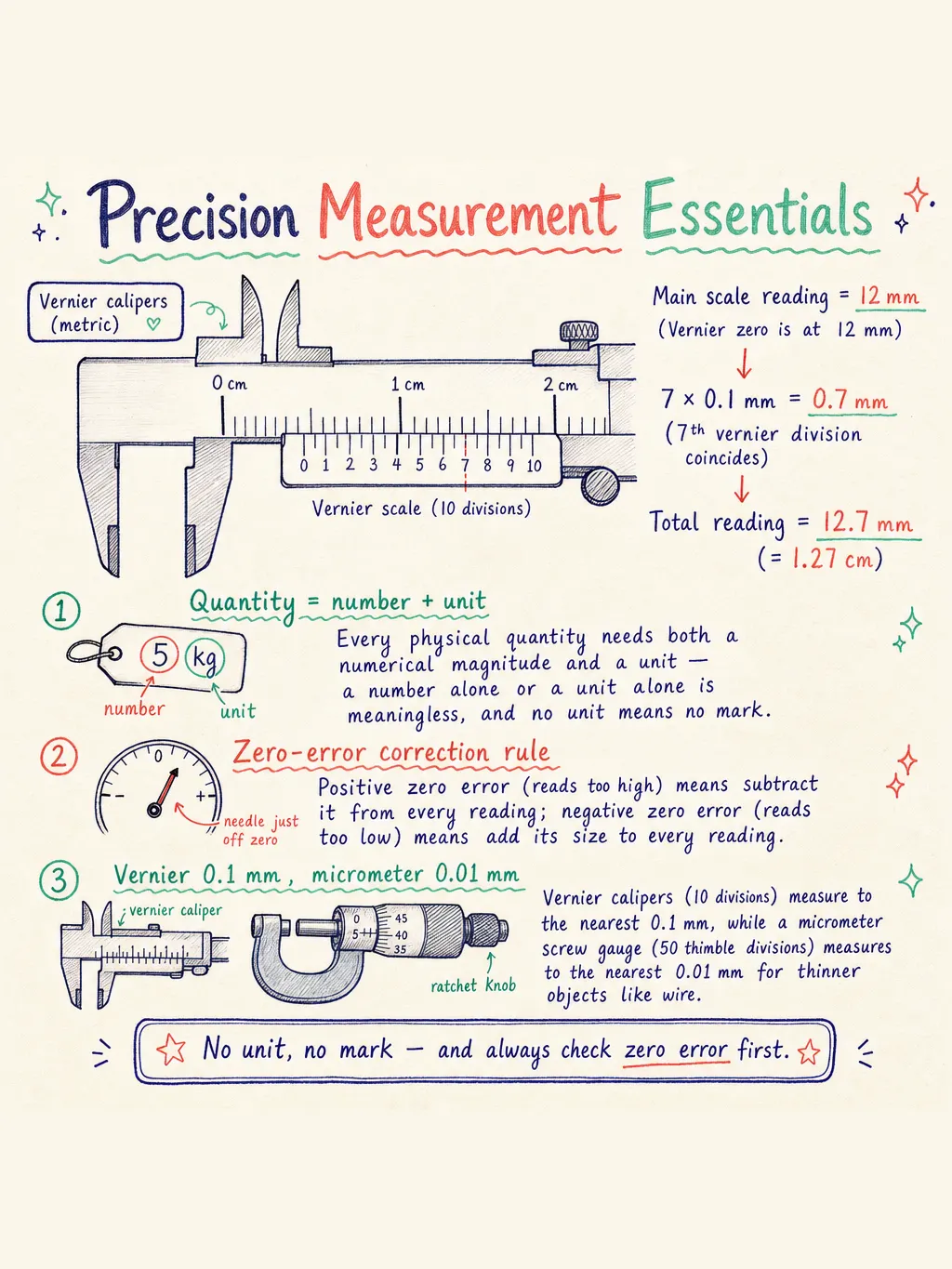
Write "37" as the answer to a physics question and a strict marker gives you zero — even if 37 is the exact right figure. Nothing about a bare number tells anyone what was actually measured, and O-Level Physics punishes that gap hard.
A Number on Its Own Means Nothing
Any measurable property of the world — mass, length, time, temperature and so on — only counts as a complete answer once it carries two things together: a size and a unit that says what's being counted. Drop either half and the statement collapses. "37" could be seconds, degrees or kilograms; only pairing it with a unit turns it into something meaningful.
Physics groups its units into a short list of fundamental ones — kilogram, metre, second, ampere, kelvin, mole — agreed internationally so a reading taken in one country matches a reading taken anywhere else. Nearly everything else you'll calculate, from speed to density, is built by combining these fundamentals rather than standing on its own.
Worked Example — Converting a Prefixed Unit
- A component is rated at 620 microamperes. The prefix "micro" always stands for multiplying by 10⁻⁶, regardless of which unit it sits in front of.
- Swap the prefix for its power-of-ten meaning: 620 microamperes = 620 × 10⁻⁶ amperes.
- Tidy the front digit into standard form (one non-zero digit before the decimal point): 620 × 10⁻⁶ = 6.2 × 10⁻⁴ A.
Mixing up "micro" with the much larger "milli" prefix is one of the most common slips here — always check which power of ten a prefix actually represents before converting.
Reading real lab instruments correctly — where a hidden offset can quietly throw off every measurement, and where combining two directional quantities needs its own drawing method — plus the full audio walkthrough and practice worksheet, are waiting in the full lesson below.
Keep going — unlock the whole topic
Notes, audio and the worksheet for this topic, plus every other topic in the subject.
Claim a free seat →