Sea of Delocalised Electrons — study notes
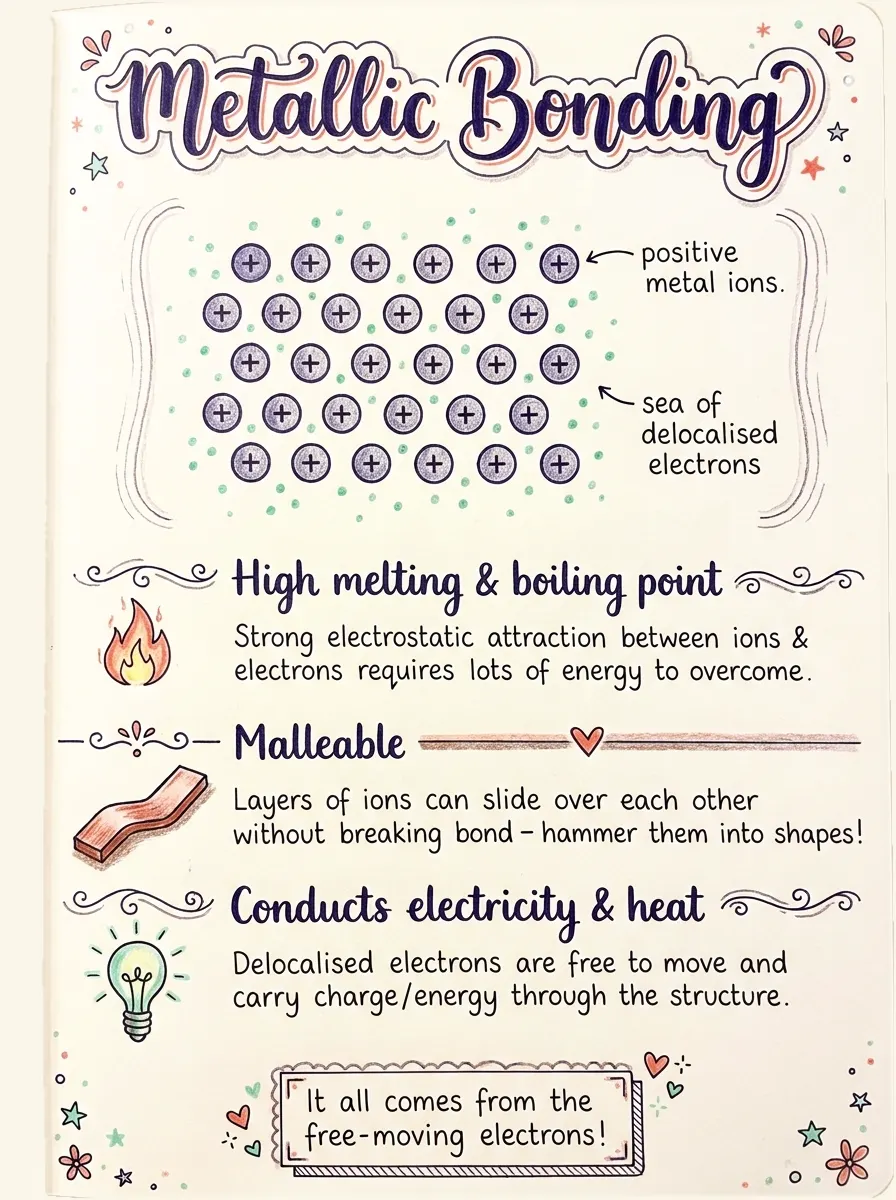
Hammer a lump of gold and it spreads into a thin sheet instead of cracking. Hammer a lump of glass and it shatters. That single difference — bendable versus brittle — plus a metal's shine and its knack for carrying electricity, all come from one shared arrangement inside the solid, and O-Level examiners expect you to name it precisely rather than describe it vaguely.
The Structure Behind Every Metal Property
When metal atoms pack together, each one releases some of its outermost electrons into the space around it. Losing that negative charge turns every atom into a positive ion, so the solid is really a tightly packed grid of these ions, not a grid of neutral atoms. The electrons that left don't settle on any single ion — they roam freely across the whole structure, forming what chemists label delocalised electrons: mobile, unattached, belonging to the metal as a whole rather than to one particle.
Because the roaming electrons carry negative charge and the ions they surround are positive, the two pull on each other constantly — an electrostatic pull, never a magnetic one. That pull acts on every ion from every direction at once, which is exactly why this arrangement makes such a tough, resilient solid: nothing gets a free pass out of the attraction.
Worked Example — Why Magnesium Melts at a Higher Temperature Than Sodium
- Both magnesium and sodium are giant structures of positive ions surrounded by a mobile electron cloud, so the same reasoning about attraction strength applies to both.
- A sodium atom gives up just one outer electron, so its ions carry a 1+ charge. A magnesium atom gives up two, so its ions carry a 2+ charge and the mobile cloud around them is denser.
- A more heavily charged ion sitting in a denser electron cloud experiences a stronger pull toward that cloud than a less-charged ion does.
- Breaking a stronger pull apart takes more energy, so magnesium needs a much higher temperature to melt (around 650°C) than sodium does (around 98°C).
Notice the answer never mentions "bigger atoms" or "more mass" — it stays fixed on ion charge and how strongly that charge is being attracted.
The remaining worked examples — why metals conduct heat and electricity, why they bend rather than snap, plus a listen-along audio walkthrough and a practice worksheet — are in the full lesson below.
Keep going — unlock the whole topic
Notes, audio and the worksheet for this topic, plus every other topic in the subject.
Claim a free seat →