Monohybrid Crosses — Study Notes
Ever wondered how two brown-eyed parents can have a blue-eyed child, when neither parent has blue eyes themselves? The trait didn't come from nowhere — it was hiding, and monohybrid crosses give you the exact tool to predict when hidden traits like this resurface.
The Vocabulary Behind Every Cross
A gene is a section of DNA carrying the instructions for one characteristic (e.g. eye colour) — think of it as a "slot" everyone has. But people don't all carry the same version of that instruction: each different version of a gene is called an allele (e.g. a "brown eye" allele vs a "blue eye" allele).
Every body cell carries two alleles for each gene, one from each parent. A dominant allele (written with a capital letter, e.g. B) shows its effect even if only one copy is present. A recessive allele (lower-case, e.g. b) is hidden unless both of an organism's copies are recessive. This is exactly how a blue-eyed child can appear from two brown-eyed parents: brown masks blue whenever it's present, but if both parents secretly carry one hidden blue allele each, a child can inherit blue from both sides.
The actual pair of alleles an organism carries is its genotype (e.g. Bb); what you actually observe is its phenotype (e.g. "brown eyes"). Two different genotypes (BB and Bb) can give the identical phenotype — which is exactly why a hidden genotype can't be seen just by looking.
Worked Example — Predicting a Cross
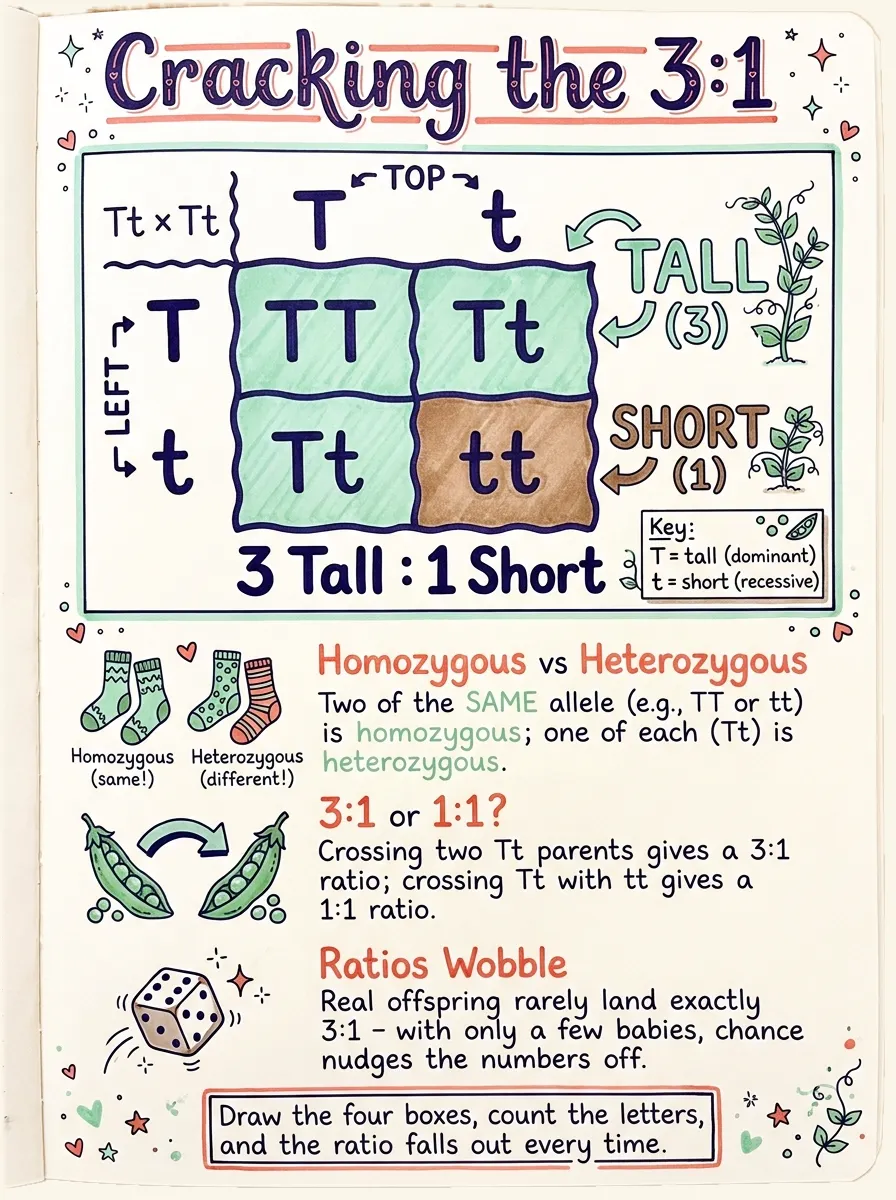
Cross two heterozygous brown-eyed parents (Bb × Bb). Each parent can produce a gamete carrying B or b. Laying every combination out in a grid (a Punnett square) gives four possible offspring: BB, Bb, Bb, bb — a genotypic ratio of 1:2:1.
Converting to phenotype: BB and Bb both show brown eyes (B is dominant), and only bb shows blue eyes. So the phenotypic ratio is 3 brown eyes : 1 blue eyes — the single most common result in this topic.
The rest of the method — every worked example, a listen-along audio walkthrough and a practice worksheet — is in the full lesson below.
Keep going — unlock the whole topic
Notes, audio and the worksheet for this topic, plus every other topic in the subject.
Claim a free seat →