Natural Selection and Evolution — Study Notes
Head lice shampoo used to wipe out an infestation in a single treatment. Ask around now and you'll find families who've gone through three different brands before one finally works. That drift — a treatment losing its bite over the years — is evolution happening on a timescale short enough for a parent to notice, and this guide gives you the toolkit to explain precisely why it occurs.
The chain that turns a difference into a trend
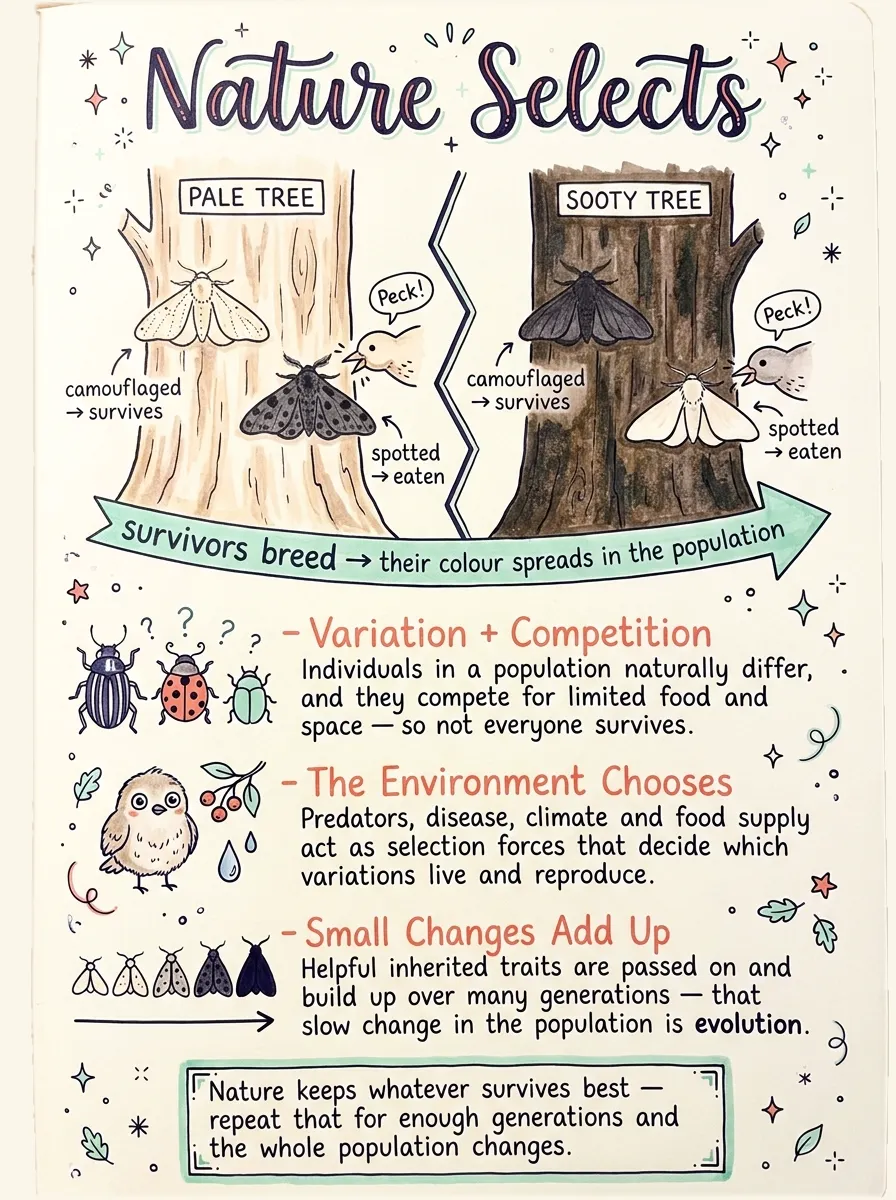
A population is never made of identical copies. Some members already carry small, inherited differences — a slightly tougher shell, a faster reflex, an unusual chemical defence — long before any threat arrives to test them. Nothing in the surroundings hands these differences out on demand; they were already sitting there, produced by earlier random changes to genetic material and passed down from parents.
Now add a squeeze: food, space or safety runs short, so not every member gets enough to survive and breed. Whichever individuals happen to hold the traits that suit this particular squeeze tend to out-survive and out-breed the rest — not because they tried harder, but because the traits they were born with fit what the moment demanded. Those survivors then pass the same traits on to their young, so the next generation contains a larger share of individuals carrying them. Run that cycle across many, many generations and the whole population's typical characteristics visibly shift — an outcome, not a single event.
Worked Example — Weedkiller resistance in a farm field
- A weed population growing in a field already contains a handful of plants with an unusual gene that lets them break down a common weedkiller chemical — this arose earlier by chance, well before any spray was ever used.
- The farmer begins spraying every season. Most weeds are killed outright, but the resistant few survive because their gene neutralises the chemical.
- With competitors gone, the survivors face far less crowding for light, water and soil nutrients, so they grow on and set seed largely unchallenged.
- Their offspring inherit the resistance gene, so each new season's crop of weeds contains a bigger proportion of resistant plants than the last.
- After several seasons, most of the field's weeds shrug off a spray that once cleared it completely — the field's typical weed population has measurably changed.
Notice what the chemical didn't do: it never taught any plant to resist it. It only removed the ones lacking a gene that was already circulating in the population.
The remaining worked examples, a full audio walkthrough and a self-check worksheet are waiting in the full lesson below.
Keep going — unlock the whole topic
Notes, audio and the worksheet for this topic, plus every other topic in the subject.
Claim a free seat →