Nervous Control — Study Notes
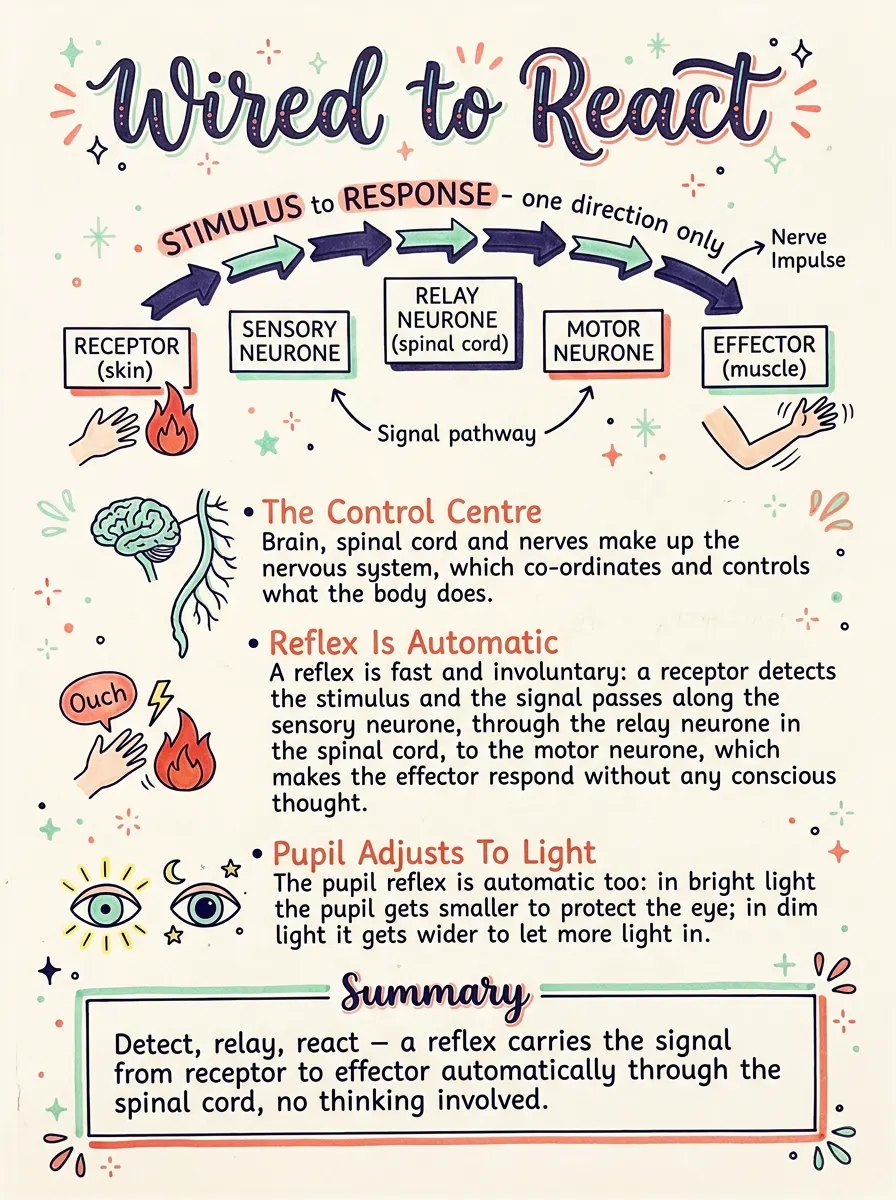
Touch a drawing pin and your foot yanks back before the pain even registers. That gap between "ouch" and "already moved" isn't magic — it's a fixed nerve pathway your body runs on autopilot, and O-Level examiners love asking you to trace it step by step.
How a Reflex Actually Travels Through the Body
A stimulus is anything your body can detect — heat, a sharp point, bright light. A receptor picks it up and turns it into an electrical impulse. From there the impulse always follows the same five-stage route, called a reflex arc: receptor, then a neurone carrying the signal inward, a connecting neurone inside the spinal cord, a neurone carrying the signal back out, and finally an effector — typically a muscle, sometimes a gland — which actually carries out the reaction. Three named neurone types do this relay work, and their names simply describe direction of travel: one type runs signals in towards the spinal cord, one type sits inside the spinal cord linking the other two together, and one type runs signals back out towards the effector. The whole point of looping the signal through the spinal cord instead of sending it up into the skull for processing first is speed — skip that longer detour and you're already reacting before you're even aware anything happened.
Worked Example — Tracing the Arc for a Thorn Prick
- Identify the stimulus: a sharp thorn presses into the pad of your thumb while gardening.
- A pain-sensitive receptor in the skin of the thumb detects this and fires an impulse.
- That impulse travels inward along the first neurone, reaching the spinal cord.
- Inside the spinal cord, a connecting neurone passes the impulse across to the outward-bound pathway.
- The impulse now runs outward along a second neurone toward the thumb's muscles.
- The muscle (the effector) contracts sharply, snapping the thumb away from the thorn — milliseconds before the sting is consciously felt.
Miss out the connecting step in the middle and examiners will mark the answer incomplete — it's one of the most common slip-ups in this topic. The full lesson below walks through the brain-and-spinal-cord command structure, the eye's own reflexes for light and focus, an audio walkthrough you can listen to on the go, and a worksheet to lock the sequence into memory.
Keep going — unlock the whole topic
Notes, audio and the worksheet for this topic, plus every other topic in the subject.
Claim a free seat →