Listening Note-taking — Study Notes
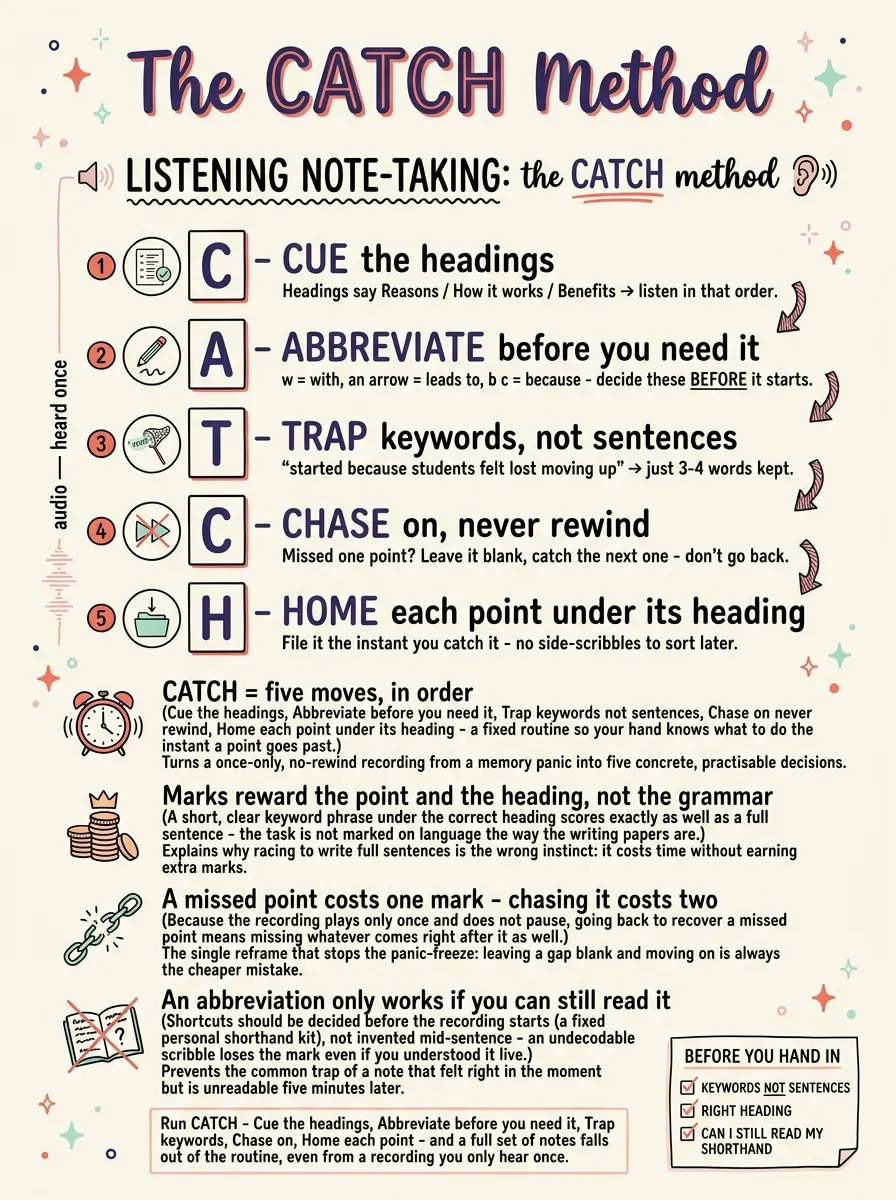
Picture the recording starting, and by the time you've finished writing point two as a full sentence, the speaker is already three ideas ahead of you. Almost every candidate hits this wall on the listening note-taking task — and it isn't a memory problem. It's a technique problem.
Why Full Sentences Cost You Marks
This task gives you a page of printed headings with empty space beneath each one, then plays an informational recording exactly once. The instinct is to copy down roughly what the speaker says, word for word — but forming a grammatical sentence eats seconds you don't have, and the next scorable idea arrives whether your pen is free or not. A marker isn't grading your prose; they're checking whether the right fact landed under the right heading. So the work starts before a single word of audio plays: scan the headings and let each one tell you what kind of answer belongs beneath it — a cause, a place, a change over time — so your ear is already primed. The instant a matching idea turns up, drop only the handful of words that carry it into that space and keep listening. Going back to patch an earlier gap is the costliest move of all — it steals attention from what's playing now, so one missed idea quietly becomes two.
Worked Example — Filing a Recording on a School Recycling Drive
Three headings sit on the page: Reason / Method / Result. A short recording says: "Our school launched a recycling drive after the caretaker kept finding the bins full by Wednesday lunchtime. Each class now competes weekly to collect the most paper and cans, and the winning class gets first choice of a new library book. Since the drive began, the weight of rubbish sent to landfill every week has fallen by close to a third."
- Scan the headings before listening starts and predict what each wants: Reason needs a cause, Method needs an action, Result needs a change.
- Catch the cause as it plays — bins full by Wednesday — and write it straight under Reason, nothing extra.
- Catch the action — classes compete weekly, prize is a library book — and file it under Method as a fragment, not a sentence.
- Catch the outcome — landfill weight down by close to a third — under Result, keeping the actual figure rather than softening it to "less rubbish."
Nothing here is a full sentence, and every note lands under its heading the moment it's caught — nothing gets set aside to sort out afterwards.
The complete routine — the full method, the spoken signal phrases that warn a scorable idea is coming, a weak-versus-strong comparison, guided practice, plus the audio walkthrough and worksheet — is in the full lesson below.
Keep going — unlock the whole topic
Notes, audio and the worksheet for this topic, plus every other topic in the subject.
Claim a free seat →