OIL RIG & Redox Agents — study notes
Drop a copper wire into a colourless silver nitrate solution and something strange happens: the liquid slowly turns blue, and silvery crystals grow on the wire. Nothing was heated, nothing burned — yet atoms have swapped something invisible. That swap is what chemists call a redox reaction, and once you know what's really moving, reactions like this stop looking like magic.
The Real Mechanism: Electrons Changing Hands
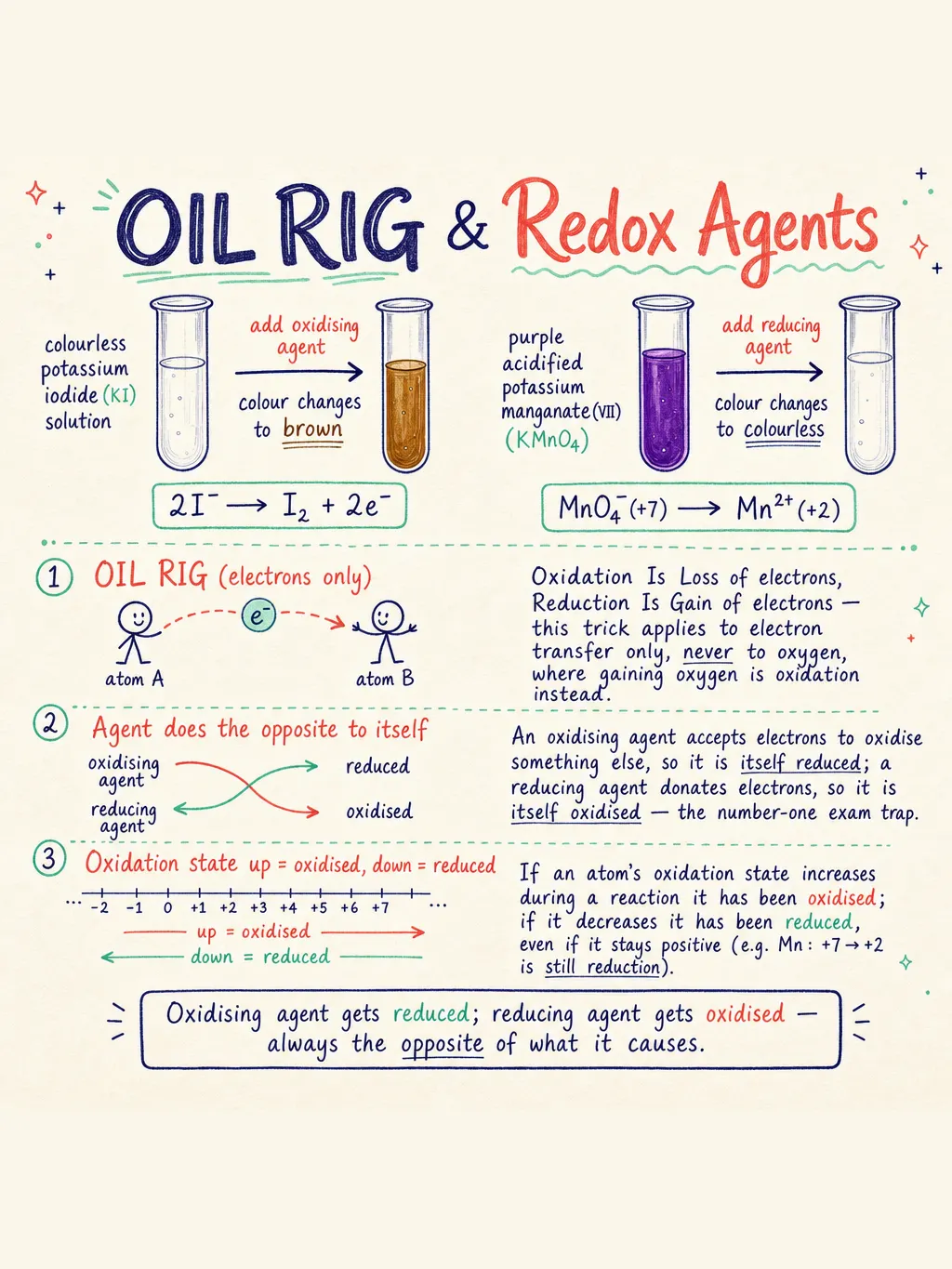
Older definitions of oxidation talk about gaining oxygen, but that idea breaks down the moment a reaction has no oxygen in it at all. The underlying cause, in every case, is electrons moving from one atom to another. Think of it like a relay race: the runner who hands the baton over has given something up — that atom is oxidised — while the runner receiving it has gained something, so that atom is reduced. Chemists compress this into the mnemonic OIL RIG, which unpacks as Oxidation means Loss, while Reduction means Gain — and the thing being lost or gained is always electrons. Never stretch OIL RIG onto oxygen, because with oxygen it's gaining that counts as oxidation, the opposite direction.
This also unlocks what an agent is. A substance that pulls electrons off something else is an oxidising agent, because it forces the other atom into oxidation — but pulling electrons in means the agent itself has gained them, so the agent ends up reduced. A reducing agent is the mirror image: it gives electrons away, reducing its partner while getting oxidised in the process. Read an agent's name as a job title — it tells you the job done on the partner, never the fate of the agent.
Worked Example — Copper Displacing Silver
- Copper metal is placed into silver nitrate solution: Cu + 2AgNO₃ → Cu(NO₃)₂ + 2Ag.
- Copper starts as a neutral metal atom and finishes as the Cu²⁺ ion inside copper nitrate — it has given away two electrons (OIL: loss), so copper has been oxidised.
- Each silver ion carries a + charge because it is missing one electron. It finishes as neutral silver metal, meaning it has gained an electron back (RIG: gain) — so silver has been reduced. Those silvery crystals on the wire are the reduced silver.
- Copper supplied the electrons that reduced silver, making copper the reducing agent; the silver ions took electrons from copper, making Ag⁺ the oxidising agent.
That's the electron-transfer view sorted — the full lesson below walks through the matching oxidation-state method, the colour-change tests for spotting each type of agent, an audio walkthrough you can listen to on the go, and a worksheet to lock it all in.
Keep going — unlock the whole topic
Notes, audio and the worksheet for this topic, plus every other topic in the subject.
Claim a free seat →