Position Predicts Properties — study notes
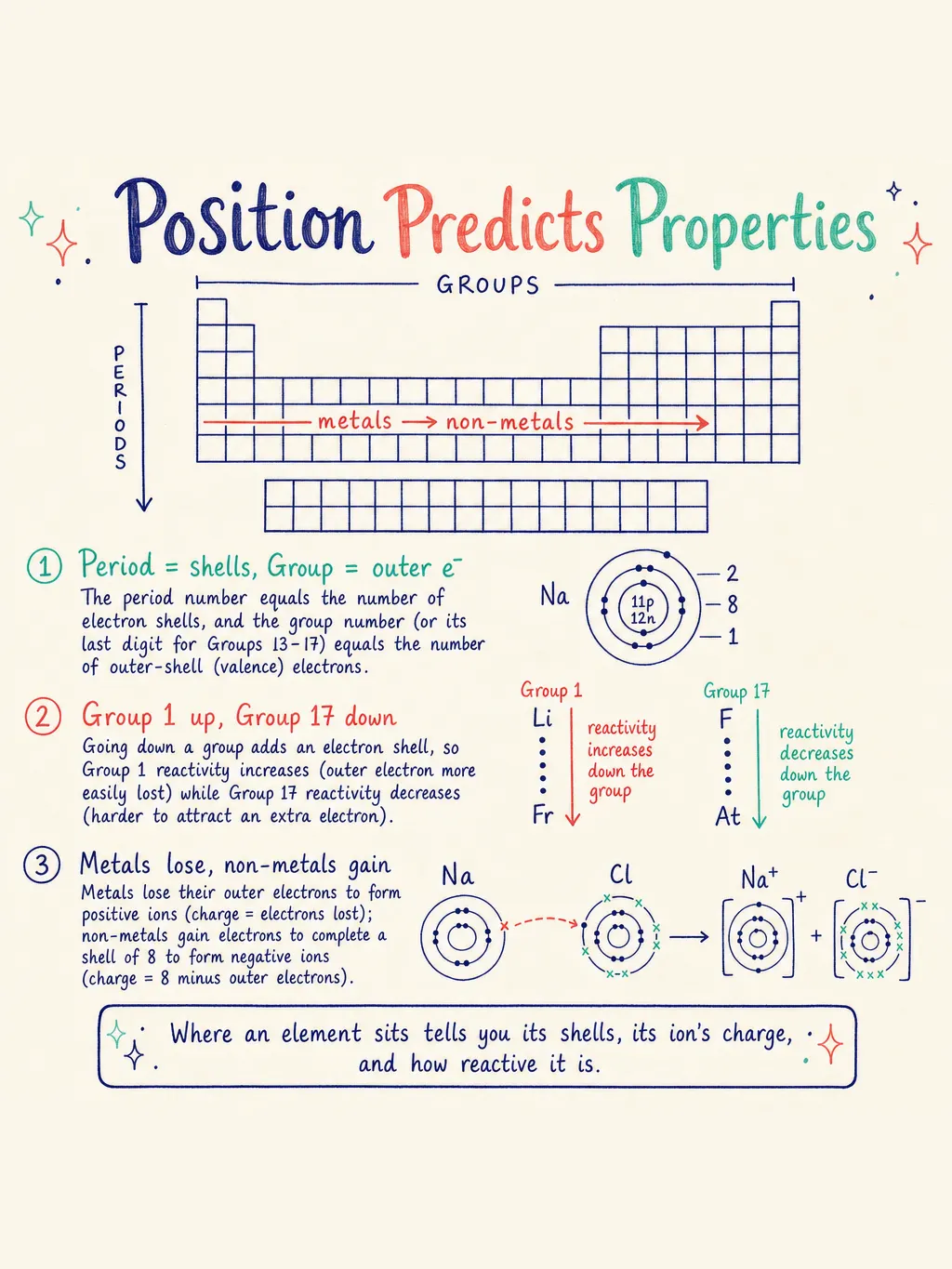
Two elements sitting in completely different corners of the Periodic Table can still share a chemical "personality" — while two neighbours sitting right next to each other can behave nothing alike. The difference isn't random. It comes down to one thing you can read straight off an atom's electron arrangement: exactly where it sits.
Reading a Position Straight From an Electron Arrangement
Every atom's electrons sit in shells layered around the nucleus, and those shells are what fix an element's home on the grid. Count how many shells are occupied and you've found the row that atom belongs to — no lookup needed, just a count. Then look at the outermost shell only: for a small handful of electrons there, that count is the column number directly; for a larger handful, it's whatever digit sits last in the column number. A nearly-empty outer shell pulls an atom toward giving electrons away; a nearly-full one pulls it toward taking electrons in — and that single fact is what decides whether the resulting particle ends up carrying a plus charge or a minus one.
Worked Example — Where Does Phosphorus Sit, and What Ion Could It Form?
- Phosphorus has 15 protons, with electrons arranged 2, 8, 5 across its shells.
- Count the shell listing: three numbers appear (2, 8, 5), so three shells are in use → row 3.
- Read the final shell only: it holds 5 electrons. Since this falls in the "read the last digit" range, the column ends in a 5 → column 15.
- Five outer electrons is closer to a full set of eight than to none, so phosphorus is pulled toward taking in electrons rather than giving them up — it needs 3 more to complete that outer shell, giving an ion of charge 3−.
Notice the charge (3−) is nowhere near the column number (15) — a trap many students fall into by assuming the two must match.
This same shell-counting method is what lets you size up any element on sight — including the ones you've never met before an exam. The full lesson below walks through the metal side of this method with its own worked cases, plus how reactivity shifts as you move up or down a column, an audio walkthrough you can listen to on the go, and a worksheet to lock it in.
Keep going — unlock the whole topic
Notes, audio and the worksheet for this topic, plus every other topic in the subject.
Claim a free seat →