Photosynthesis — Study Notes
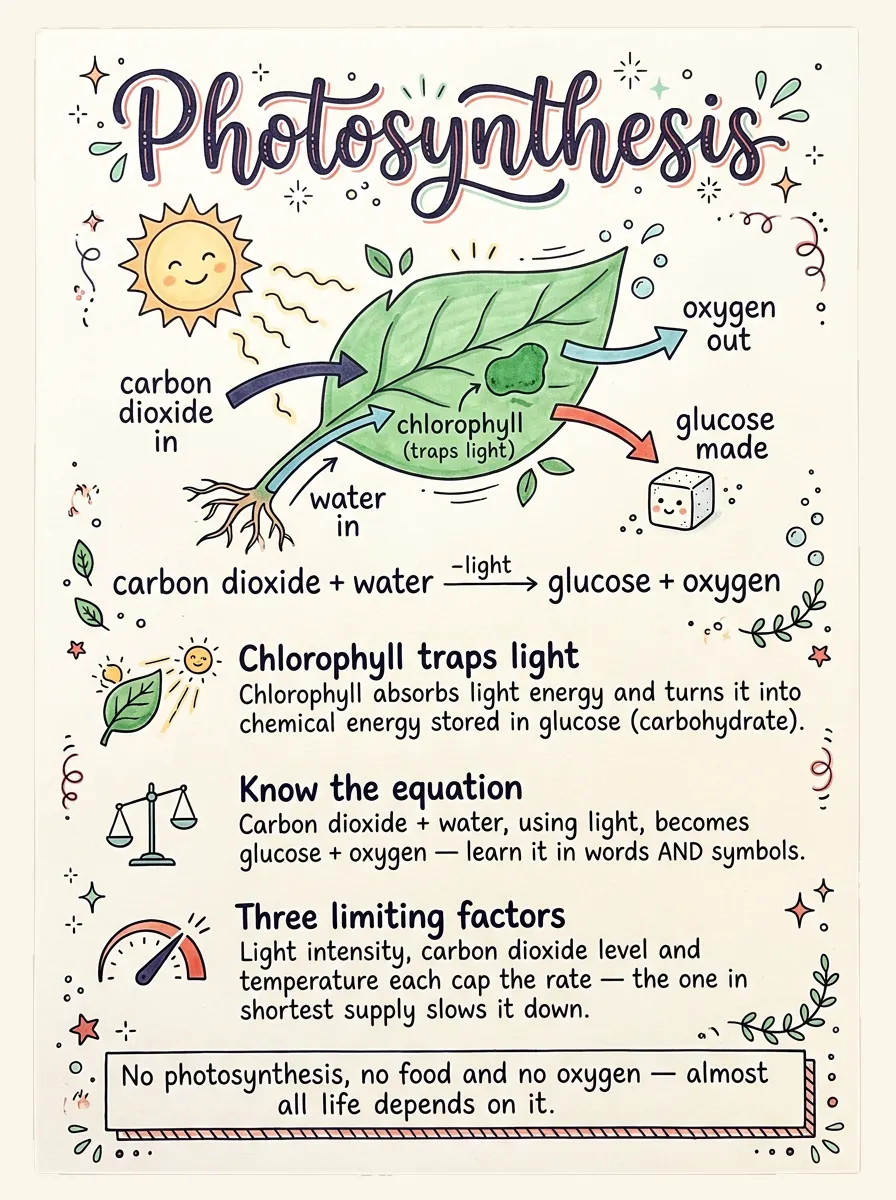
Plant a seedling, come back in ten years, and you'll find a tree whose trunk might weigh a tonne. Most of that extra mass didn't come from the soil — it came from thin air and water, stuck together using sunlight. That's photosynthesis, and this is exactly how it works.
What Photosynthesis Actually Does
Animals get energy the easy way — they eat something that already contains it. Plants can't eat, so they build their own energy-containing food from scratch, using light as the power source. The green pigment chlorophyll soaks up that light and turns it into chemical energy, locked inside the bonds of carbohydrates the plant builds. Think of chlorophyll as a solar panel: it doesn't use sunlight directly for anything — it converts sunlight into a storable form of energy the plant can draw on any time, day or night, by breaking those bonds back down. That stored energy powers respiration, growth and repair, and can also be kept in reserve as starch.
Worked Example — Reading the Equation
Photosynthesis is summarised in one equation you must know both ways, in words and in symbols:
6CO₂ + 6H₂O → (light energy, chlorophyll) → C₆H₁₂O₆ + 6O₂
- Check the atom count balances: 6 molecules of CO₂ supply 6 carbon atoms — exactly how many carbon atoms glucose (C₆H₁₂O₆) contains.
- Notice where "light energy" and "chlorophyll" sit: above the arrow, not on the left with the reactants.
- That placement means they're conditions the reaction needs, not substances used up — chlorophyll comes out the other side chemically unchanged, ready to absorb more light.
The rest of the method — every worked example, a listen-along audio walkthrough and a practice worksheet — is in the full lesson below.
Keep going — unlock the whole topic
Notes, audio and the worksheet for this topic, plus every other topic in the subject.
Claim a free seat →