Planned Response — Study Notes
You're handed a video, a question on the screen, and a few minutes to think — then you have to speak, alone, for up to two minutes, with nothing written down to fall back on. Most students freeze not because they lack an opinion, but because they've never practised turning one into a spoken answer with a shape.
Why a Loose Opinion Isn't Enough
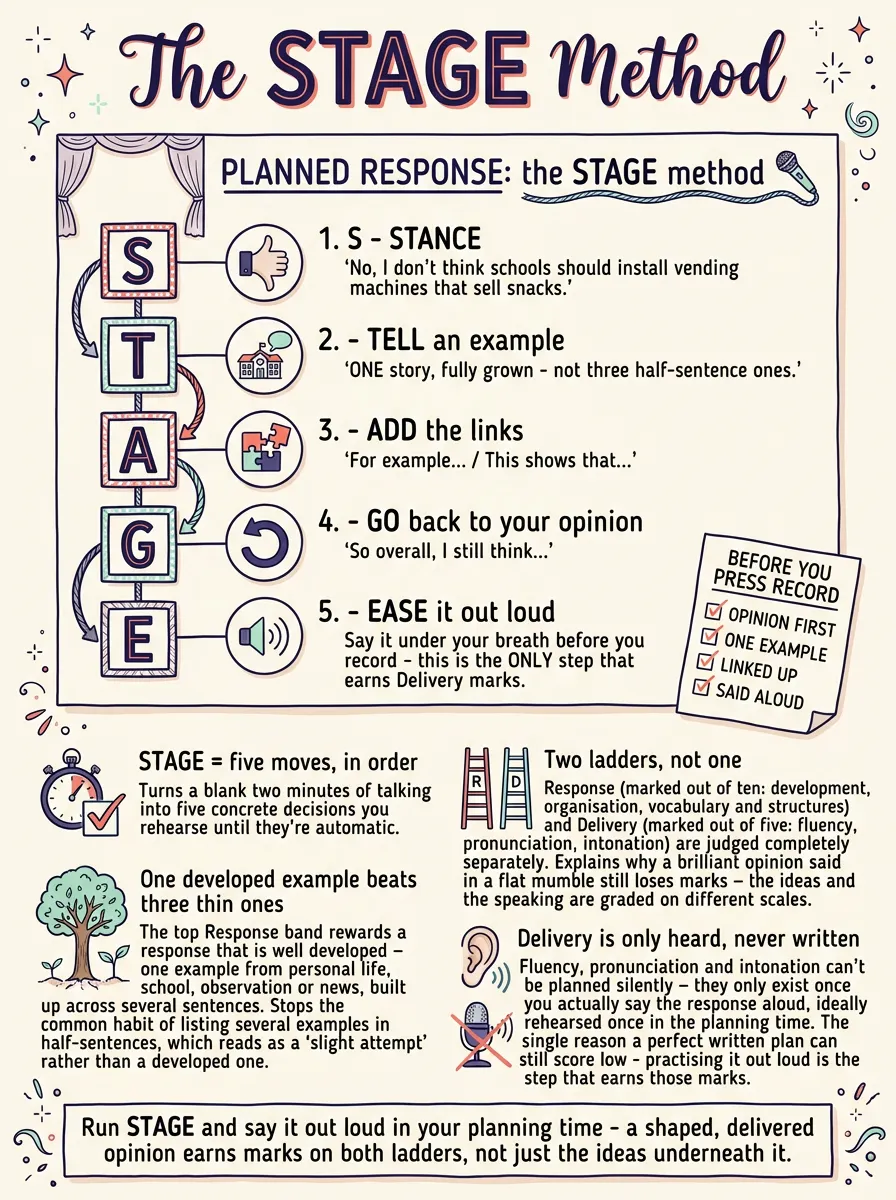
This task marks two things separately: what you built (your ideas, how fully you develop them, and how they're organised) and how you deliver it (fluency, clarity, and whether your voice actually varies). A strong opinion said in a monotone still loses marks, and a flat idea said confidently still loses marks — you need a system that handles both halves at once.
That's what a five-move planning routine gives you: open by naming your opinion outright, pick a single real memory and build it up rather than skimming three, join the pieces with connecting phrases so they read as one argument, circle back to restate your opinion at the close, and — crucially — whisper the whole thing to yourself before you record, because how you actually sound only shows up once you speak, not while it's still sitting silently in your head.
Worked Example — "Should students be allowed to listen to music while studying at home?"
- Name your opinion immediately, with the topic in the same breath: "Yes, I believe music can genuinely help students focus while studying at home."
- Build one concrete memory across several sentences rather than three vague ones: "Last term I put on instrumental tracks during a long revision night before my science test, and it drowned out my younger sibling's video games so I could actually concentrate."
- Join the story to your opinion with a connecting phrase: "Because of that, I finished twice as many practice questions as I normally manage in an evening."
- Restate your opinion in fresh wording to close, rather than trailing off: "So overall, I still think music helps, as long as it's the calm, wordless kind."
- Whisper the full answer to yourself once before recording, letting your pitch rise and fall naturally on "twice" and "concentrate" — the words carrying the actual meaning.
Notice the shape: one opinion, one deep example, two joins, and a return — not four separate thoughts loosely bundled together.
The full lesson below walks through the complete five-move method with an audio model response you can listen to line by line, a weak-to-strong rewrite, a printable worksheet, and several more worked prompts so you can drill the routine until it's automatic.
Keep going — unlock the whole topic
Notes, audio and the worksheet for this topic, plus every other topic in the subject.
Claim a free seat →