Planning a Fair Test — study notes
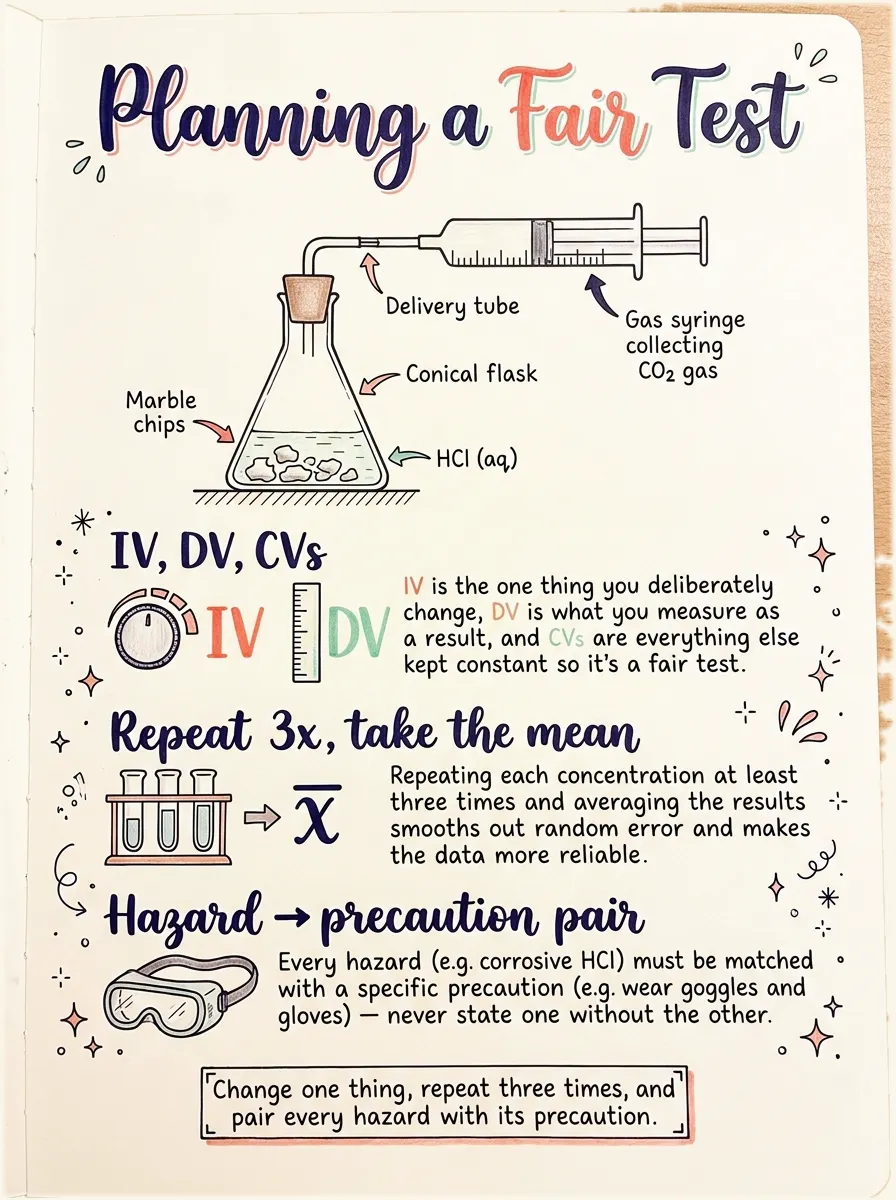
Picture two students testing the same idea but each one changes a different thing halfway through — one swaps the acid strength, the other quietly swaps the flask size too. Neither of them can now say what actually caused their result. Planning questions exist to stop that mess before it happens, and the whole skill rests on one habit: naming exactly what you're changing, measuring, and locking still.
Sorting Your Three Variables
Every fair-test question hides three roles. The independent variable is the single quantity you choose to alter on purpose across your trials. The dependent variable is whatever you read off an instrument afterwards — it reacts to your choice rather than being set by you. Everything else that could quietly nudge the outcome gets fixed as a control variable, because letting even one of those drift means you can no longer pin the result on your intended cause. Students usually lose marks not from misunderstanding chemistry, but from swapping these three labels around under exam pressure.
Worked Example — Sodium Thiosulfate and Dilute Acid
- Question: does the concentration of dilute hydrochloric acid change how quickly a cloudy precipitate forms when mixed with sodium thiosulfate solution?
- Spot the independent variable first: it's the one term the question says is being altered — here, concentration of the acid, e.g. tested at 10, 20, 30, 40 and 50 g/dm³.
- Find the dependent variable by asking what you'd actually time or read off a scale: the time taken for a printed mark under the flask to become invisible through the cloudy mixture.
- List at least two control variables by asking what else, besides concentration, could speed up or slow down the cloudiness: volume of thiosulfate solution used, and room temperature.
- State the conclusion pattern in advance: a shorter disappearing time at higher concentrations would show that raising acid concentration speeds up the reaction, because more particles packed into the same space collide with each other more often.
That's the pattern examiners are really testing — sort the roles, then build a repeatable method around them. The remaining worked examples, a full audio walkthrough, and a printable worksheet are all waiting in the full lesson below.
Keep going — unlock the whole topic
Notes, audio and the worksheet for this topic, plus every other topic in the subject.
Claim a free seat →