Plant Structure — Study Notes
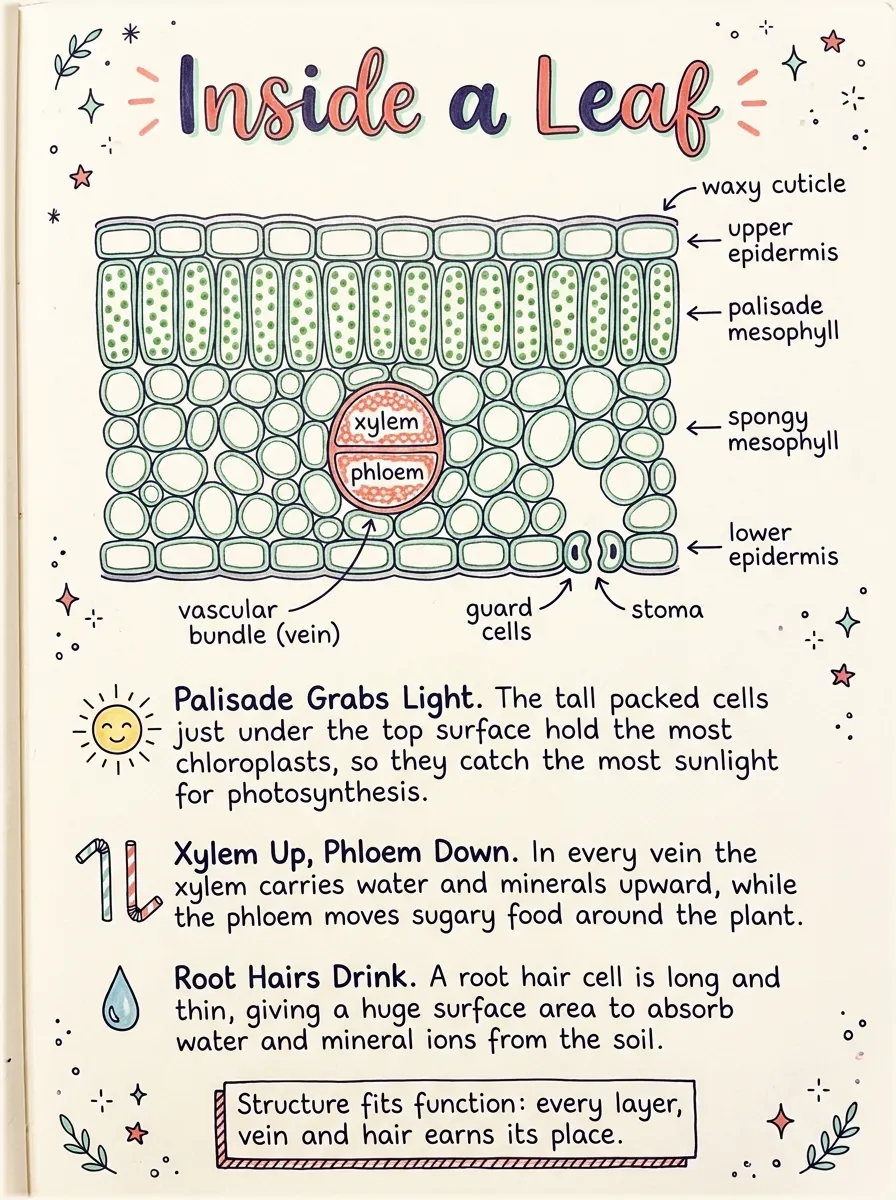
Cut a leaf in half and you're not looking at random green fluff — you're looking at an arrangement where every layer earns its place. O-Level examiners love asking "why is this bit built this way," and there's one reasoning move that answers almost all of them: name the job a part does, then explain how its shape or position makes that job easier.
Reading Structure As A Clue To Function
Biology structure questions aren't really testing memory of labels — they're testing whether you can connect a visible feature to the task it performs. Take the palisade mesophyll, the layer of narrow, upright cells sitting just beneath the leaf's clear outer skin. Nothing about "tall and column-shaped" is decorative: that arrangement squeezes far more chlorophyll-bearing cells into the region where light lands first, and it means incoming light only has to pass through one or two thin cell walls before reaching a chloroplast. Once you can spot that pattern — feature → mechanical or physical consequence → job done better — you can apply it to almost any structure this syllabus throws at you: guard cells, xylem, root hairs, all of it.
Worked Example — Explaining Why Palisade Cells Are Packed Just Below The Leaf Surface
- Identify the job this tissue is responsible for: trapping light energy for photosynthesis.
- State the observable feature: the cells are long and upright, tightly packed side by side, directly under the transparent surface layers rather than deeper in the leaf.
- Link the feature to a mechanism: standing on end lets many chloroplast-filled cells occupy the same shallow strip near the surface, so light barely travels before meeting a chloroplast — and being positioned first, right after the clear layers that let light through unblocked, means none of that light is absorbed or scattered before arriving.
- State the resulting advantage clearly: this positioning and shape are why the palisade layer does more photosynthesis than any other layer in the leaf, which is the actual mark-scoring answer rather than just naming the tissue.
That same four-step move — job, feature, mechanism, advantage — is exactly how you'll tackle the remaining structures in this topic: the guard cells that open and close stomata, the xylem and phloem running through leaf, stem and root, and the root hair cells built for absorption. Hear it worked through in full, with the practice worksheet, in the complete lesson below.
Keep going — unlock the whole topic
Notes, audio and the worksheet for this topic, plus every other topic in the subject.
Claim a free seat →