Recycling Plastics: Two Routes — study notes
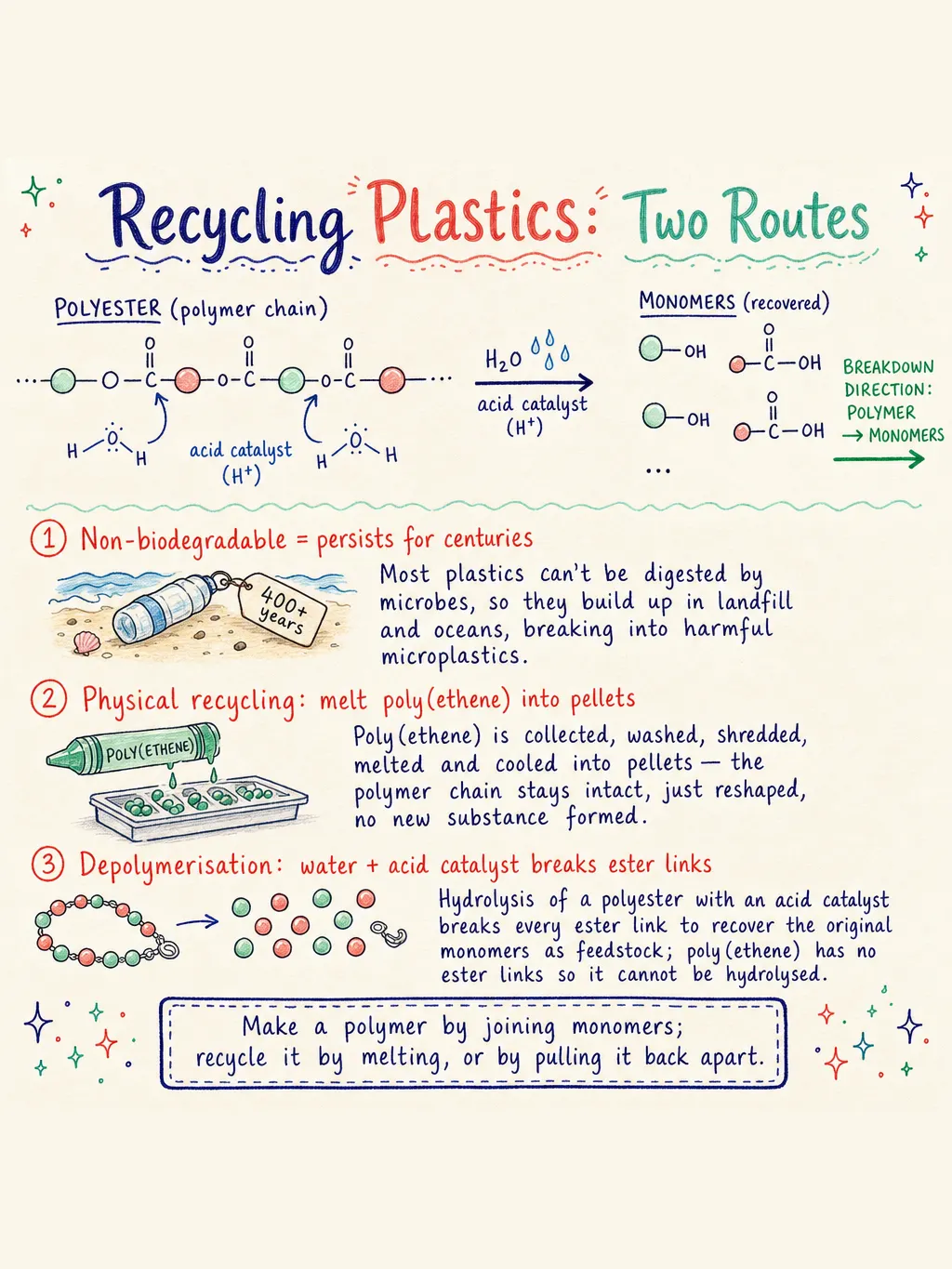
A single-use fork tossed in a bin today could still be sitting in a landfill when your own grandchildren are pensioners — plastic simply refuses to rot the way food scraps do. Understanding why unlocks the whole recycling story, because the reason plastic won't decay is also the reason there are two totally different fixes for it.
Two Genuinely Different Recycling Strategies
Ordinary microbes can digest natural molecules like starch or protein, but a plastic's long carbon backbone doesn't match anything their enzymes evolved to grip, so it simply sits there rather than rotting away. Because nothing breaks that chain down on its own, chemists reach for one of two very different fixes.
Physical recycling never touches the chemistry at all: a thermoplastic such as poly(ethene) gets collected, sorted, shredded, melted and remoulded, since its tangled chains aren't chemically joined to each other and simply slide apart once warmed. The catch is that every remelt snaps a few chains shorter, so quality slips a little each cycle.
Chemical recycling goes further and actually severs bonds inside the chain itself. There isn't just one such method — a polyester's ester links can be attacked by water with an acid catalyst present (this is called hydrolysis) to recover pure monomers, while a plain hydrocarbon backbone with no such link, like poly(ethene), instead needs intense heat to split it into shorter hydrocarbon fragments useful as fuel or feedstock.
Worked Example — Picking the Right Route for a Fizzy-Drink Bottle
- Identify what the bottle is made from: most fizzy-drink bottles are a polyester, held together along its chain by repeating ester links.
- Ask whether water can attack those links: yes — ester links are exactly what hydrolysis targets, so this polymer qualifies for the water-based route rather than heat-based splitting.
- Add water plus a dilute acid catalyst; the acid speeds things up without itself being used up, and given enough time, every ester link along the chain eventually gives way.
- Once every link has broken, what remains are the original small monomers — pure enough to sell on as raw material for making fresh, high-quality polyester.
That's the reasoning behind choosing water-based splitting over heat-based splitting for one particular polymer — the full lesson below covers the heat route for poly(ethene) in the same depth, plus an audio walkthrough, a printable worksheet, and the environmental, economic and social discussion points examiners love to ask about.
Keep going — unlock the whole topic
Notes, audio and the worksheet for this topic, plus every other topic in the subject.
Claim a free seat →