Practical Electricity — study notes
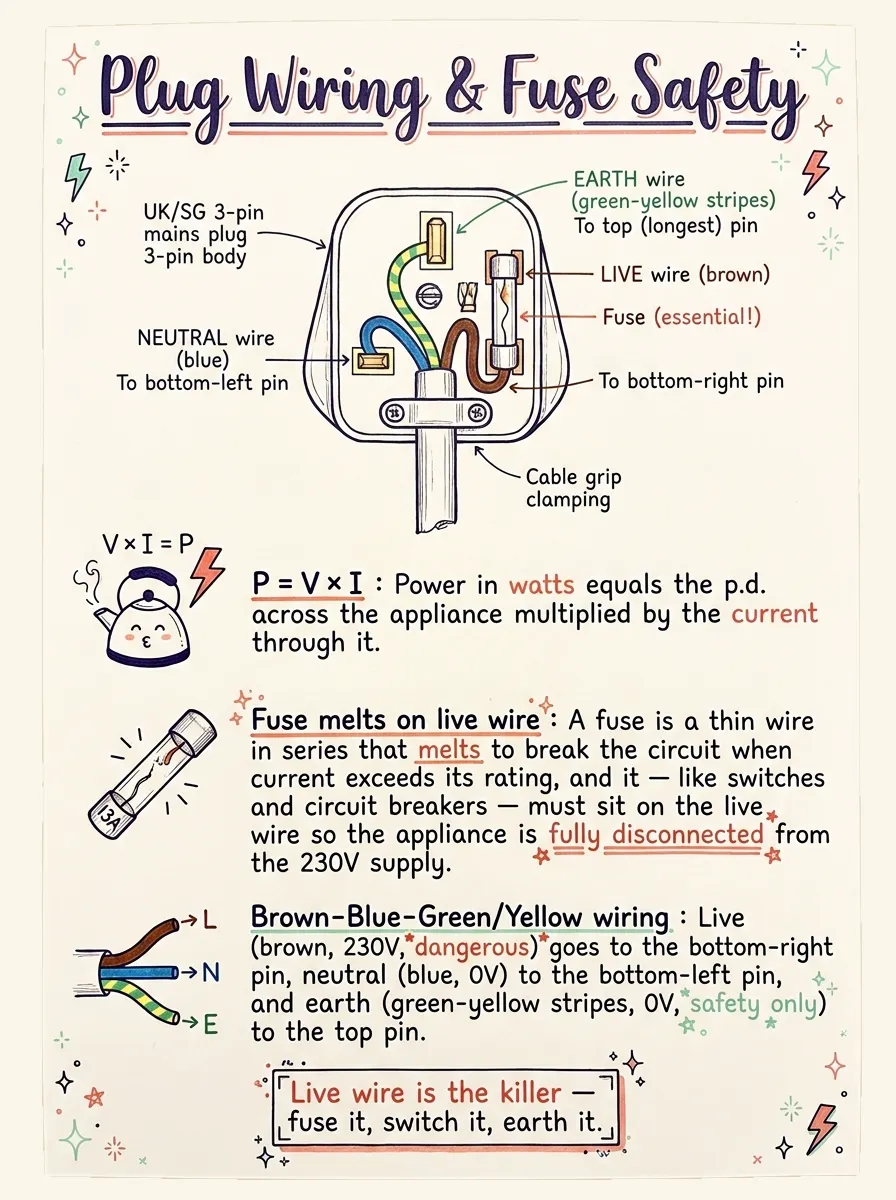
Flick on a hairdryer and something invisible starts happening straight away: charge gets pushed through a heating coil, and energy starts draining out of the wall socket at a steady rate. That rate has a name, a formula, and it happens to be one of the most exam-tested ideas in this whole topic.
Electrical Power: The Rate Energy Gets Used
Two appliances can consume the exact same total energy overall, yet one finishes in seconds while the other drags on for ages — the difference is simply how quickly each one transfers that energy. Physicists have a word for "how quickly": power, measured in watts, where one watt means one joule handed over every single second.
For any appliance, power depends on only two numbers you can read straight off a circuit: the push driving charge through it, and how much of that charge actually moves as a result. Multiply those two together and you get the power:
Power = potential difference × current, written P = V × I, where P is in watts, V is in volts and I is in amps.
Picture voltage as how hard charge is being shoved along, and current as how much of it streams past a given point each second — multiply "shove" by "flow" and the result is exactly how fast work is being done inside that appliance.
Worked Example — Power of an Induction Cooker
- An induction cooker is plugged into a 230 V supply and, once switched on, an ammeter clipped onto the cable shows it draws 6.5 A.
- Write down the relationship linking these two quantities: P = V × I.
- Substitute the known numbers straight in: P = 230 × 6.5.
- Evaluate the product: P ≈ 1 495 W, which rounds sensibly to roughly 1.5 kW — right in the range printed on a real induction hob, a handy check that nothing was multiplied wrong.
Once finding power feels automatic, the next natural question is how much total energy an appliance racks up across an entire session, and how that total turns into an actual dollar figure on a bill — plus the wiring-safety half of this topic, worked entirely with fresh numbers, an audio walkthrough and a printable worksheet, all waiting for you in the full lesson below.
Keep going — unlock the whole topic
Notes, audio and the worksheet for this topic, plus every other topic in the subject.
Claim a free seat →