Pressure — study notes
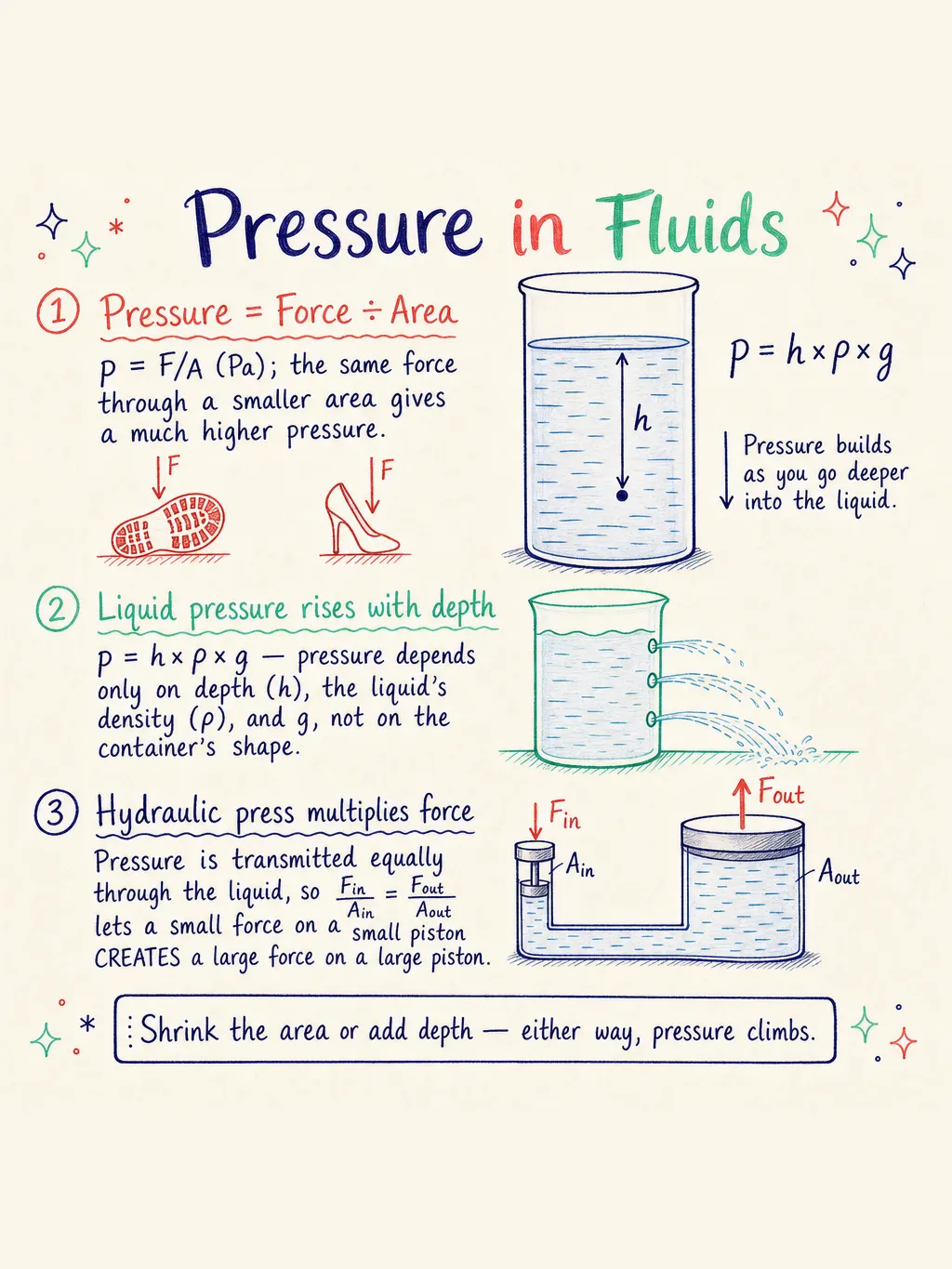
Press your thumb on a table — nothing happens. Press a drawing pin with the same force and it sinks straight in. Same force, totally different result — because pressure isn't about how hard you push, it's about how that push is spread over an area.
What Pressure Actually Measures
Strap snowshoes onto boots on soft snow and you glide instead of sinking. Your weight (the force) hasn't changed at all — the snowshoes just spread that same force over a bigger footprint, so every patch of snow underneath only has to carry a small share of it. That's the whole idea: pressure is how much force is squeezed into each unit of area. Spread a force over a big area and each bit of surface feels only a little of it — low pressure. Squeeze the same force into a tiny area and each bit feels a lot — high pressure. That's exactly why the pin sinks in and your thumb doesn't.
The formula: p = F ÷ A, where p = pressure (pascals, Pa), F = force (newtons, N), and A = area (square metres, m²).
Worked Example
A box weighs 600 N and sits on a floor. Its base measures 2 m². What pressure does it put on the floor?
- Read off what's given: F = 600 N (the weight pressing down), A = 2 m² (the contact area).
- Apply the formula: p = F ÷ A = 600 ÷ 2 = 300 Pa.
Every square metre of floor under the box feels 300 N of push — notice the box's shape or material never entered the calculation, only the force and the area it's spread over.
The rest of the method — every worked example, a listen-along audio walkthrough and a practice worksheet — is in the full lesson below.
Keep going — unlock the whole topic
Notes, audio and the worksheet for this topic, plus every other topic in the subject.
Claim a free seat →