Punctuation that Changes Meaning — Study Notes
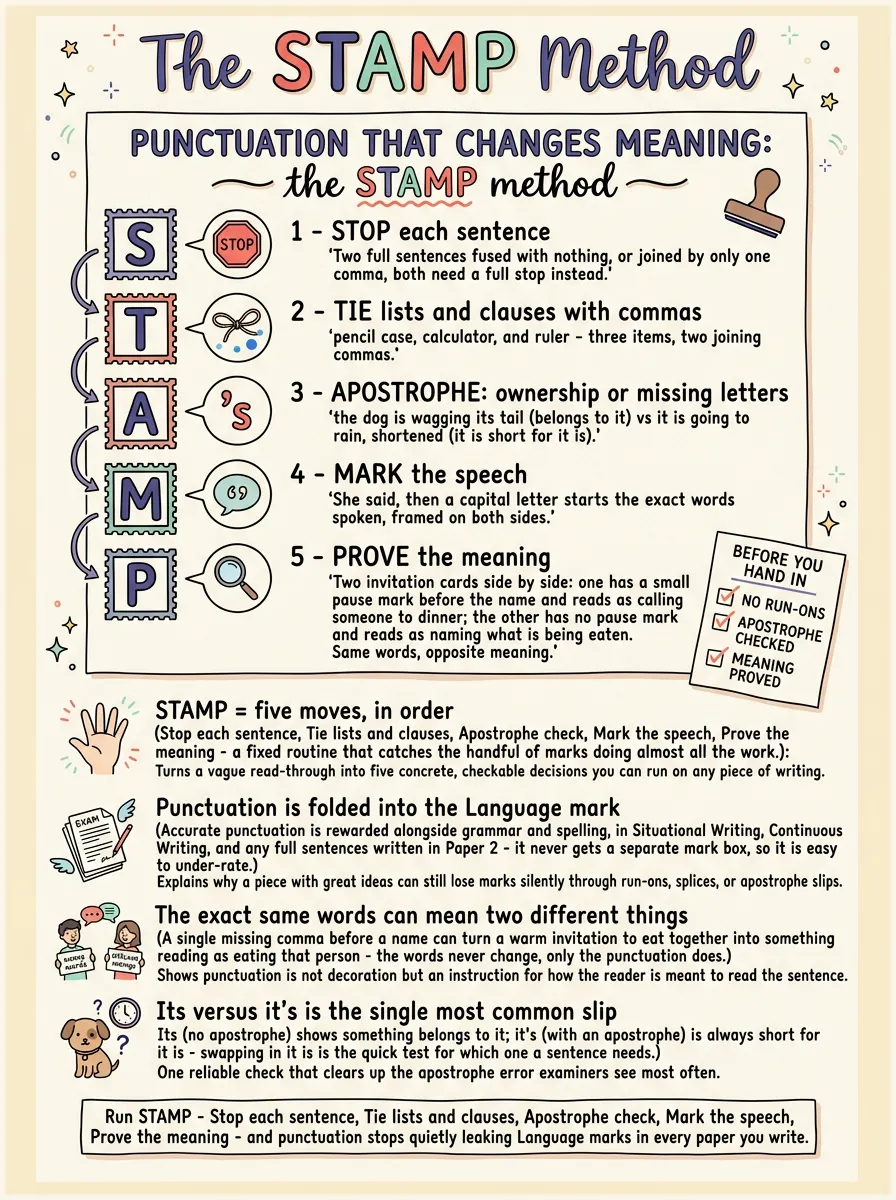
No examiner stops halfway through your script wondering what you were trying to say. If a mark is missing or lands in the wrong spot, they simply grade the words as printed, however you meant them — and because that slip repeats quietly, sentence after sentence, it can chip away at far more of your Language score than most students realise.
Why a Few Marks Carry So Much Weight
Punctuation isn't scored on its own line — it's folded into the Language component, alongside grammar and spelling, for both pieces of Paper 1 writing, and again wherever Paper 2 asks for full sentences. Only a handful of marks do almost all of this work: the full stop, the comma, the apostrophe and the speech mark. Get one wrong and it isn't just untidy — the sentence can end up telling the reader something different from what you intended. Take "I love cooking, my family and my pets" against "I love cooking my family and my pets": drop one comma and a fond list turns into something alarming. That's the whole point — these marks aren't decoration, they're instructions for how a sentence should be read, and examiners grade what's actually written, not what you had in your head.
Worked Example — Fixing a Fused Sentence
- Start with the problem sentence: "The bus was late I decided to walk instead." Two separate thoughts sit next to each other with nothing at all joining them.
- Check each half on its own: "The bus was late" and "I decided to walk instead" both work as complete sentences by themselves — which confirms the fault is a missing join, not a missing word.
- Repair it one of two ways: give each thought its own full stop, or bridge them with a comma plus a linking word such as so. Either "The bus was late. I decided to walk instead." or "The bus was late, so I decided to walk instead." is correct — what's never acceptable is leaving them touching with only a comma between them.
That single check — are two complete ideas sitting unjoined or barely joined? — catches one of the most common silent deductions on the paper. It's only one piece of a five-part routine for catching every mark that can flip a sentence's meaning; the rest of the method, an audio walkthrough you can listen to on the go, and a full practice worksheet with answers are in the full lesson below.
Keep going — unlock the whole topic
Notes, audio and the worksheet for this topic, plus every other topic in the subject.
Claim a free seat →