Identifying Ions & Gases — study notes
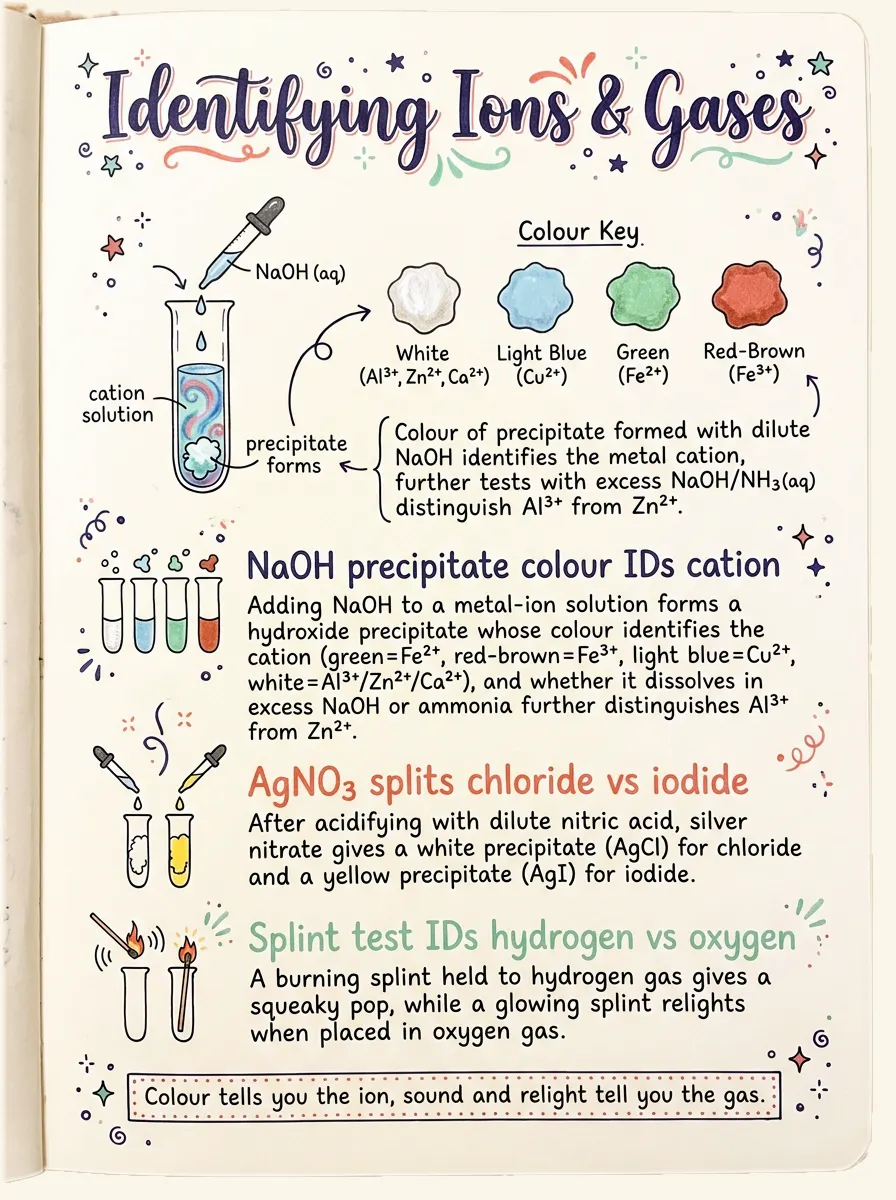
A forensic scientist doesn't need to see a culprit to identify them — a fingerprint is enough, because every person's is unique. Qualitative analysis works the same way in chemistry: you don't need to *see* an ion to know it's there, you just need a test whose result is unique to that one ion. Learn the pattern behind these tests and a topic that looks like a long list of facts becomes one simple idea, repeated.
Reading a Precipitate Like a Fingerprint
Metal ions in solution (cations) are positively charged — think Al³⁺ or Cu²⁺. Add a base such as aqueous sodium hydroxide (NaOH), and its negative hydroxide ions (OH⁻) are pulled toward the positive metal ion, locking together to form a metal hydroxide. Almost every metal hydroxide is insoluble in water, so instead of dissolving it appears as a precipitate — a cloudy solid suddenly appearing in the liquid.
Here's the useful part: the colour of that precipitate is different for each metal, so it identifies the ion on sight. Two reagents do the identifying — aqueous sodium hydroxide and aqueous ammonia — and between them they distinguish every cation on the syllabus. The twist examiners love: some ions give the same colour with sodium hydroxide alone, so you also have to check what happens when you keep adding the reagent well past the point a precipitate first forms — some precipitates dissolve back into solution in excess, others just sit there unchanged.
Worked Example — Telling Zinc and Aluminium Apart
A colourless solution gives a white precipitate with NaOH, and the precipitate dissolves back to a colourless solution when NaOH is added in excess. Identify the ion.
- A white precipitate that dissolves in excess NaOH narrows it down — but only to two possible ions, Al³⁺ or Zn²⁺, since both behave identically with this one reagent.
- To split them, switch reagents and repeat the test with excess aqueous ammonia instead. Zinc's white precipitate dissolves in excess ammonia too, going colourless; aluminium's precipitate stays solid no matter how much ammonia is added.
- Running the ammonia test on this sample: the precipitate dissolves, and the solution goes colourless.
- Since it dissolved in excess of both reagents, the ion must be Zn²⁺.
The rest of the method — every worked example, a listen-along audio walkthrough and a practice worksheet — is in the full lesson below.
Keep going — unlock the whole topic
Notes, audio and the worksheet for this topic, plus every other topic in the subject.
Claim a free seat →