Radioactivity — study notes
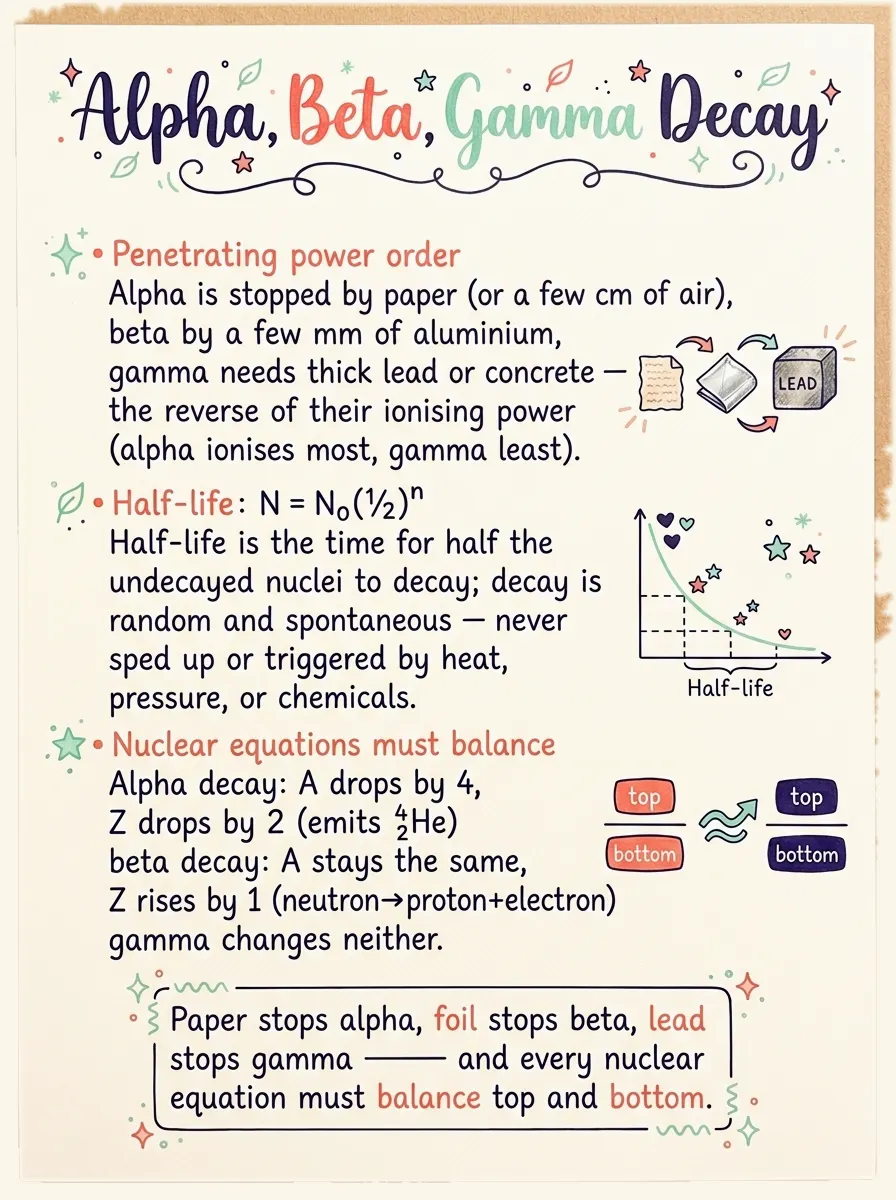
Leave a lump of radioactive rock on a shelf for a year, come back, and less of it will still be "live." Yet ask a physicist which single atom inside that rock decayed first, and nobody on Earth can answer — not because our instruments are too weak, but because nature genuinely doesn't decide in advance. So how does something so unpredictable produce numbers exam boards can ask you to calculate to the nearest gram?
Turning Randomness Into a Reliable Countdown
Each individual nucleus decays at a completely unpredictable moment — no clock, no trigger, no warning. But gather trillions of identical nuclei together and a pattern snaps into focus: over a fixed stretch of time, roughly one in two of them will have gone. Wait that same stretch again, and again about one in two of whatever survived will go too. That fixed stretch — the time for a sample's undecayed nuclei to fall to one-half of whatever amount you started counting from — is what we call half-life. It's a property of chance acting on huge numbers, not a promise about any one particle.
Because each round always halves rather than removing a flat amount, the maths compounds: after n half-lives have passed, the surviving quantity is N = N₀ × (½)ⁿ, where N₀ is what you began with and n is found by dividing the elapsed time by the half-life itself. Skip that division step and plug raw minutes or years straight into the exponent, and you'll halve far too many times and get an answer that's absurdly small — always work out n first, as its own step.
Worked Example — Iodine-131 Over 32 Days
- Iodine-131 has a half-life of 8 days, and a hospital starts with 960 mg of it.
- Find n: n = 32 ÷ 8 = 4 half-lives have elapsed.
- Apply the formula: N = 960 × (½)⁴ = 960 ÷ 16 = 60 mg remains after 32 days.
Notice the sample never truly hits zero — it keeps halving forever, just by ever-smaller amounts each round.
The full lesson below walks through the rest of this topic with a listen-along audio explanation, a printable worksheet, and further worked examples — including how to read n straight off a decay-curve graph instead of a stopwatch.
Keep going — unlock the whole topic
Notes, audio and the worksheet for this topic, plus every other topic in the subject.
Claim a free seat →