Reactivity Series Decides All — study notes
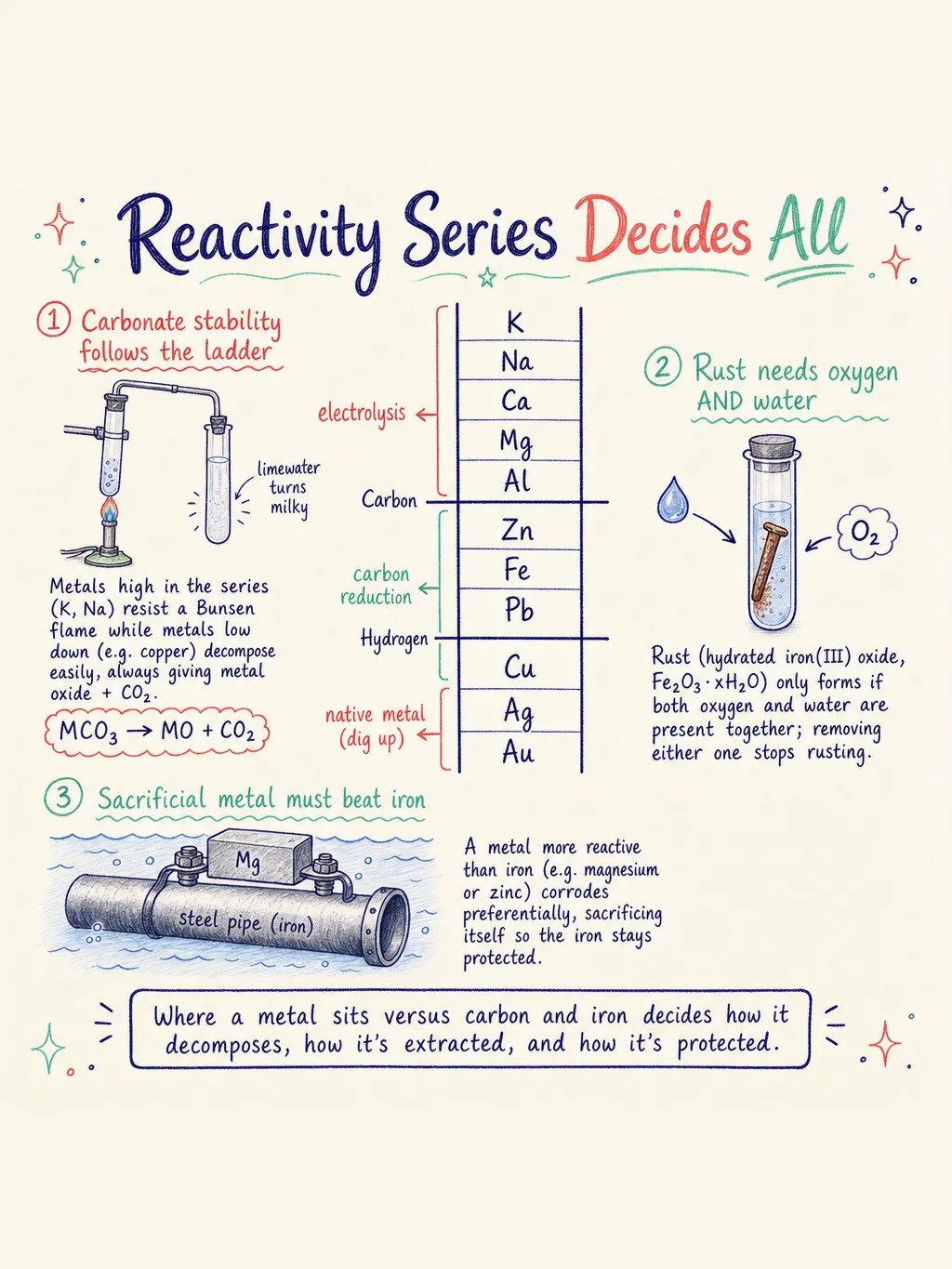
Why can you dig up a lump of gold that already looks like the metal in a ring, while a chunk of aluminium ore looks like ordinary rock? The reactivity series answers that for every metal, and once you know where carbon sits inside it, extraction methods stop feeling random and start feeling like a single rule applied over and over.
One Comparison Decides How a Metal Is Extracted
Metals near the very bottom of the reactivity series — silver and gold, for example — barely react with anything around them, so they can turn up as pure lumps straight from the ground. Every other metal is locked inside a compound called an ore, and getting the pure metal out means breaking that bond apart.
Carbon sits partway down the reactivity series, and that one position is the deciding factor for almost the whole topic. A metal below carbon loses its oxygen more easily than carbon does, so heating the ore together with carbon lets carbon grab that oxygen instead, leaving the pure metal behind — this is called reduction. A metal above carbon clings to its oxygen far too tightly for carbon to ever win that contest; those metals need electrolysis instead, forcing the compound apart with electricity. Before writing any equation, ask one question: is this metal above carbon, or below it?
Worked Example — Extracting Lead from Lead(II) Oxide
- Find lead's position in the reactivity series: it sits well below carbon, down near zinc and copper.
- Since lead is below carbon, carbon is reactive enough to strip the oxygen away from lead(II) oxide, so reduction with carbon is the right method here.
- Write the equation: lead(II) oxide + carbon → lead + carbon dioxide, or in symbols, 2PbO + C → 2Pb + CO₂.
- Check it balances: two lead atoms and two oxygens' worth of PbO on the left match the two Pb atoms on the right, and the leftover oxygen combines with carbon to form CO₂.
Swap lead for zinc or copper and nothing about the reasoning changes — only the metal and the oxide's formula do.
That locate-compare-write routine is exactly what the full lesson builds on next, working through carbonate stability, rusting and sacrificial protection, with an audio walkthrough, a printable worksheet and the rest of the worked examples waiting below.
Keep going — unlock the whole topic
Notes, audio and the worksheet for this topic, plus every other topic in the subject.
Claim a free seat →