Metal Reactivity League Table — study notes
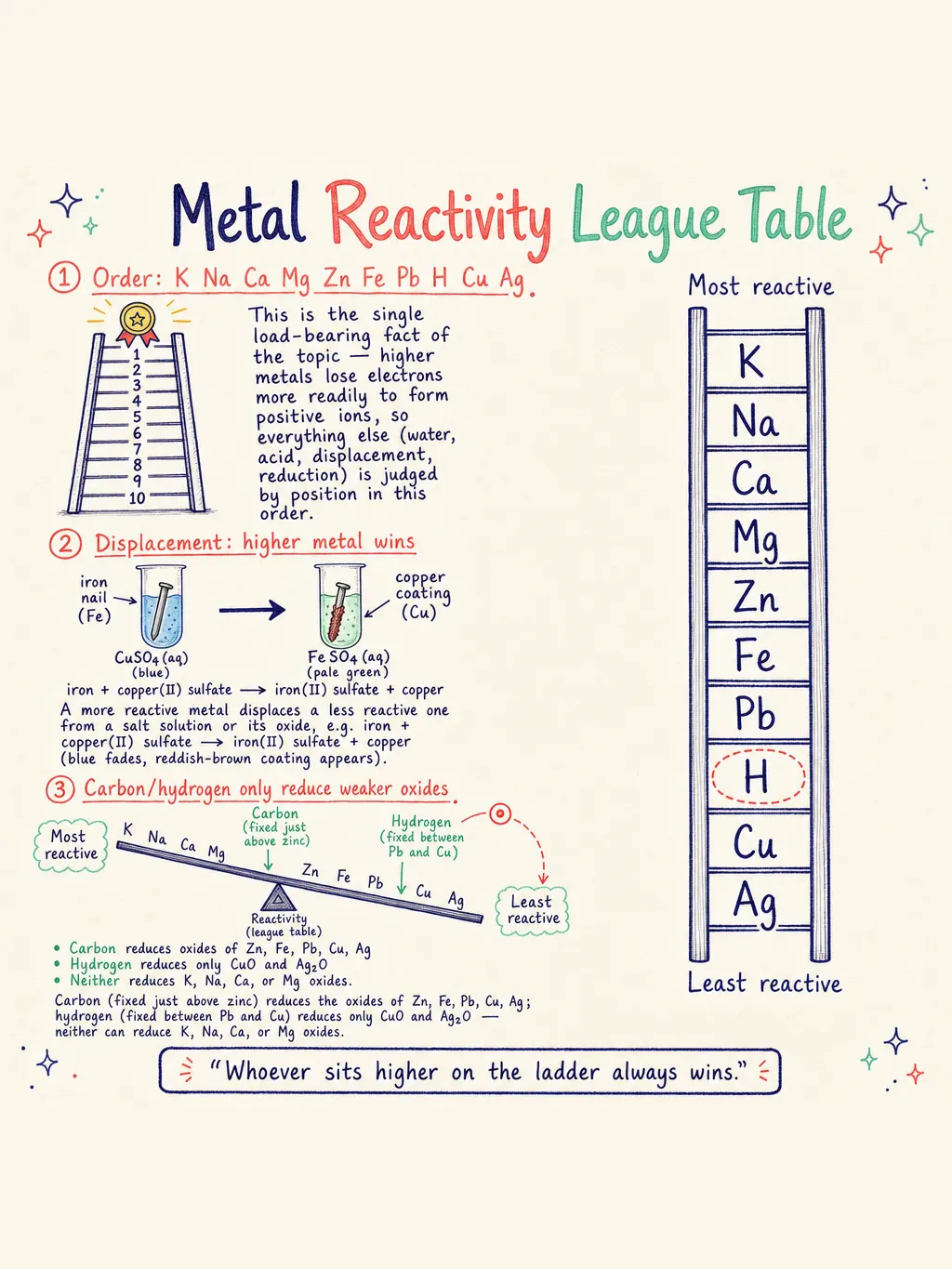
Drop a chunk of zinc into a beaker of blue copper sulfate and watch the colour slowly fade while a pinkish crust builds up on the metal. Nothing was added except the zinc itself — so what decided that zinc comes out on top and copper doesn't?
The Idea Behind the Ranking
Chemists arrange metals into an ordered list called the reactivity series, running from the metal that lets go of its electrons fastest down to the one that clings onto them hardest. A metal turns into a positive ion by losing electrons, so the more willingly it does that, the higher its spot on the list. That single habit — how readily a metal gives up electrons to become an ion — is the hidden driver behind every pattern in this topic, whether the metal is meeting water, an acid, or another metal's compound.
Because the list is fixed, two metals never need to be tested against each other directly — their ranking already tells you the outcome. Whichever one sits higher will always win when they're competing for the same role, be that shedding electrons, becoming an ion, or pulling an oxygen atom free. That one comparison is the engine behind every displacement you'll meet, which is exactly why learning the order pays off far beyond a single question.
Worked Example — Will Magnesium Push Iron Out of Solution?
- Find both metals' spots on the reactivity series: magnesium sits well above iron.
- Apply the ranking rule: whichever metal ranks higher takes the place of a lower-ranked metal dissolved as ions, forcing that metal out as a solid.
- Since magnesium outranks iron, lowering a strip of magnesium into dissolved iron(II) sulfate lets magnesium take over as the ion in solution, and iron is forced out as solid metal: magnesium + iron(II) sulfate → magnesium sulfate + iron.
Swap in any other pairing and the same three steps still get you the answer — only the names change, never the logic.
The full lesson below covers every reaction this ranking controls — water, acid and oxide-reduction — with a listen-along audio walkthrough and worksheet to help the order itself stick.
Keep going — unlock the whole topic
Notes, audio and the worksheet for this topic, plus every other topic in the subject.
Claim a free seat →