Reading Comprehension — Study Notes
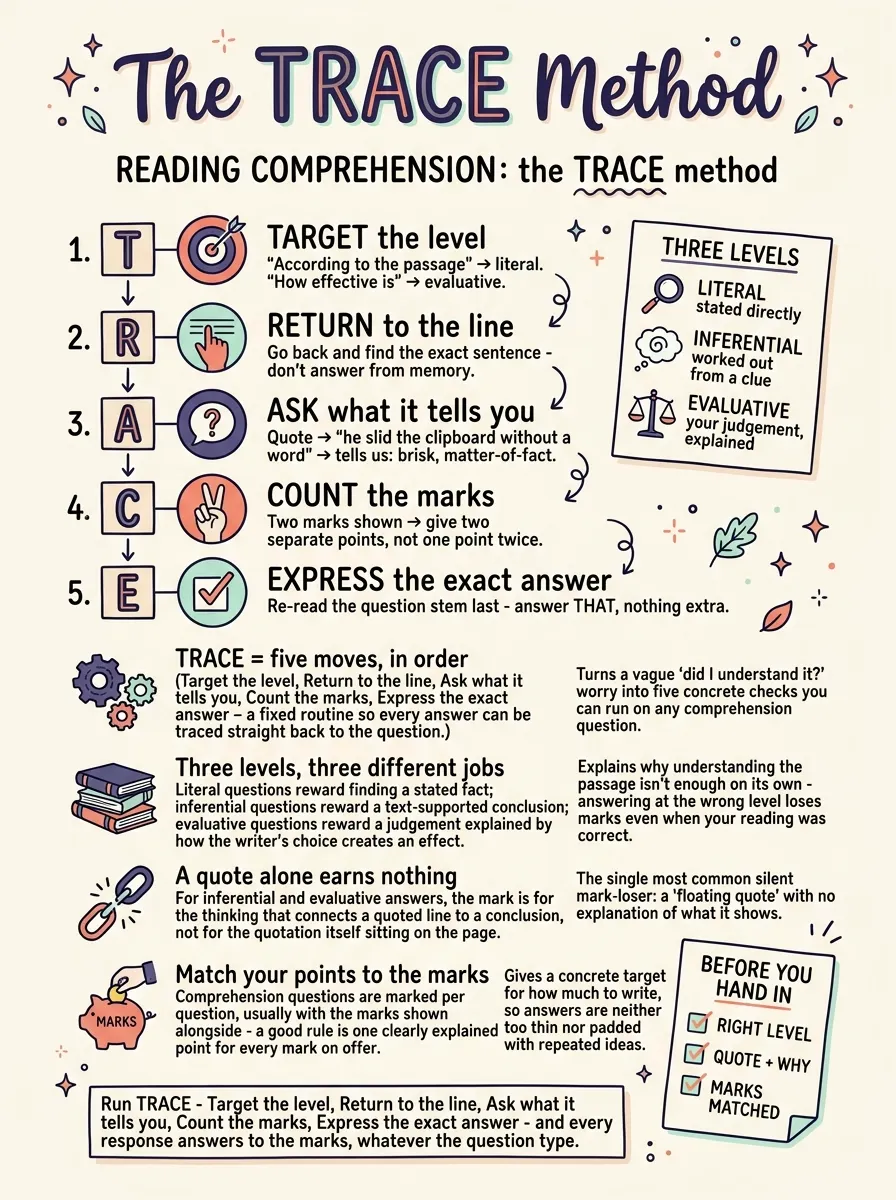
You can read a passage perfectly, follow every twist of the story, and still hand back only half the marks on offer — not because your reading was weak, but because your answer aimed at the wrong target. Every comprehension question is quietly asking for one of three different things, and giving the wrong kind of answer costs marks even when your understanding was fine.
Reading the Signal Before You Answer
O-Level comprehension questions split into three families — literal, inferential and evaluative — and each one rewards a completely different style of writing. A literal question, opening with a word like "state" or "give", is hunting for something written plainly on the page — go find it, put it down, move on. An inferential question, built around "why" or "what does this show", wants you to reason one step beyond the printed words, using a short piece of evidence to support that step. An evaluative question, phrased as "how effective" or "to what extent", wants a verdict with backbone: say what you think, then pin down exactly which wording or choice earns that opinion. Treating all three the same way — quoting when a judgement was wanted, or reasoning when the fact was sitting in plain sight — is where confident readers quietly bleed marks.
Worked Example — Reading What "Suggest" Is Asking For
Passage snippet: Grandfather set his tools down slowly and stared out at the empty field. He said nothing for a long while. Question: What does his silence suggest about his feelings towards the field?
- Check the command word first — that's the instruction word the question is built on. Here it is "suggest", which rules out a plain-fact answer: the passage never states his feelings directly, so this needs one step of reasoning, not a search.
- Pin down the exact details doing the work: the tools set down slowly, and the pause that lasts a long while — both are deliberate, unhurried actions, not rushed ones.
- Turn the details into a claim rather than repeating them: unhurried, wordless reactions like these usually mean feelings too large or too private for speech, not an absence of feeling.
- Write the full answer: his slow, silent response suggests the field carries deep personal meaning for him — likely grief or attachment — that words wouldn't easily capture.
That's the reasoning move behind one question type out of three. The full lesson below walks through the remaining two types on a passage written specifically for this topic, plus an audio walkthrough you can listen to on the move and a worksheet to drill the technique yourself.
Keep going — unlock the whole topic
Notes, audio and the worksheet for this topic, plus every other topic in the subject.
Claim a free seat →