Sentence Structure and Variety — Study Notes
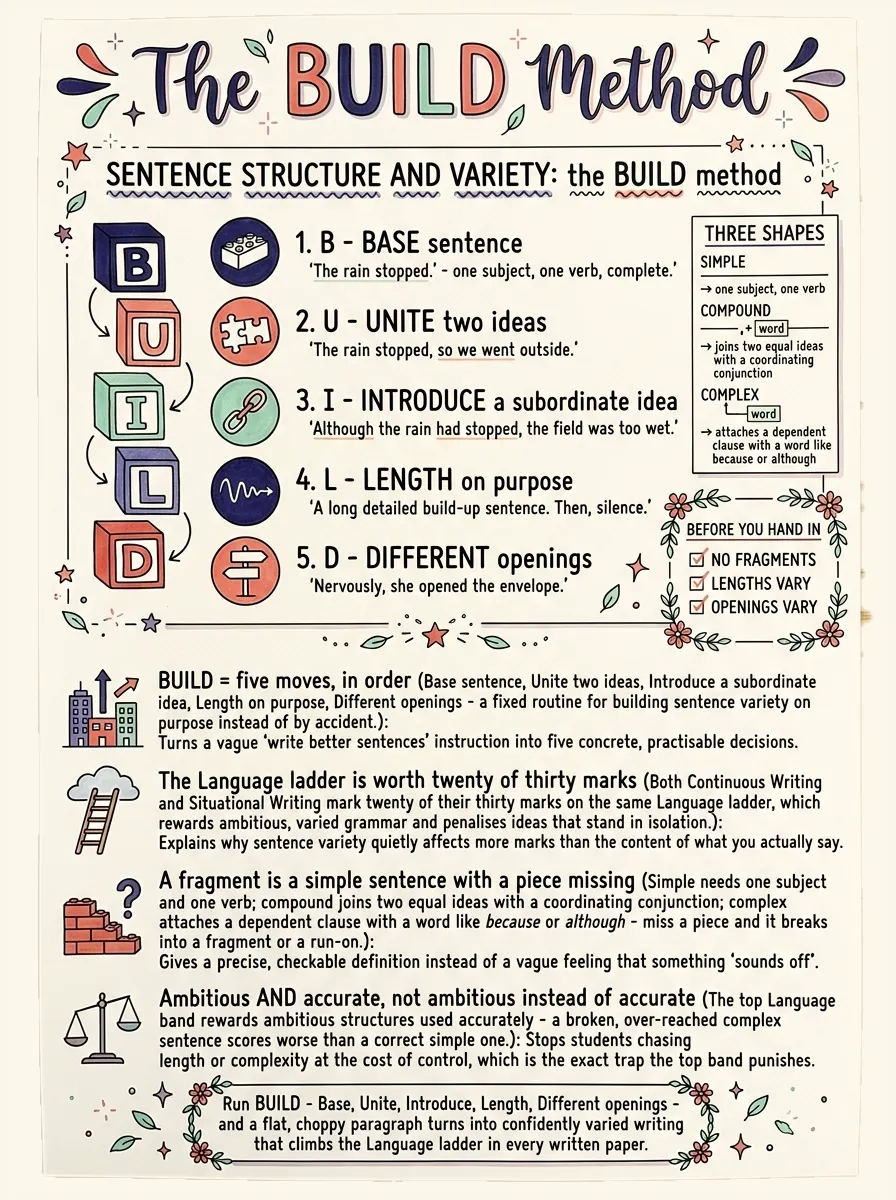
Picture two scripts with identical spelling, identical grammar, and identical facts — yet one lands two full bands above the other. The gap almost never comes down to vocabulary. It comes down to whether every sentence on the page was assembled the same plain way, or whether the writer deliberately mixed short and long, tight and loose, subject-first and something else entirely.
Why Your Sentence Shapes Decide the Band
Both Continuous Writing and Situational Writing score heavily on a language-quality scale, and range of sentence type sits right at the centre of it — not as a bonus, but as a baseline expectation once you're past the very lowest band. Three shapes do almost all the work. A simple sentence holds a full subject-and-verb idea by itself. A compound sentence links two equally weighted ideas using a connector such as and, but, or yet. A complex sentence hooks a dependent clause — signalled by a word like since, unless, or whereas — onto a main clause, letting one idea explain or qualify the other instead of the two just sitting side by side. A script that leans on only one of these shapes, page after page, reads as flat no matter how accurate the grammar is; examiners are trained to catch that sameness within a paragraph or two.
Worked Example — Reshaping One Flat Idea
- Start from a raw fact: a fire drill cut short a maths quiz. Written plainly, it's a single simple sentence: "The alarm sounded." Correct, but standing entirely alone.
- Give it a partner fact of equal weight, joined by a connector, to build a compound sentence: "The alarm sounded, and the class filed into the corridor at once." Two facts now share one sentence, tied loosely together.
- Turn one fact into the reason behind the other by swapping in a subordinating word: "Since the quiz was still unfinished, several students glanced back toward their desks on the way out." "Since" does the heavy lifting — it tells the reader this is cause, not two coincidences.
- Close by opening the next sentence somewhere other than its subject, so it doesn't echo the rhythm of the one before it: "Halfway down the stairwell, one girl remembered her calculator was still on the desk." A place phrase leads instead of a name.
That four-move reshaping routine, the full shape-by-shape reference table, a genuine flat-versus-varied paragraph comparison, and guided practice questions with worked answers are all waiting in the full lesson below, alongside an audio walkthrough and a printable worksheet.
Keep going — unlock the whole topic
Notes, audio and the worksheet for this topic, plus every other topic in the subject.
Claim a free seat →