Spelling the Words the Exam Tests — Study Notes
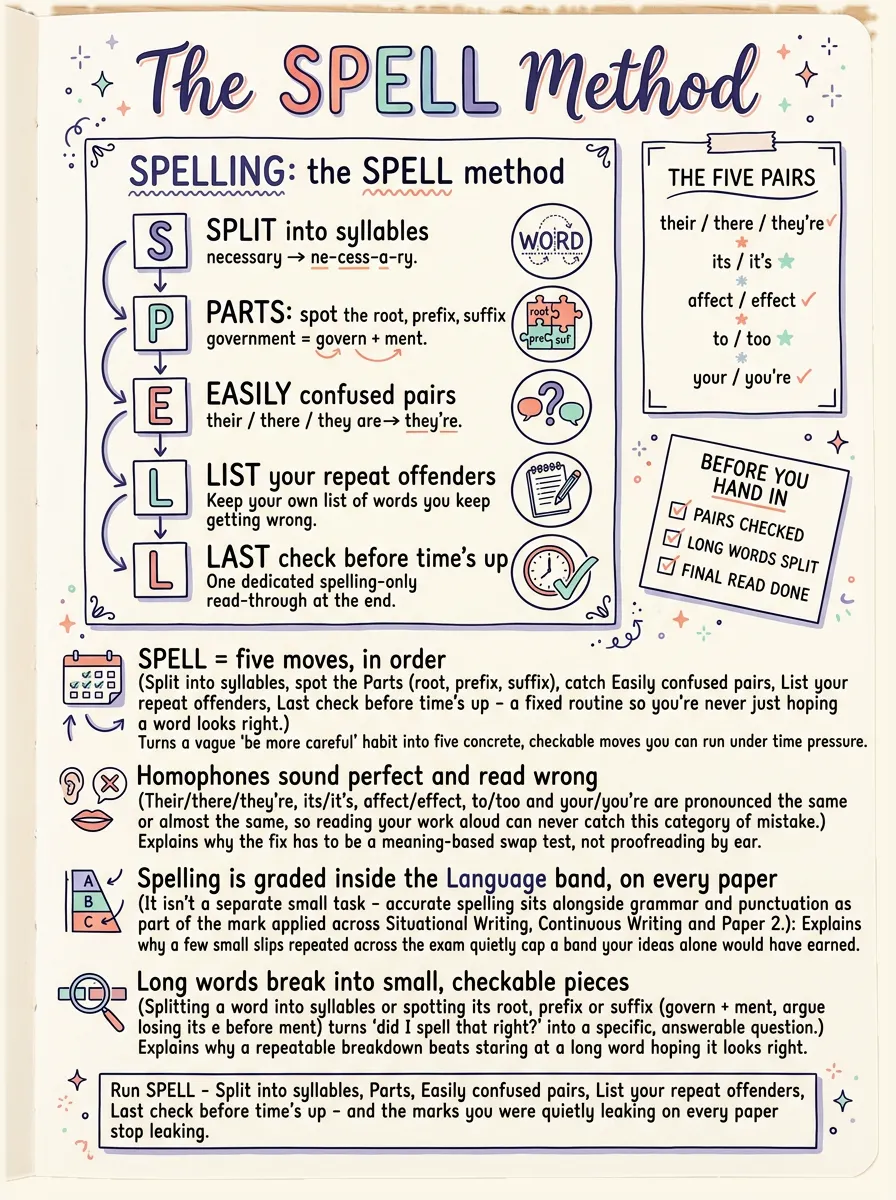
Read your own writing back inside your head and a spelling mistake will sound completely fine — your ear can't tell a correctly spelled word apart from one that only looks right. The exam only ever sees the page, so any slip that would vanish the moment you said it aloud just sits there in black and white, waiting for a marker to notice.
Why These Mistakes Hide From You
Spelling errors mostly fall into two different families, and each needs its own fix. The first is a pair of words that sound identical but mean something different — no amount of reading aloud will ever catch this kind, because both spellings come out of your mouth exactly the same way. The only reliable check is to try swapping in the longer phrase a short word secretly stands for; if that longer version still makes sense in the sentence, you've found the spelling you actually need. The second family is the long, unfamiliar-looking word that feels intimidating as one solid block of letters. Break it into its syllables first, then hunt for a smaller, recognisable piece hiding inside it — a long word is almost always just a shorter, known chunk with something bolted onto the front or back, so once you spot that chunk, the rest tends to follow naturally.
Worked Example — Checking "accommodate"
- Split the word into syllables first, instead of judging it as one long, scary shape: ac-com-mo-date.
- Look for where a letter doubles up. This word hides two separate doubles — a doubled c right after the first syllable, then a doubled m immediately after that.
- Rebuild the word piece by piece with both doubles included: a + cc + o + mm + odate → accommodate.
A quick memory hook for next time: a hotel needs two c's and two m's worth of rooms to properly accommodate every guest.
That's one error family cracked. The full lesson below walks through the specific homophone pairs the exam quietly catches almost every student on, a repeatable checking routine you can run in the closing minutes of any paper, plus a listen-along audio walkthrough and practice worksheet to make it stick.
Keep going — unlock the whole topic
Notes, audio and the worksheet for this topic, plus every other topic in the subject.
Claim a free seat →