Static Electricity — study notes
Static Electricity: Charges, Fields, and Sparks
Physics · Static Electricity — revision notes
Ever got a shock touching a door handle after walking across a carpet? Nothing touched you first — and then, snap, you felt it. That spark is not magic. It is a tiny, sudden movement of electric charge that built up on you as you walked, with nowhere to go until your finger got close enough to metal. This guide builds up, piece by piece, exactly how charge gets there, what it does once it is there, and why the very same physics that shocks you at a door handle also cleans smoke in a factory chimney. Every idea in this guide comes down to one particle you already know: the electron.
Why Does Your Hair Stand Up When You Pull Off a Jumper?
That hair-raising moment is static electricity too. Hold onto that question — by the end of Section 2 you'll be able to explain exactly why it happens, using nothing more than electrons moving from one surface to another.
1. Two Types of Charge
Rub a balloon on your hair and two odd things happen at once: the balloon now sticks to a wall, and your individual strands of hair push apart from each other and stand up. Sticking to a wall and pushing apart look like opposite behaviours — so whatever is going on can't be just "one kind" of effect. The simplest explanation, and the one physics actually uses, is that there are exactly two types of electric charge — positive and negative — and how two charged things behave together depends on whether they carry the same type or different types:
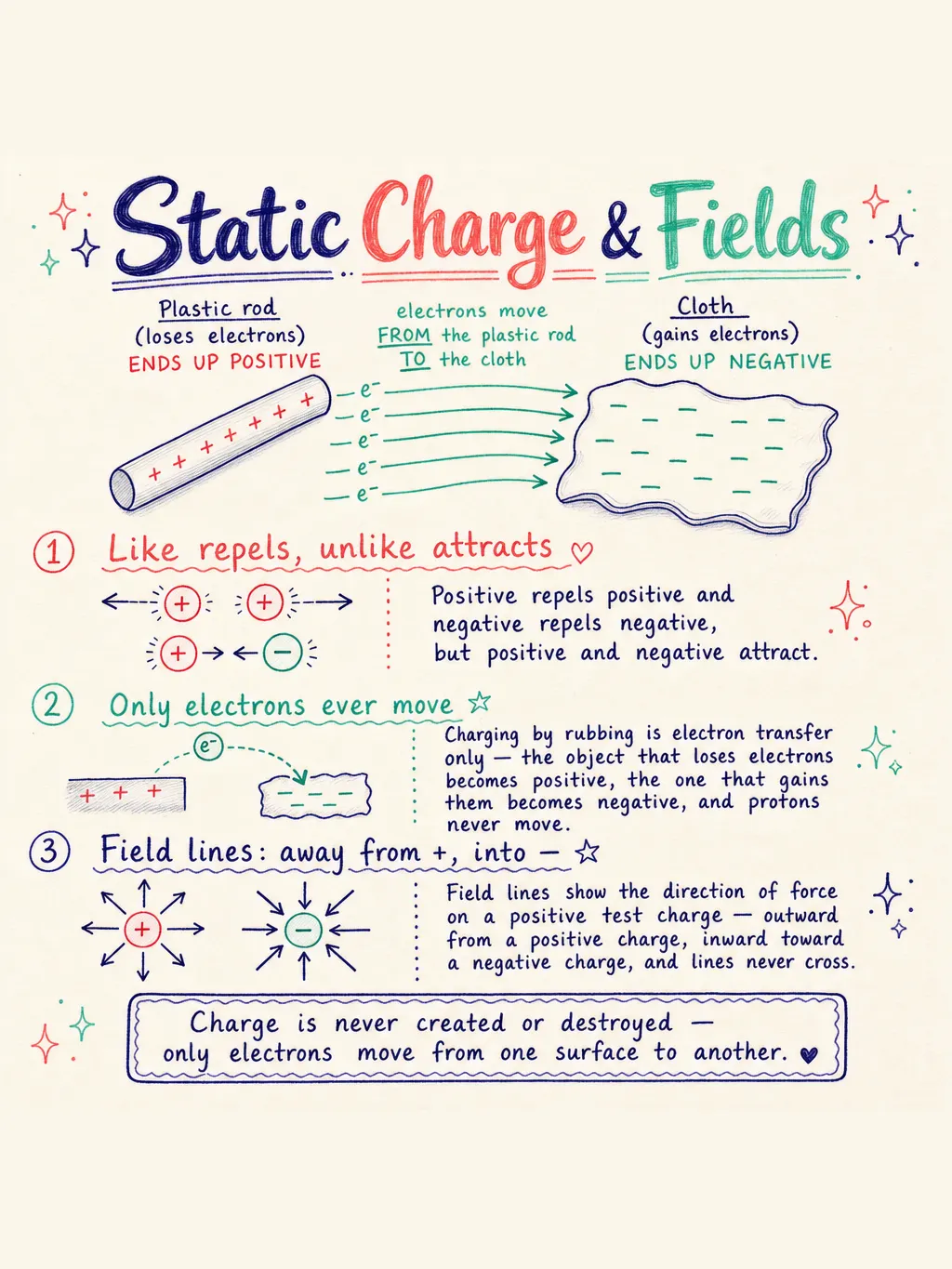
- Unlike charges attract (positive attracts negative) — this is why the balloon sticks to the wall.
- Like charges repel (positive repels positive; negative repels negative) — this is why hair strands, which all pick up the same type of charge from the same rubbing, push apart from each other.
Charge is measured in coulombs (C). One coulomb is actually a huge amount of charge — the static charge on a balloon or a jumper is only a tiny fraction of a coulomb, which is why static shocks sting rather than kill.
Your turn. Two identical balloons are each rubbed separately against the same wool jumper, then held close together. Do they attract or repel? Hint (only if stuck): rubbing against the same material both times gives both balloons the same type of charge.
Answer - have a real go first. They repel. Because both balloons were rubbed on the same jumper, they both end up with the same type of charge (like charges) — and like charges repel, never attract. If you answered "attract" — the usual slip is assuming any two charged objects must be opposites — remember attraction only happens between different types of charge; two objects charged the same way are always like charges.
2. Charging by Rubbing — Electron Transfer
Rubbing doesn't create charge out of nothing — charge is never created or destroyed, only moved. What rubbing actually does is knock loosely-held negative charge off one surface and onto the other, so two objects that started off perfectly balanced (neutral) end up unbalanced in opposite directions.
To see why, zoom into the atom. Every atom has a nucleus at its centre — this holds the protons, which are positively charged and locked tightly in place. Surrounding the nucleus are electrons, tiny negatively charged particles that are held on much more loosely, especially the outermost ones. On some materials those outer electrons are so loosely held that friction — rubbing two surfaces together — is enough to knock them off one surface and onto the other. Protons never move: they're buried deep in the nucleus. Only electrons ever transfer between materials, and this single fact is the key to everything about charging.
Example — rubbing a plastic rod with a cloth:
- The plastic holds its outer electrons more loosely than the cloth does, so friction knocks some of the rod's electrons across onto the cloth. The rod now has fewer electrons than protons — it is left positively charged. (Nothing positive was added; it simply lost some of its negative charge, and losing negative charge leaves the fixed positive charge relatively in the majority.)
- The cloth gains those same electrons, giving it more electrons than protons — it becomes negatively charged.
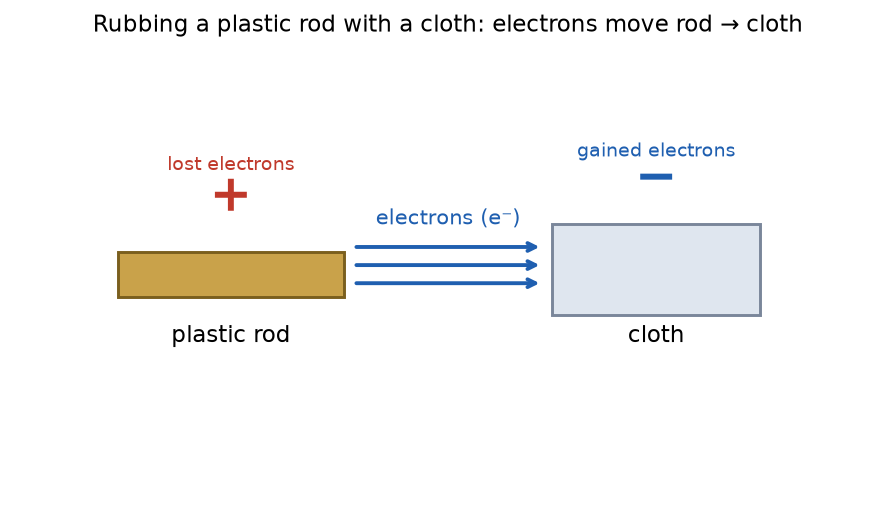
Common confusion to defuse: it's tempting to think the rod "gains positive charge" from the rubbing. It doesn't — nothing positive ever moves. The rod becomes positive purely because it lost negative charge; the protons in its nucleus never budged.
Your turn. A glass rod rubbed with silk becomes positively charged. Which way did electrons move? Hint (only if stuck): the object left positively charged is the one that lost electrons, not gained them.
Answer - have a real go first. Electrons moved from the glass to the silk. The glass ended up positive, and an object only becomes positive by losing electrons (never by gaining protons), so the glass must be the one that lost them — meaning the silk is the one that gained them, leaving the silk negatively charged. If you said electrons moved from silk to glass — the usual slip is pairing "positive" with "gained something" — remember positive charging by rubbing always means lost electrons, not gained.
3. Charging by Induction — No Touching Required
Rubbing has two real limits. First, it needs contact, which can scratch or contaminate a delicate surface. Second, the sign of charge you end up with depends entirely on which two materials you happen to rub together — you can't just choose. Charging by induction solves both problems: you can charge an object using nothing but a nearby charged rod, without ever touching it, and — as you'll see — you can even choose which sign of charge you end up with.
Charging by induction means causing a charge rearrangement using a nearby charged object, with no contact at all.
Experiment A: Charging a Single Metal Sphere by Induction
- Start with a neutral metal sphere on an insulating stand — equal numbers of protons and electrons, so no net charge.
- Bring a negatively charged rod close to one side — do not touch.
- Like charges repel (Section 1), so the rod's negative charge pushes the sphere's own free electrons away from it — they rush to the far side. The near side is left relatively positive (its share of electrons has thinned out), the far side relatively negative (electrons have crowded in). This is induced charge separation — note the sphere's total charge hasn't changed yet, it's just rearranged.
- While the rod is still close, earth the sphere — connect it to the ground with a wire. The electrons crowded at the far side are still being pushed by the rod and now have somewhere to escape to — the enormous reservoir of the Earth — so they flow out through the wire. This time the sphere really does lose electrons overall, not just rearrange them.
- Remove the earth connection first, while the rod is still in place. This seals in whatever charge is left before anything can flow back.
- Now remove the rod. With the escape route already cut off, the electrons that left cannot return. The sphere is left with a genuine shortage of electrons — a net positive charge — even though the rod never touched it and gave it nothing directly.
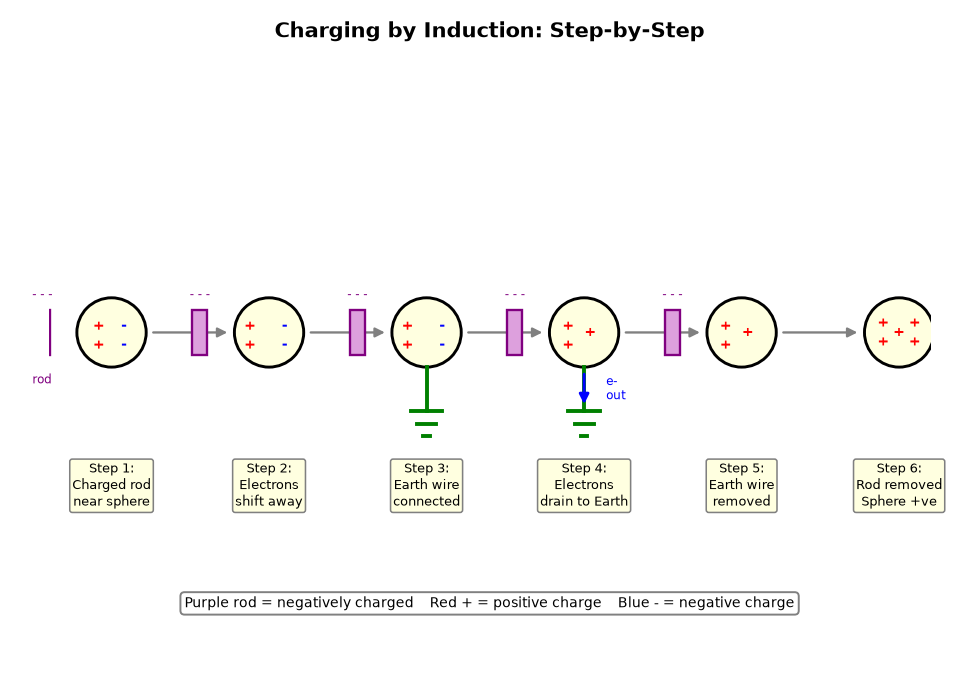
Why the order in steps 5–6 matters: if you removed the rod before disconnecting the earth, the repulsion holding electrons away would vanish. Freed from that push, the remaining electrons spread back out evenly — and because the earth path is still open, more electrons flow in from the Earth to replace the imbalance. The sphere ends up neutral again, not charged. The earth path has to be sealed while the rod is still repelling electrons, or the whole effect undoes itself.
Your turn. If a positively charged rod is used instead in step 2, which side of the sphere do the free electrons rush toward — near or far? Hint (only if stuck): the force reverses when the rod's sign reverses.
Answer - have a real go first. The near side. A positive rod attracts the sphere's electrons (unlike charges attract) instead of repelling them, so electrons crowd toward the rod, leaving the far side short of electrons — positive. If you said "far side" — the usual slip is copying the negative-rod answer without re-checking the direction of the force — remember attraction pulls electrons toward the rod, the opposite of what repulsion does.
Experiment B: Charging Two Spheres by Induction
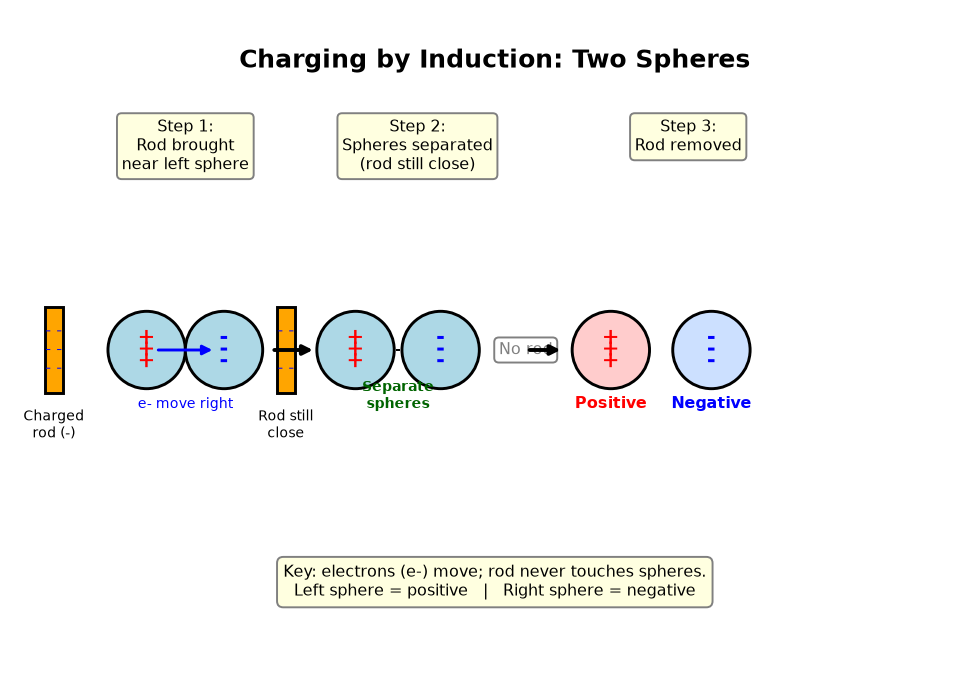
No earth wire handy? A second neutral sphere can play a similar role. Instead of draining electrons into the Earth and sealing the result by disconnecting a wire, you drain electrons into a second sphere and seal the result by physically separating the two spheres while the rod is still there.
- Place two neutral metal spheres touching each other on insulating stands.
- Bring a negatively charged rod close to one sphere — do not touch.
- Electrons in both spheres (now effectively one connected conductor) are repelled by the rod; they migrate as far away as they can get — into the far sphere.
- While the rod is still close, separate the two spheres. This is the equivalent of Experiment A's "disconnect the earth first" — it locks each sphere's share of electrons in place before anything can flow back.
- Remove the rod.
- With no path left between them, the charge on each sphere can't rebalance: the sphere that was near the rod is left positive (it lost electrons to the other sphere); the far sphere is left negative (it gained them).
Your turn. If the rod used in Experiment B is positive instead of negative, is the sphere nearest the rod left positive or negative after separation? Hint (only if stuck): a positive rod pulls electrons toward it, not away.
Answer - have a real go first. Negative. A positive rod attracts electrons toward itself, so electrons are pulled into the near sphere this time, leaving the far sphere short of electrons — positive. If you said "positive" — the usual slip is assuming the near sphere is always the one left positive — remember that only holds for a negatively charged inducing rod; flipping the rod's sign flips which sphere ends up which way.
4. Electric Fields — The Invisible Force Zone
We've been saying charges "push" or "pull" each other without touching. How do we describe that force at every point in space, even before we know exactly what will be placed there? Physicists use the idea of a field — a map of what force a charge would feel at any point, whether or not anything is actually there yet. It's the same trick as a weather map showing wind direction and strength everywhere, whether or not a boat happens to be at that exact spot right now.
An electric field is any region where a charge feels an electric force.
We draw electric fields using field lines — arrows showing the direction of force on a positive test charge (an imaginary tiny positive charge, used purely as a probe, so that everyone reading the diagram agrees on which way "the arrow points" means).
Rules for field lines: - Arrows point in the direction a positive charge would be pushed. - Lines closer together = stronger field (like contour lines close together meaning a steep hill). - Lines never cross — at any single point in space, a charge can only feel one net force in one direction. If two lines crossed, that point would be claiming two different directions at once, which is impossible.
Your turn. You're shown a diagram where two field lines cross at a point. What does that tell you about the diagram? Hint (only if stuck): think about how many directions a charge can be pushed in, at one single point.
Answer - have a real go first. The diagram is wrong — field lines are never drawn crossing. A charge sitting at that exact point can only feel one net force in one direction, so two lines meeting there would be claiming two directions at once, which can't happen. If you assumed the crossing point somehow shows a "combined" direction — the usual slip — remember real field-line diagrams are drawn so that never needs to happen: they curve around each other instead of crossing.
5. Field Around a Single Point Charge
Positive point charge: the test charge is positive, and like charges repel, so wherever you place it around a positive source it gets pushed away — field lines point away from the charge, radiating outward.
Negative point charge: unlike charges attract, so the positive test charge gets pulled in toward a negative source from every direction — field lines point toward the charge, converging inward.
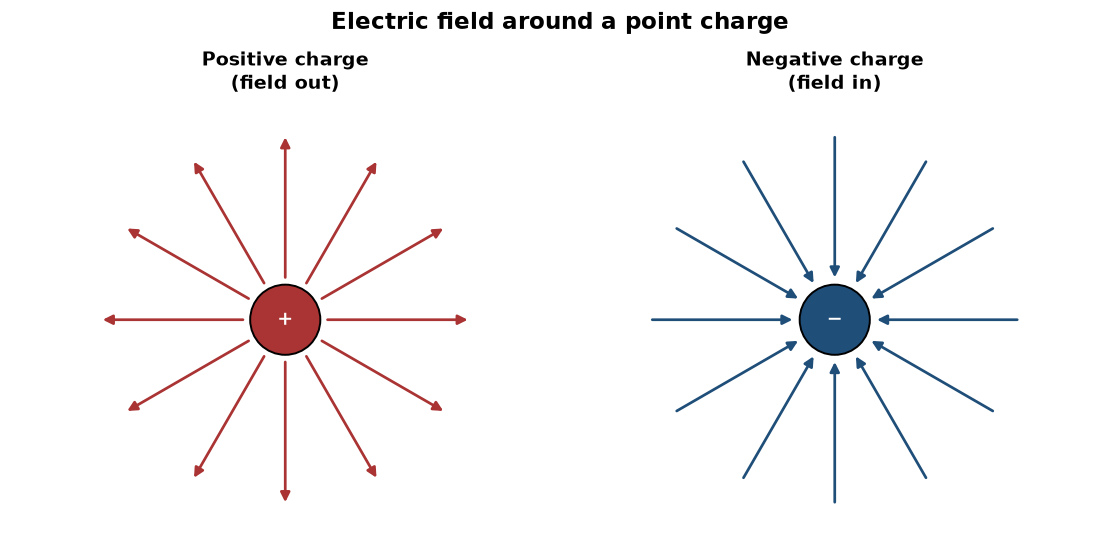
Both patterns are radial (spreading in all directions from the centre) — only the arrow direction flips between the two.
Your turn. A field-line diagram shows arrows pointing toward a point charge from every direction. Is the source charge positive or negative? Hint (only if stuck): think about what happens to a positive test charge near this source.
Answer - have a real go first. Negative. Inward arrows mean the positive test charge is being pulled toward the source, and only unlike charges attract — so the source must carry the opposite sign to the test charge, which is negative. If you said "positive" — the usual slip is reasoning "arrows pointing at it means it's attractive, so it must be positive" — remember the arrows always show the force on a positive test charge; inward arrows mean attraction, and attraction toward a positive test charge only happens from a negative source.
6. Field Between Two Point Charges
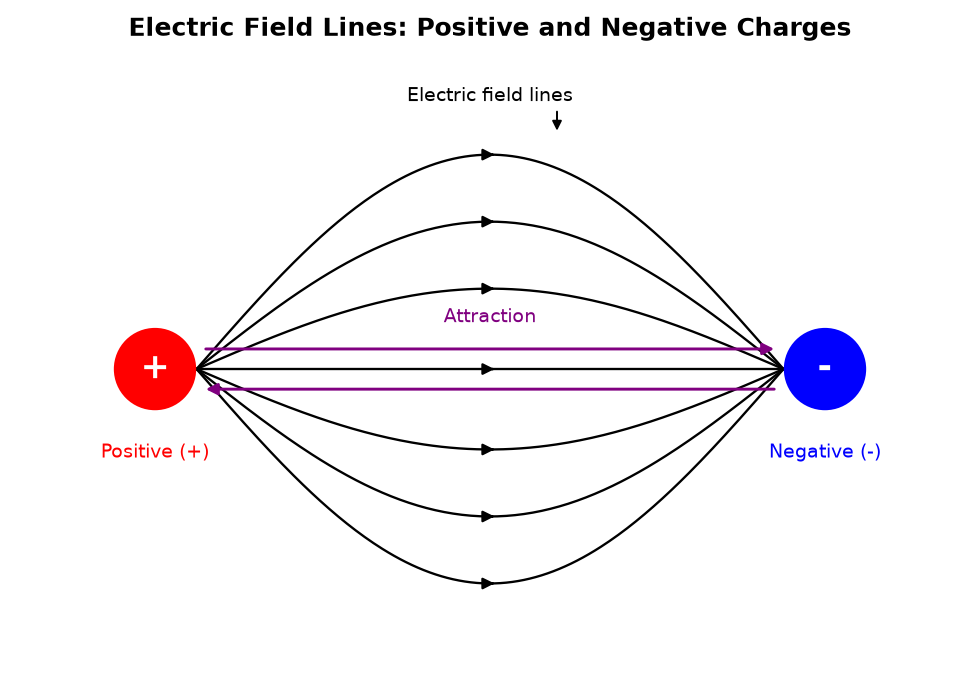
Opposite charges (unlike — one positive, one negative): Near the positive charge, a positive test charge is still pushed away from it; near the negative charge, it's still pulled toward it. Put both effects together and the lines curve smoothly from the positive charge across to the negative one, showing overall attraction between the pair.
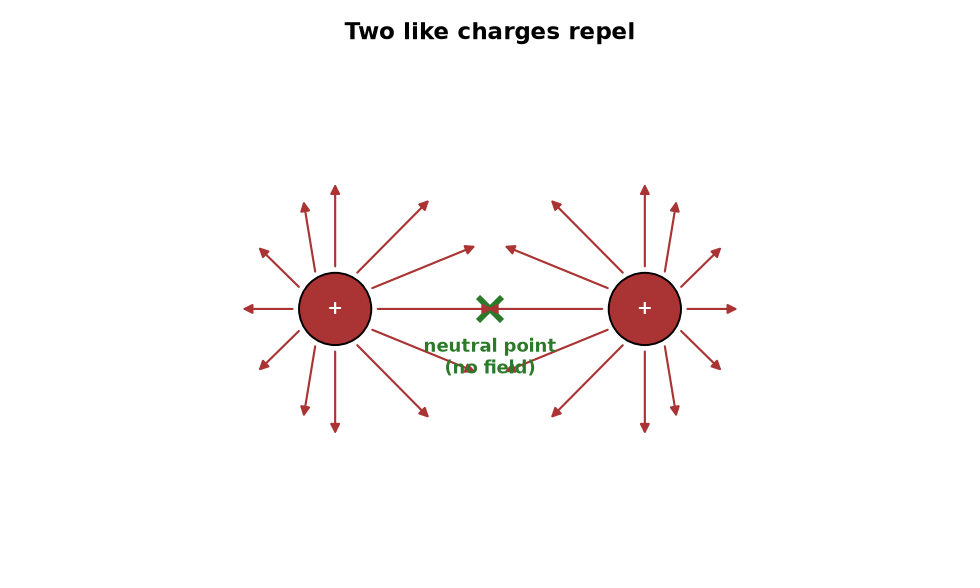
Like charges (both positive, or both negative): This time both charges push (or both pull) a positive test charge the same way — away from each of them — so the lines have nowhere to link up to; they curve away from each other instead. Exactly midway between two equal like charges, symmetry forces the push from the left charge to exactly cancel the push from the right charge — the net force there is zero, so it's a neutral point, and no line passes through it.
Your turn. Two negative charges of equal size sit side by side. Where is the neutral point (zero net force on a test charge)? Hint (only if stuck): think about what has to be true of the two pushes at that spot for them to cancel out.
Answer - have a real go first. Exactly midway between the two charges, on the line joining them. Because the two charges are equal, the repulsion (or attraction) each one exerts there is equal in size and opposite in direction, so they cancel to zero. If you assumed a neutral point needs an actual absence of charge nearby — the usual slip — remember it only needs the forces to cancel; for two equal like charges that always happens exactly at their midpoint.
7. Static Electricity Hazards
Charge builds up whenever there's friction and no path for it to drain away — and a spark is simply that built-up charge finding a sudden path all at once. We already used a deliberate, safe version of this in Experiment A (earthing); the hazard cases below are what happens when that path is missing and the spark finds its own way instead, sometimes somewhere dangerous.
Fuel tankers: friction between flowing fuel and the pipe strips electrons off surfaces exactly the way rubbing did in Section 2, so the tanker and fuel can build up real charge as fuel is pumped. Tankers are earthed (connected to the ground by a metal cable) before fuel transfer starts — the same principle as Experiment A step 4 — so that charge drains away continuously as it forms, instead of ever being allowed to accumulate near flammable fuel vapour.
Aircraft refuelling: aircraft build up charge from friction with the air in flight. An earthing wire is connected before refuelling to drain it the same way. The fuel pipe is also bonded to the aircraft — bonding means joining two conductors directly with a metal wire so that both are forced to the same charge — no difference can build up between them, and a spark needs a difference to jump across, so bonding blocks sparks even if some charge is still present on both.
Sensitive electronics: microchips can be destroyed by a static discharge far too small for a person to even feel. Engineers wear anti-static wrist straps connected continuously to earth, so any charge building up on their body drains away steadily instead of discharging suddenly through a chip.
Your turn. A fuel tanker's earthing cable is clipped to the ground before fuel starts flowing, not part-way through. Why before, and not after? Hint (only if stuck): think about exactly when the friction — and therefore the charge build-up — actually starts.
Answer - have a real go first. Charge starts building up the instant fuel starts flowing through the pipe (friction), so earthing has to be in place before flow begins so charge drains away continuously as it forms and never gets the chance to accumulate. If you thought earthing part-way through would be fine — the usual slip is treating earthing as a one-off "reset" you can apply anytime — remember its whole job is a continuous escape path; charge that already built up before the path existed would be at risk of sparking in the gap.
8. Electrostatic Precipitator — Static Electricity Saving Lives
Now put charging and field-attraction together to build a real machine.
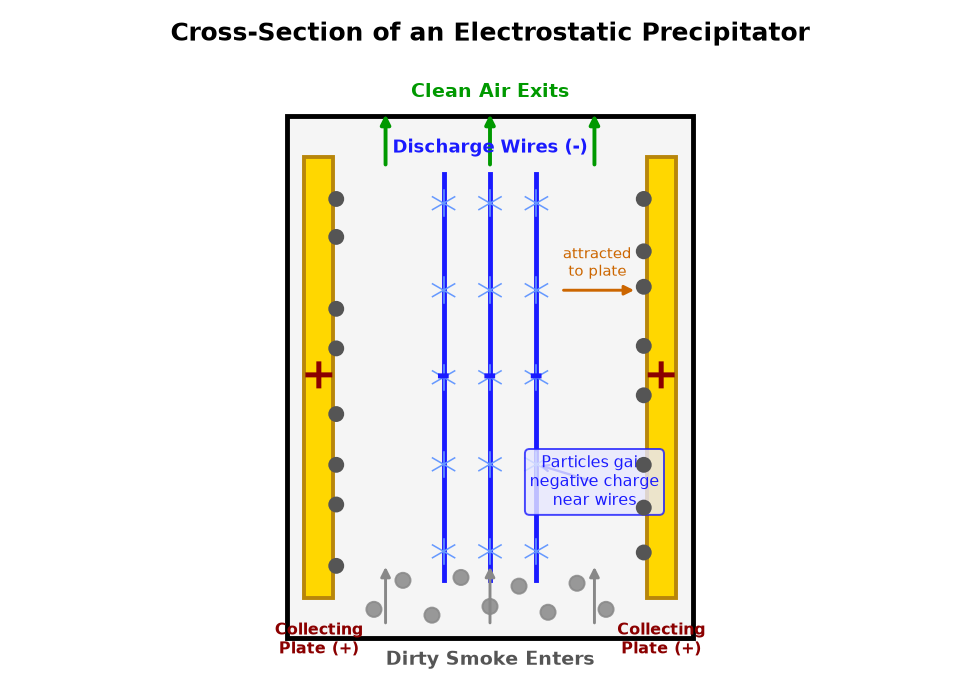
An electrostatic precipitator is a device that uses static electricity to remove dust and ash particles from industrial smoke before it leaves a chimney.
How it works:
- Smoke rises through a chamber inside the chimney.
- Negatively charged wire grids (electrodes) inside the chamber charge the surrounding air, which in turn transfers negative charge onto the smoke particles — the same electron-transfer idea from Section 2, just happening through the charged air rather than direct rubbing.
- Further along, large positively charged metal collecting plates line the chamber walls.
- Unlike charges attract (Section 1), so the negatively charged smoke particles are pulled across to the positive plates.
- Particles stick to the plates; the plates are periodically shaken so that once the stuck layer gets heavy enough, gravity plus the shake overcomes the (fairly weak) sticking force and particles fall into a collection bin.
- Clean air exits the chimney.
Applying the same principle to new situations: The same idea — charge particles, then attract them to an oppositely charged surface — is used in spray painting: paint droplets are charged and attracted to a grounded (earthed) car body, giving even, efficient coverage with less waste.
Note: Photocopiers also involve electrostatic effects but work through a more complex process; they are not a straightforward application of the precipitator principle and will not be examined as such.
Your turn. If the wire grids in a precipitator were made positive instead of negative, what sign would the collecting plates need to be, and why? Hint (only if stuck): work out what sign the smoke particles would end up with first.
Answer - have a real go first. The plates would need to be negative. Positive grids would give the smoke particles a positive charge instead of negative, and only unlike charges attract, so the collecting surface has to switch sign too, to stay opposite to whatever the particles carry. If you assumed the plates are "just always positive" — the usual slip, treating it as a fixed design rule — remember the plate's sign isn't fixed in principle; it only has to be opposite to whichever sign the grid gave the particles.
Quick Recap
- Two charges: positive and negative. Measured in coulombs (C).
- Unlike attract; like repel.
- Charging by rubbing = electron transfer (only electrons move; protons stay fixed).
- Charging by induction = charge rearrangement without contact; two methods: single sphere with earthing, or two spheres separated.
- Electric field = region where a charge feels a force; field lines show direction of force on a positive test charge.
- Single charge: radial field lines (out from positive, in to negative).
- Two charges: lines connect opposites; lines curve away between likes, with a neutral point between equal like charges.
- Static hazards: sparks near fuel, damaged electronics — earthing/bonding gives charge a safe, continuous escape route.
- Precipitator: charge particles → attract to oppositely charged plates → clean air.
Key Definitions and Rules
- Coulomb (C): the unit of electric charge.
- Electric field: the space around a charge where another charge would feel a force.
- Field line direction rule: field lines always point in the direction a positive test charge would move — away from positive source charges, toward negative source charges.
(There are no formulae to memorise in this topic.)
Common Mistakes
- Saying protons move when something is charged by rubbing — only electrons move; a positively charged object simply lost electrons, it never gained protons.
- Wrong order in induction: remove the earth connection before removing the rod. If you remove the rod first (while still earthed), electrons are no longer repelled to one side; they redistribute evenly and more flow in from Earth — the sphere ends up neutral, not charged.
- Drawing field lines that cross — they never cross; a charge can only experience one net force direction at any point.
- Thinking field lines show where charge is — they show the direction of force on a positive test charge in that region, not the location of charge itself.
- Wrong arrow direction for a negative charge — field lines point inward toward a negative charge, not outward.
Exam Tips
- For charging by rubbing: always state which object gains electrons, which loses them, and the resulting charge on each.
- For induction (single sphere): describe every step in order — rod close → electrons shift → earth connected → electrons drain → earth removed first → rod removed → state final charge.
- For induction (two spheres): rod close → spheres separated while rod is near → rod removed → state charge on each sphere.
- When drawing field lines: put arrows on every line and check they point the correct way — examiners check arrow direction.
- For precipitator questions: link each step explicitly to "unlike charges attract" — examiners want to see the principle applied, not just the machine described.
- For "apply to a new situation" questions: identify what is being charged, and what oppositely charged surface attracts it — spray painting is the clearest example.
📝 Listening worksheet
Print this (or keep it open) and fill in the blanks as the podcast reaches each idea. Answers are at the bottom for self-check.
Download worksheet (PDF)