Diamond vs Graphite Bonding — study notes
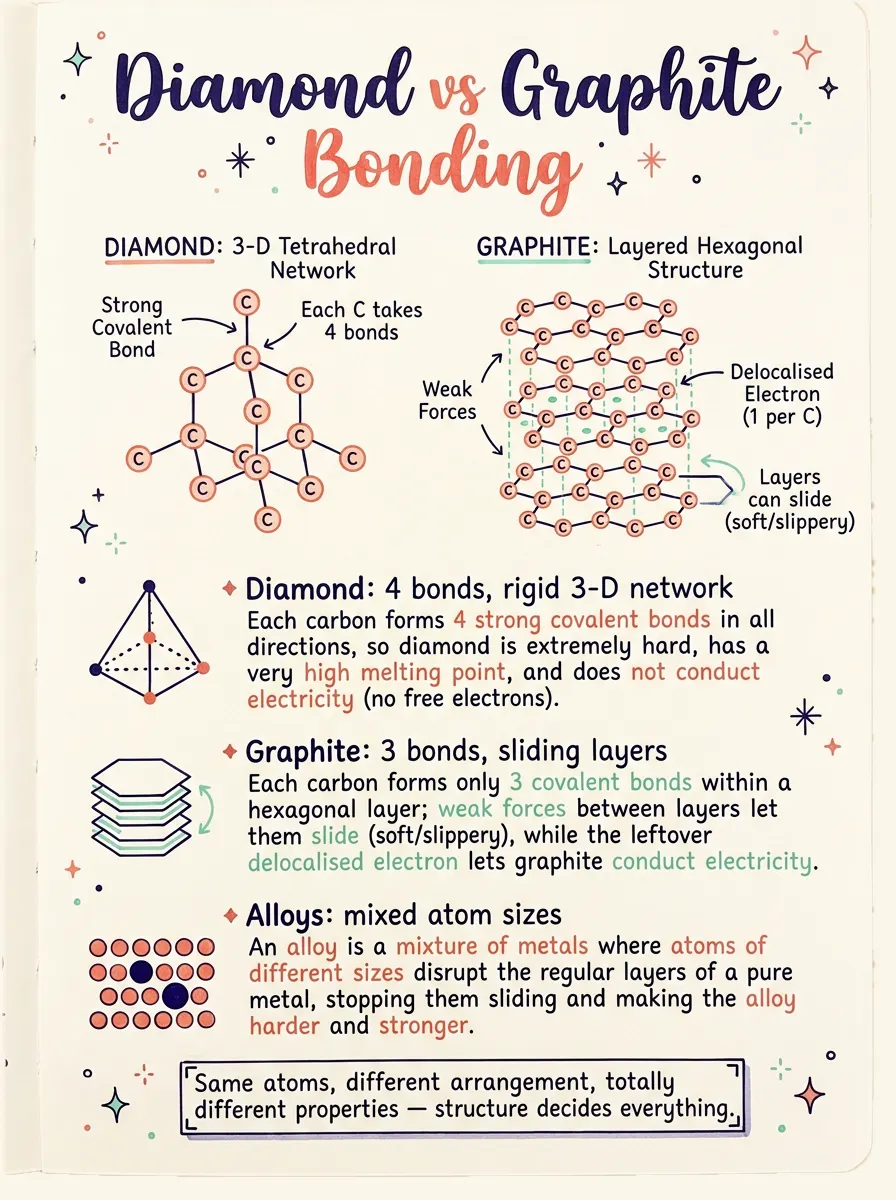
A pencil "lead" and an engagement ring are both pure carbon, nothing else — yet one crumbles under a fingernail and the other slices glass. If the atoms are identical, the gap has to live somewhere else entirely: in how those atoms are joined up.
Structure Decides the Properties, Not the Atom Itself
Every carbon atom has four electrons available for bonding. What differs between the two forms is how many of those four actually get used to join neighbours, and in what shape. Use all four on bonds pointing outward in every direction and you build a rigid lattice with nothing spare — that gives diamond. Use only three, arranged flat in six-membered rings that tile into broad sheets, and one electron per atom has nowhere to go — it wanders freely across its own sheet instead. That leftover electron explains almost everything else: it's why one carbon form carries current and the other doesn't, and it has nothing to do with purity — both forms are carbon and only carbon.
Worked Example — Predicting a Property from a Bonding Count
- Start from the bonding count: in one carbon form, each atom joins only three neighbouring atoms rather than four.
- Work out what's left: carbon offers four bonding electrons per atom, so one electron isn't used in any bond — it sits free to roam inside its own sheet.
- Link that spare electron to conductivity: a mobile charge carrier lets this form of carbon conduct electricity, which is unusual for a non-metal.
- Link the flat, stacked shape to softness: each sheet is held firmly inside itself but only loosely attracted to the sheet above it, so the sheets glide apart under light pressure — which is exactly why this form rubs off onto paper and is used to reduce friction.
Notice the method: name the bonding arrangement first, then read every property straight off it — nothing here needs memorising in isolation. The full lesson below runs the same reasoning for the four-bond carbon form, covers alloys and long-chain substances with their own worked examples, plus an audio walkthrough and a worksheet to lock it all in.
Keep going — unlock the whole topic
Notes, audio and the worksheet for this topic, plus every other topic in the subject.
Claim a free seat →