Summary Writing — Study Notes
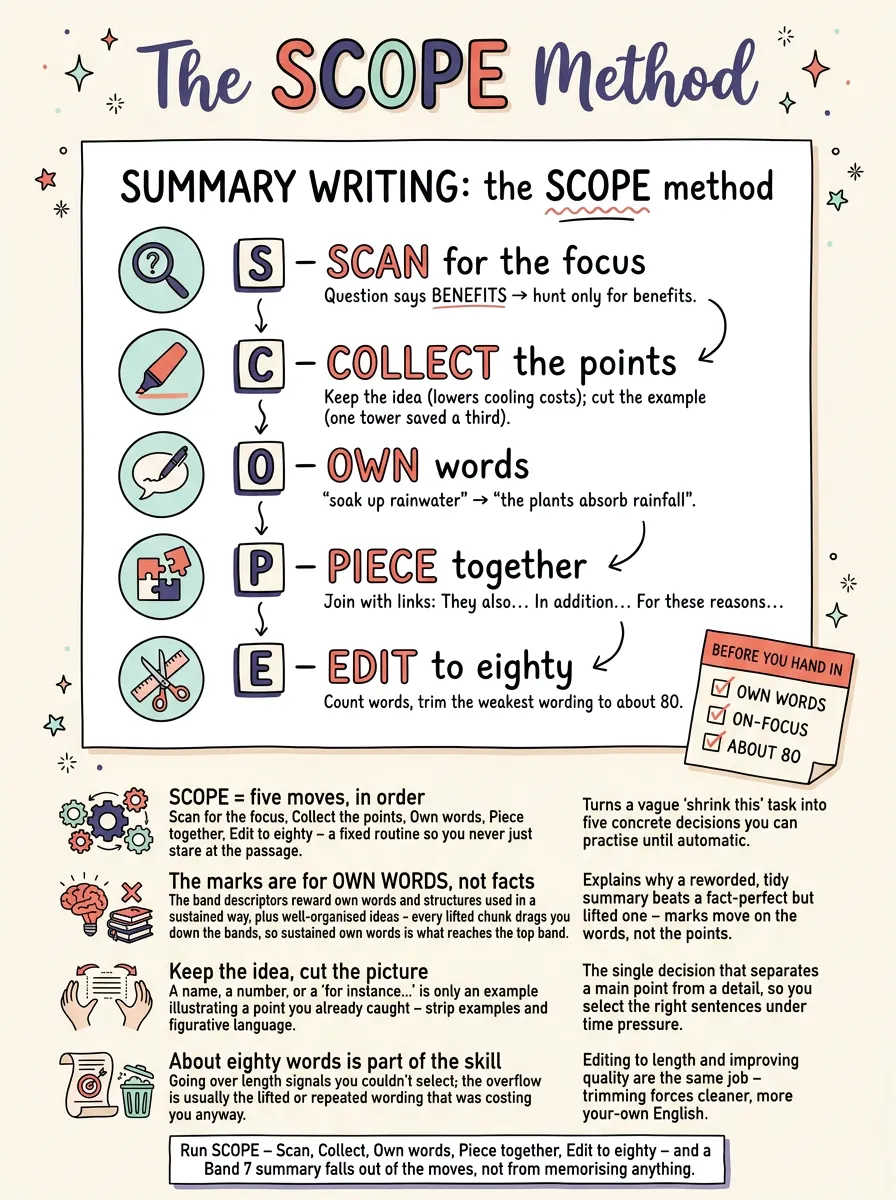
Summary Writing
Here's the honest reason summary feels horrible: you're handed a passage packed with interesting stuff, and then told to throw most of it away — in about 80 words, in your own words, without missing the bits that matter. It feels less like writing and more like defusing a bomb. Every instinct says "keep it in, it might be important," and that instinct is exactly what loses the marks.
But summary isn't a test of how much you can cram in. It's a test of whether you can find the few ideas that actually answer the question and say them cleanly in your own voice. That's a skill — a set of moves you can practise until they're automatic — not a fact you either know or don't. This episode gives you those moves, names them, and drills them on passages we wrote ourselves so you can see exactly how each one earns a mark.
What the examiner actually wants
The task (Paper 2, Section C) gives you a non-narrative passage and a focus — a specific thing to summarise, like "the reasons people do X" or the "benefits of Y." You write one connected paragraph of about 80 words that pulls together the points answering that focus, in your own words and your own sentence structures. Seven marks are on the line.
Here's the part students never quite believe: those marks are mostly not for how many facts you squeeze in. Look at what the band descriptors actually reward:
| Band | Marks | What the marker sees |
|---|---|---|
| Band 7 | 7 | Your own words and structures used in a sustained, successful way; ideas well-organised, conveying the meaning clearly and precisely. |
| Band 5–6 | 5–6 | Own words used frequently and usually appropriately; ideas mostly well-organised and clear. |
| Band 3–4 | 3–4 | Own words used in places; some attempt to organise the ideas. |
| Band 1–2 | 1–2 | Own words appear only occasionally — mostly lifted from the passage. |
Read those top to bottom and one thing jumps out: what moves you up the bands is how consistently the words are yours and how well the ideas are organised. Every lifted chunk drags you down the bands; heavy lifting lands you in Band 1–2 regardless of content. A summary in confident, own-words English that flows in a sensible order climbs to Band 7. So the whole game is: pick the right points, then re-say them as you — clearly, in a sensible order, inside the word limit.
THE METHOD — SCOPE
You need a repeatable routine so you're not just staring at the passage hoping. Ours is SCOPE — five moves, in order. The name is the point: a summary has a scope, a fixed boundary of what belongs in and what stays out, and each letter is one decision about that boundary.
1 — S: Scan for the focus. Before reading a single line of the passage, read the question and underline exactly what it asks for. Why: the passage is full of true, interesting ideas that are not what you were asked for — and every one of those wastes words and buries the meaning. The focus is your filter. Snippet: the question says "summarise the benefits of rooftop gardens" → you are now hunting only for benefits, nothing else.
2 — C: Collect the points. Read the passage and mark every sentence that gives a main point answering the focus — not the examples, statistics or descriptions dressing it up. Why: main points are what the meaning is made of; examples are just there to illustrate a point you've already caught. Snippet: "green roofs cool the buildings, so offices spend less on air-conditioning" → point = they lower cooling costs (the "one tower cut its bill by a third" is only the example — leave it).
3 — O: Own words. Take each point you collected and re-write it in your own vocabulary and your own sentence shape. Why: this is the single biggest source of marks — the bands are built almost entirely around own words and structures, so a lifted phrase actively drags you down a band. Snippet: "soak up rainwater, easing the strain on drains" becomes the plants absorb rainfall, so drainage systems cope better in storms.
4 — P: Piece together. Join your own-words points into one connected paragraph, in a logical order, with linking words. Why: the marker rewards ideas that are "well-organised" and read smoothly, not a bullet list of disconnected facts. Ordering rule: by default, keep the points in the order the passage gave them — that's always safe. Upgrade only when related points can be grouped together, e.g. put the two building-and-cost benefits (cooling, drainage) before the two people-and-nature benefits (wildlife, workers), so similar ideas sit side by side. Snippet: stitch with joins — "They also…", "In addition…", "For these reasons…" — so the points feel like one argument, not a pile.
5 — E: Edit to eighty. Count your words and trim until you're at roughly 80, cutting the weakest wording first. Why: going over the limit shows you couldn't select, and the extra words are usually the lifted or repeated ones that were costing you anyway. Snippet: "in order to make sure that" → "to"; "due to the fact that" → "because". Tightening the language and hitting the limit are the same job.
Say it once and it sticks: Scan, Collect, Own words, Piece together, Edit to eighty.
Ask the text these questions
Steps S and C live or die on one repeated decision: does this sentence go in, or stay out? Don't decide by feel. Interrogate every sentence with the same two questions — if it fails either one, it stays out.
| Ask the sentence… | Keep it if… | Cut it if… |
|---|---|---|
| Is this a main point, or just an example? | it's the general idea the passage is making | it's a name, number, or "for instance…" that only illustrates a point you've already got |
| Does it answer the focus I underlined? | it's directly about the thing the question asked for | it's true and interesting but about something else in the passage |
The second question is the one students skip. A passage about rooftop gardens might spend two sentences on the history of city planning — genuinely part of the passage, completely irrelevant if the focus is "benefits." Interesting is not the test. On-focus is the test.
(These two questions are about selection — what goes in. Whether you've put a kept point in your own words is a separate, drafting question — that check lives in the Self-check section at the end.)
Watch it done — an annotated model
Here is a passage we wrote ourselves (nothing here is quoted from any real text). The task set on it is: "Summarise the benefits of turning city rooftops into gardens."
Across many crowded cities, empty rooftops are being turned into gardens, and the change is quietly transforming urban life. These green roofs cool the buildings beneath them, so offices spend far less on air-conditioning during blistering summers — one tower reportedly cut its cooling bill by nearly a third. The plants also soak up rainwater like a thirsty sponge, easing the strain on drains when storms hit. Birds and bees, pushed out long ago by concrete, drift back to feed among the flowers. And for the workers below, a lunchtime stroll through leaves and soil offers a rare pocket of calm in the roar of the city.
Working SCOPE on it: the focus is benefits (S). Collecting the main points (C): (1) they cool buildings and cut cooling costs; (2) they absorb rainwater and ease drainage in storms; (3) wildlife returns; (4) workers get a calm space. The "one tower cut its bill by a third" is an example — cut. "Like a thirsty sponge" and "the roar of the city" are figurative decoration — cut. Ordering note: P here just joins them in passage order — no rearranging needed. Now the same points rebuilt in our own words (O), joined up (P) and trimmed to eighty (E):
(Bands are judged on the response as a whole, not sentence by sentence — each row below is one contributing move, not a verdict on that line alone.)
| Model summary, built move by move | The move — and the mark it earns |
|---|---|
| "Turning unused city rooftops into gardens brings several benefits." | An own-words opening that names the focus — a move toward a Band 7 answer from the first line. |
| "The plants insulate the buildings below, lowering how much owners spend on cooling." | Point 1, fully reworded ("cool"→"insulate", "air-conditioning"→"cooling"). Own words like this, sustained through the answer, are what the top band needs. |
| "They also absorb rainfall, which reduces pressure on drainage systems during heavy storms." | Point 2 in own structure; the example (the "third") is gone. Selecting the point over the example is what keeps meaning clear. |
| "Wildlife such as birds and insects, once driven away by concrete, returns to the greenery." | Point 3, reworded, figurative language stripped. Own words used frequently and appropriately — another move toward a Band 7 answer. |
| "In addition, the gardens give nearby workers a quiet, restful space away from the noise of the streets." | Point 4, joined with "In addition" — the linking word is the organisation the descriptor rewards. |
| "Together, these changes cut costs, manage rainwater and enrich daily life." | A genuine closing synthesis of all four benefits, not an invented claim — ties the points into one argument without straying off-focus. |
Put together that's 79 words, every point in our own voice, connected in order, examples and imagery gone. That is what a 7 looks like as a whole response.
From Band 2 to Band 7
Same skill, a different passage — and this time you can see the source, so you can check the faults for yourself. Focus: "Summarise the benefits schools have seen from starting the day later."
A number of secondary schools have pushed the start of the school day back by a full hour, and researchers tracking the change are encouraged by what they have found. Teenagers arrive noticeably more alert in the mornings, and far fewer of them nod off during the first lesson. Attendance figures have also climbed, since pupils find it easier to get in on time. Teachers report that the general mood around the building feels calmer, with less rushing and fewer arguments in the corridors before registration. Take Northgate Secondary, for example, where recorded lateness fell by almost half within a single term of the change.
That's 105 words of source. Here's a real Band 1–2 attempt at summarising it:
"Some schools have pushed the start of the school day back by a full hour, and researchers tracking the change are encouraged by what they have found. Teenagers arrive noticeably more alert in the mornings, and far fewer of them nod off during the first lesson. Attendance figures have also climbed, and teachers report that the general mood around the building feels calmer, with less rushing and fewer arguments in the corridors before registration. Take Northgate Secondary, for example, where recorded lateness fell by almost half within a single term of the change."
Why it scores low: at 93 words, it is genuinely over length — check it against the source above and you'll find whole sentences copied almost word for word ("nod off during the first lesson," "the general mood around the building feels calmer, with less rushing and fewer arguments in the corridors" — each a run of well over three lifted words). So own words appear only occasionally, which is the Band 1–2 descriptor word-for-word. It also keeps a whole example (Northgate Secondary). Now the Band 7 rewrite:
"Pushing the morning start back by an hour has brought several clear benefits. Teenagers seem far more awake first thing and rarely doze off during their opening lesson. Getting into school on time has become noticeably easier too, so overall attendance numbers have risen. Teaching staff also report a steadier, more settled atmosphere before lessons start, with far fewer rushed tempers flaring in the hallways."
What changed, and why the marks move: every lifted run is re-said in own words ("nod off during the first lesson"→"rarely doze off during their opening lesson," "the general mood… feels calmer, with less rushing and fewer arguments"→"a steadier, more settled atmosphere… with far fewer rushed tempers") — that move from occasional to sustained own words is the jump from Band 2 to Band 7. The Northgate example is cut, so only the three main points remain. And it's trimmed from 93 words to 65, comfortably inside the eighty-word cap. Same facts underneath — the marks moved because the words became the student's and the length came under control.
A note on length: 65 words is a fine, honest length here — this source only has three real points once the example is stripped out. If your passage is richer and gives you four or five genuine points, aim to fill closer to the eighty-word cap, since there's more real content to convey.
The traps
Every one of these is a habit, and every one is beatable once it has a name.
- Lifting. Copying three or more of the passage's words in a row — the fault that alone caps you at Band 1–2, no matter how good the content is (see What the examiner actually wants, above). Beat it: after writing each point, cover the passage and re-say it from memory.
- Summarising the whole text. Including true, interesting points that don't answer the focus you underlined. Beat it: re-read your underlined focus before you keep any sentence — "interesting" isn't the test, "on-focus" is.
- Going over 80 words. It signals you couldn't select, and the overflow is usually the lifted or repeated wording anyway. Beat it: count, then cut the weakest words first (step E).
- Keeping examples and figurative language. Names, numbers, "for instance…," and pretty imagery ("like a thirsty sponge") are decoration, not meaning. Beat it: for each sentence ask "is this the point, or just a picture of the point?" — keep only the point.
Your turn
Do these before reading the answers — the wrestle is where the skill forms.
Your turn. In the rooftop passage above, is this sentence a main point to keep, or an example to cut: "one tower reportedly cut its cooling bill by nearly a third"? Hint (only if stuck): ask whether it states a benefit in general, or just illustrates one you already have.
Answer — have a real go first. Cut it — it's an example. The main point ("green roofs lower cooling costs") is already captured; the "one tower… a third" only illustrates that point with a specific case. If you wanted to keep it because the number feels important — the usual slip — remember a summary keeps the idea, never the illustration; the statistic costs you words and earns you nothing.
Your turn. The passage says workers get "a rare pocket of calm in the roar of the city." Re-write that one benefit in your own words, in under twelve words. Hint (only if stuck): what is the plain, non-figurative benefit hiding inside the imagery?
Answer — have a real go first. Something like "it gives workers a quiet, restful break from the busy city." If you kept "pocket of calm" or "roar of the city" — the usual slip — remember figurative language is the passage's style, not its meaning; the marks are for saying the plain idea in your words, so the imagery has to go.
Your turn. A student's summary of a passage about libraries reads: "Libraries lend books, and they also lend power tools, musical instruments, and even telescopes." The focus was "ways libraries help their communities." What single change lifts this line toward a higher band? Hint (only if stuck): count how many specific examples are doing the work of one point.
Answer — have a real go first. Replace the list of examples with the general point: e.g. "they lend out unusual items, so families avoid buying things they'd rarely use." If you tried to keep all three items — the usual slip — remember "power tools, instruments, telescopes" are three examples of one idea; naming the idea in your own words is what earns the mark, and it saves you words too.
Self-check against the mark scheme
Before you write your final word, run your summary past this — each line maps straight to a band descriptor:
- Own words — could I cover the passage and still recognise my summary as mine? (No lifted phrases → this is what carries you from Band 1–2 up to Band 7.)
- On-focus — does every sentence answer the focus I underlined, with no stray "interesting" points?
- Points, not examples — have all names, numbers, "for instance…," and imagery been cut?
- Organised — do the points flow in a sensible order, joined with linking words, as one paragraph? (This is the "well-organised… clear and precise" the top band asks for.)
- Length — am I at about 80 words, not over?
Tick all five and you are writing a Band 7 summary — not because you memorised anything, but because you ran the moves.
📝 Listening worksheet
Print this (or keep it open) and fill in the blanks as the podcast reaches each idea. Answers are at the bottom for self-check.
Download worksheet (PDF)