The Kidneys: Structure, Function and Dialysis — Study Notes
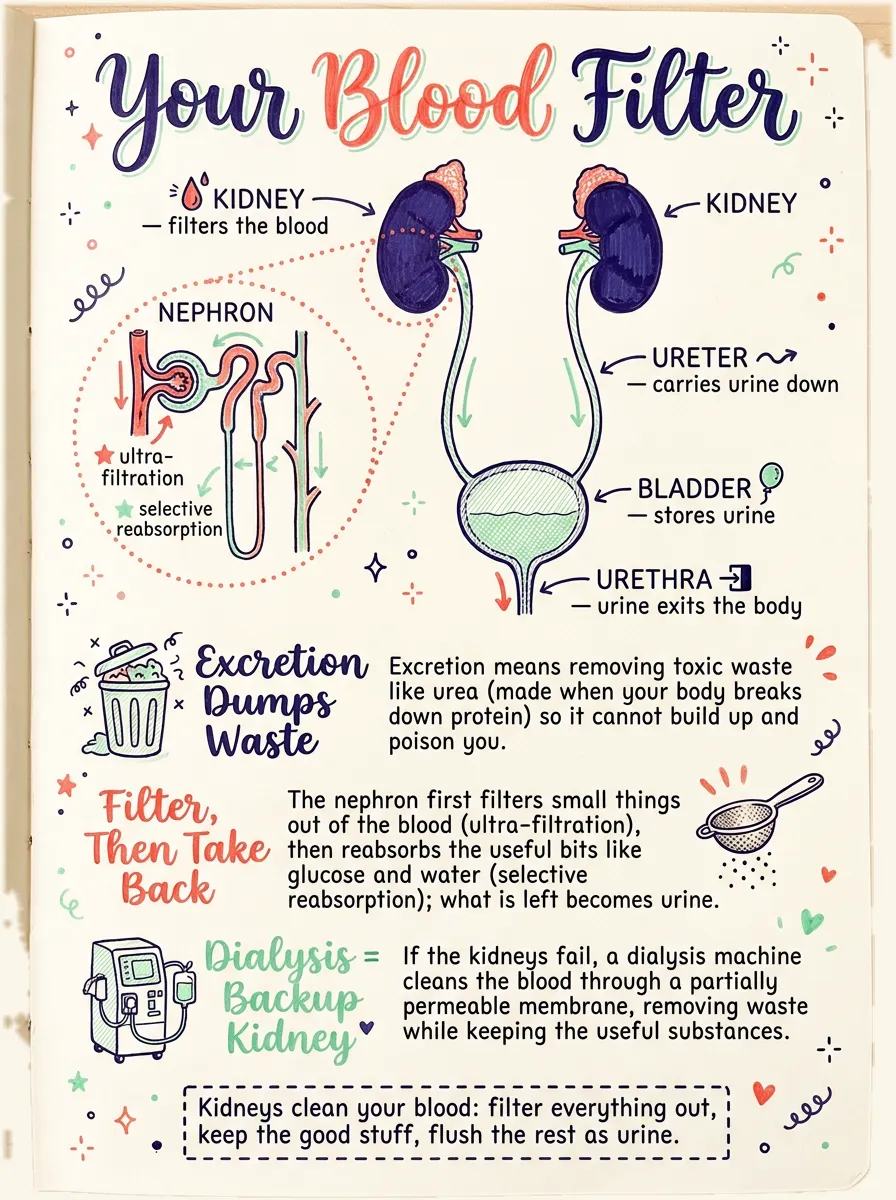
Right now, your kidneys are filtering your entire blood supply, over and over, without you noticing a thing. That silent, constant clean-up is what stops poisonous waste from piling up in your bloodstream. To see how it's done, you only need to understand one microscopic structure — repeated roughly a million times inside each kidney — called the nephron.
How a Nephron Cleans Blood in Two Stages
Blood arrives at a nephron under pressure and is forced against a fine, sieve-like wall. This first stage forces small dissolved substances — glucose, salts, urea and water — through the wall and into a narrow tubule, while blood cells and large protein molecules stay behind simply because they can't fit through the gaps. Notice what this stage can't do: it has no way of telling useful substances from waste, so anything small enough gets pushed through regardless.
That's why a second stage follows. As the filtered fluid travels along the tubule, surrounding cells reclaim precisely what the body still requires — essentially all of the glucose, the bulk of the water, and any salts not already in surplus — sending them straight back into the bloodstream. This targeted reclaiming is where the actual sorting happens. Whatever remains afterwards, chiefly urea plus leftover water, continues onward and eventually becomes urine.
Worked Example — Explaining Glucose Found in a Urine Sample
- A lab test flags glucose in a patient's urine, which shouldn't normally appear there. Start with the filtering stage: glucose molecules are small enough to be forced across the sieve-like wall and into the tubule fluid, and that happens regardless of whose kidney it is — healthy or not.
- Now check the reclaiming stage: in a properly working nephron, surrounding cells pull nearly every last trace of that filtered glucose straight back into the blood, so almost none should ever reach the bladder.
- Because glucose is still showing up in the urine, the fault must sit at the reclaiming stage rather than the filtering stage — either more glucose is being pushed through than the tubule can reclaim, or the reclaiming mechanism itself isn't functioning as it should.
Pinpointing which of the two stages has broken down, rather than vaguely blaming "the kidneys," is exactly the reasoning that earns marks on an O-Level paper.
How the kidney's own structure supports each of these stages, what happens once both kidneys fail, and a full audio walkthrough with a practice worksheet are all waiting in the full lesson below.
Keep going — unlock the whole topic
Notes, audio and the worksheet for this topic, plus every other topic in the subject.
Claim a free seat →