Mole Concept: Count, Convert, React — study notes
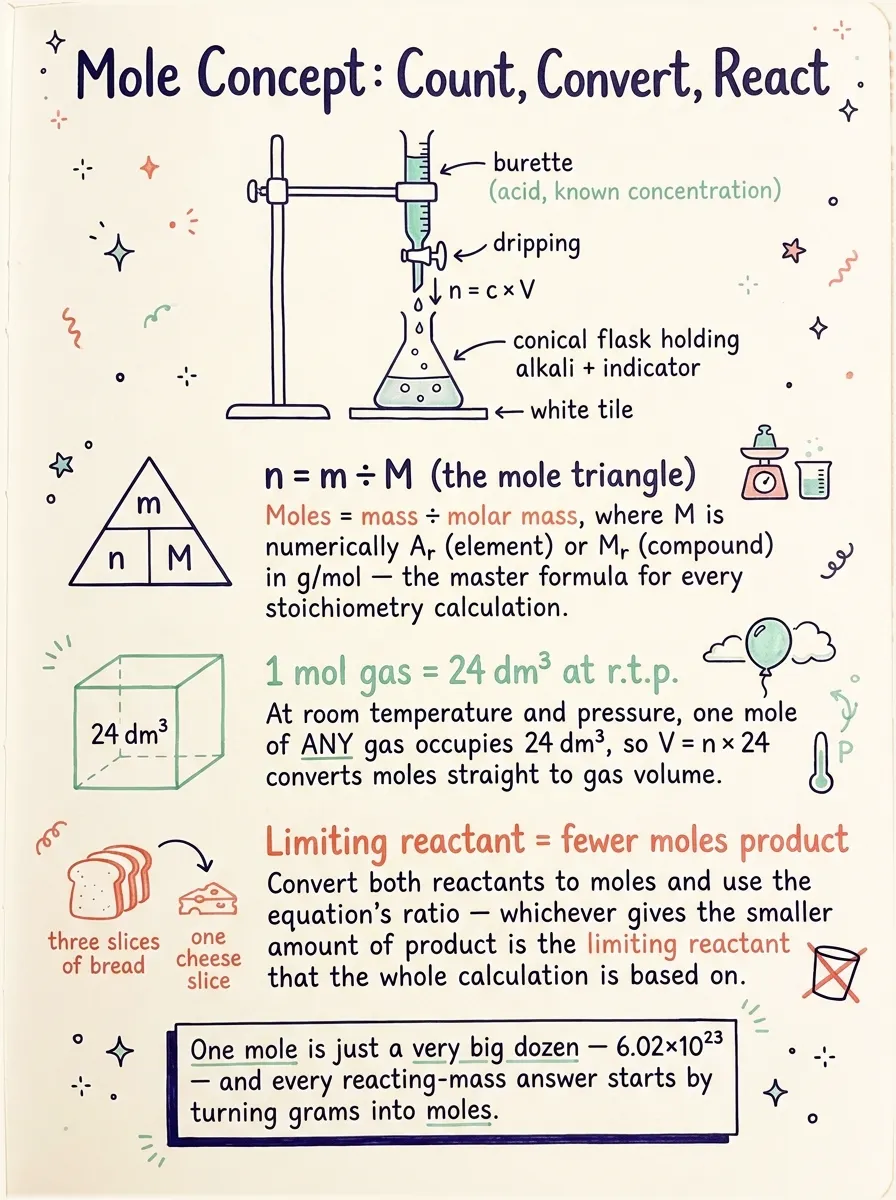
Every chemistry paper has at least one question that starts with a mass in grams and ends with a question about atoms, gas volume or concentration — and the mole concept is the one idea that lets you cross from one to the other. Miss it, and half the stoichiometry section becomes guesswork.
Why You Need a Counting Unit for Atoms
Think of a recipe: 2 eggs for every 100 g of flour. If you only have 1 egg, you can't use all the flour without wasting it — you have to scale the whole recipe down together. Chemical reactions are recipes too: atoms combine in fixed whole-number ratios. The catch is you can never count individual atoms going into a reaction — they're far too small and far too many.
That's the problem the mole solves. Chemists first gave every atom a relative atomic mass (Aᵣ) — a comparison number (no units) showing how many times heavier it is than one-twelfth of a carbon-12 atom. You don't calculate Aᵣ; you read it straight off the periodic table (H = 1, C = 12, O = 16, and so on).
One mole (mol) is then defined as the amount of substance containing 6.02 × 10²³ particles — a number called the Avogadro constant. The payoff: weigh out a mass in grams equal to a substance's Aᵣ or Mᵣ (relative molecular mass), and you have exactly one mole of it. That gives the single most useful formula in the whole topic:
n = m ÷ M, where n = number of moles (mol), m = mass of the substance (g), and M = molar mass (g/mol).
Worked Example
How many moles are in 44 g of carbon dioxide, CO₂?
- Find the molar mass first: Mᵣ of CO₂ = (1 × 12) + (2 × 16) = 12 + 32 = 44, so M = 44 g/mol.
- Apply the formula: n = m ÷ M = 44 ÷ 44 = 1 mol.
The rest of the method — every worked example, a listen-along audio walkthrough and a practice worksheet — is in the full lesson below.
Keep going — unlock the whole topic
Notes, audio and the worksheet for this topic, plus every other topic in the subject.
Claim a free seat →