Thermal Processes — study notes
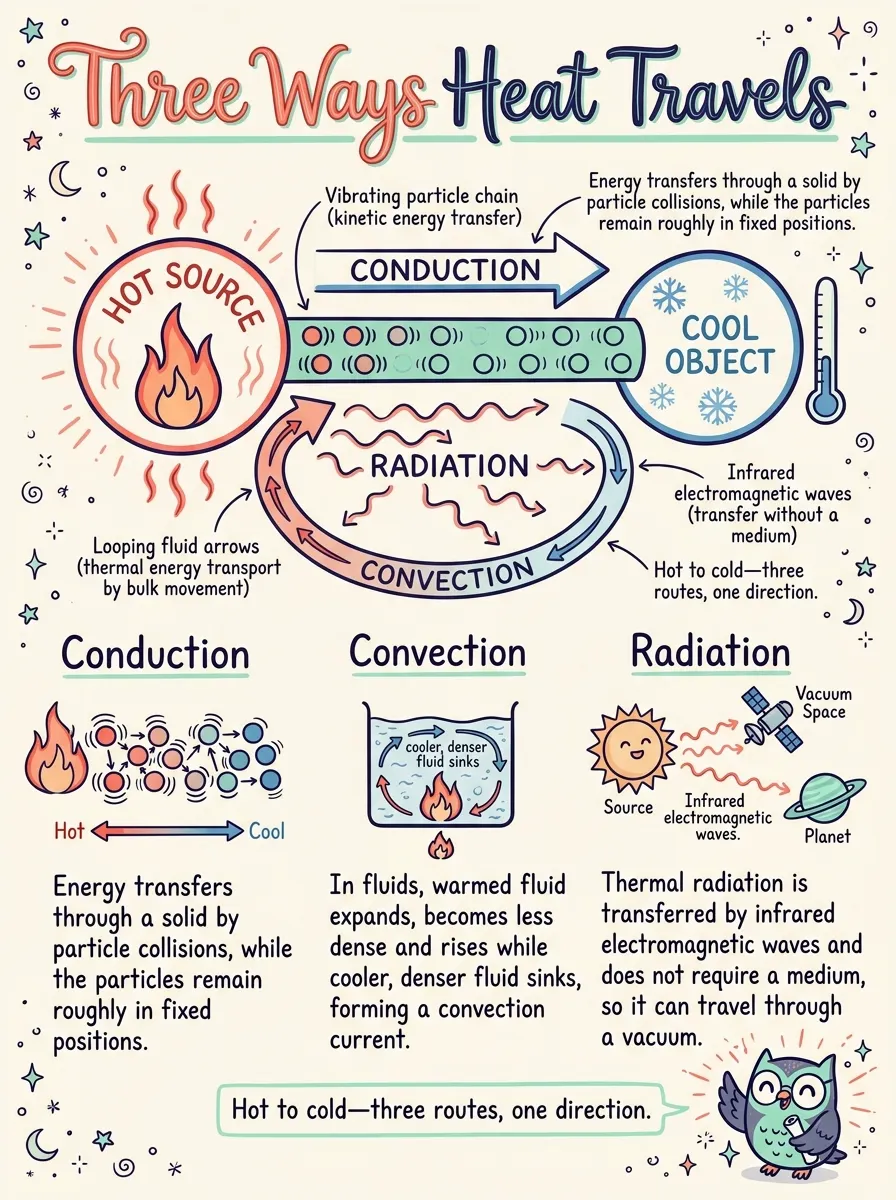
Touch a frosty windowpane and the wooden window frame right beside it on a winter morning — the glass bites cold, the wood only feels cool, even though both have sat in the same air all night. Something about how each material handles escaping heat differs, and untangling that difference is really what this whole topic is about.
Three Routes, One Rule
Heat energy only ever travels one direction: from a warmer object toward a cooler one, never backwards, until both settle at a shared temperature. But how that energy makes the journey depends on what lies between the hot end and the cold end. In solids, energy hops from particle to particle by conduction — vibrating atoms jostle their neighbours, and in metals, loose electrons race through even faster, carrying extra energy along for the ride. In liquids and gases, warmed fluid expands, ends up less dense than the cooler fluid beside it, and physically floats upward — that circulating rise-and-sink loop is convection, and it needs a fluid free to flow, so solids simply can't manage it. Across empty space, or alongside the other two routes, energy can also ride an invisible electromagnetic wave called radiation — no particles needed at all, which is the only reason sunlight can cross millions of empty kilometres to reach us. Dark, matt surfaces both soak up and give off radiation fastest; pale, shiny ones do neither job well. Spot which route a scenario relies on, and most exam questions answer themselves.
Worked Example — Why a Foil-Wrapped Baked Potato Stays Hot Longer
- Foil is shiny, so it does a poor job emitting radiation — much less energy escapes the potato as electromagnetic waves than if the skin were left bare.
- Foil also traps a thin pocket of air against the potato's skin; since air is a weak conductor, energy leaking outward through that pocket is slow going.
- Because the trapped pocket is thin and sealed, it has almost no room to circulate, so barely any convection current can form to carry energy away either.
- With all three escape routes throttled together, the potato loses its stored energy far more gradually, so it stays hotter for longer than an identical potato left unwrapped on the same plate.
Spotting mechanisms for one wrapped potato is exactly the skill exam scenarios keep testing — the full lesson below walks through many more real-world cases with an audio narration and a worksheet, so you can practise telling conduction, convection and radiation apart on your own.
Keep going — unlock the whole topic
Notes, audio and the worksheet for this topic, plus every other topic in the subject.
Claim a free seat →