Transition Metals: Colour & Catalysis — study notes
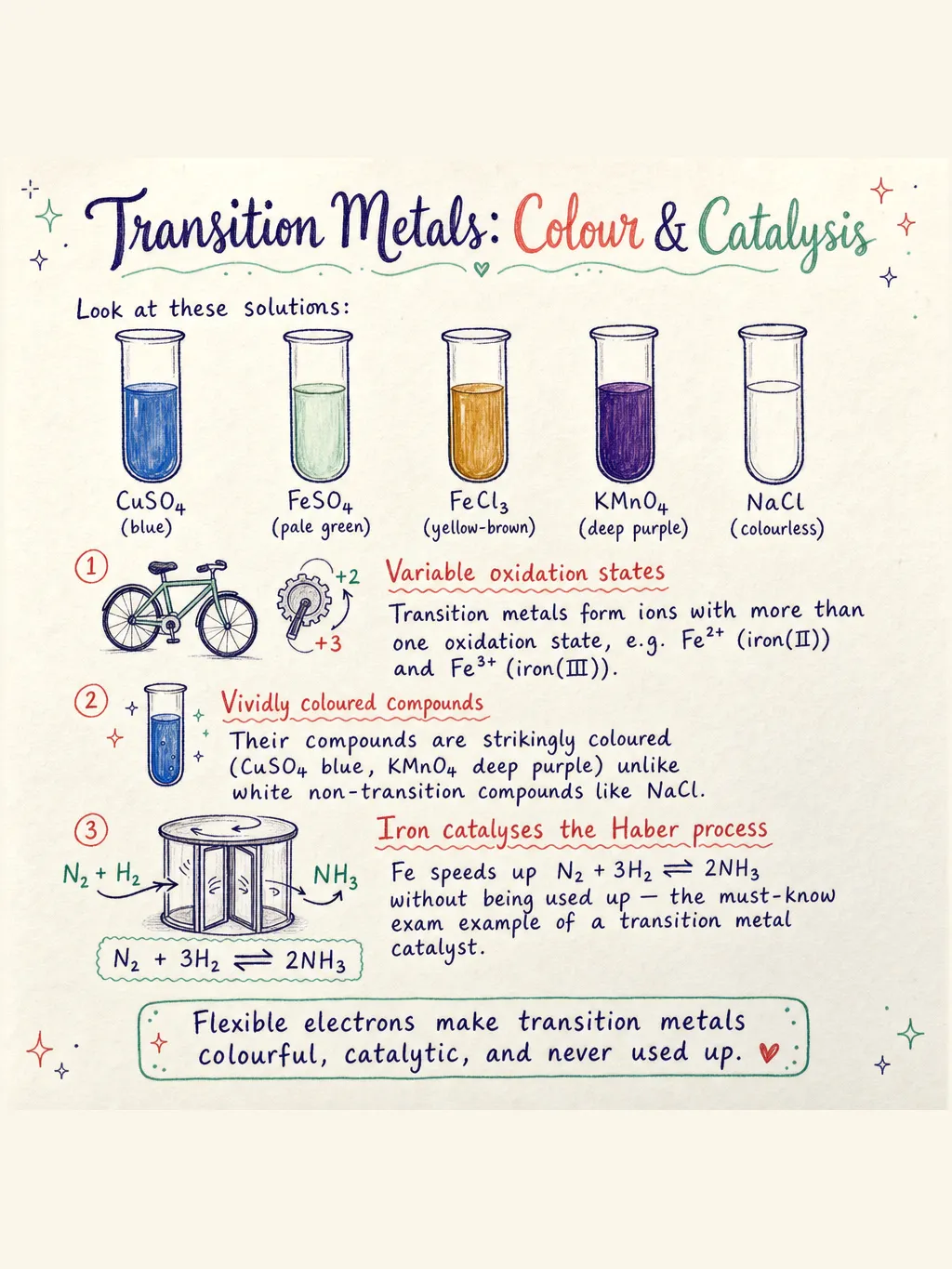
A transition metal's oxidation state isn't something you have to memorise compound by compound — you can work it out from the formula alone, using a handful of oxidation numbers you already know.
Working Out an Oxidation State From a Formula
Every atom in a neutral compound carries an oxidation number, and across the whole formula those numbers must add up to zero (for a charged ion, they add up to the ion's charge instead). Several elements keep a fixed oxidation number almost everywhere: Group 1 metals sit at +1, Group 2 metals at +2, and oxygen is almost always −2. A transition metal doesn't play along — one element can turn up with several different oxidation numbers across different compounds — so the trick is to pin down every other atom's number first, then let the transition metal be whatever value balances the total to zero.
Worked Example — Chromium in K₂Cr₂O₇
- Assign the fixed oxidation numbers: potassium (Group 1) is +1, oxygen is −2.
- Count each atom in the formula: 2 potassium, 2 chromium, 7 oxygen. Let chromium's oxidation number be x.
- The compound is neutral, so the total must equal zero: 2(+1) + 2(x) + 7(−2) = 0.
- Simplify and solve: 2 + 2x − 14 = 0, so 2x = 12, giving x = +6.
Chromium's oxidation state here is +6 — which is exactly why this compound's name carries that Roman numeral, potassium dichromate(VI).
This same balancing method works for any transition metal formula an exam question throws at you, and it's the groundwork behind the colour table, the catalyst examples and the rest of the worked problems waiting in the audio walkthrough and worksheet in the full lesson below.
Keep going — unlock the whole topic
Notes, audio and the worksheet for this topic, plus every other topic in the subject.
Claim a free seat →