Transpiration — Study Notes
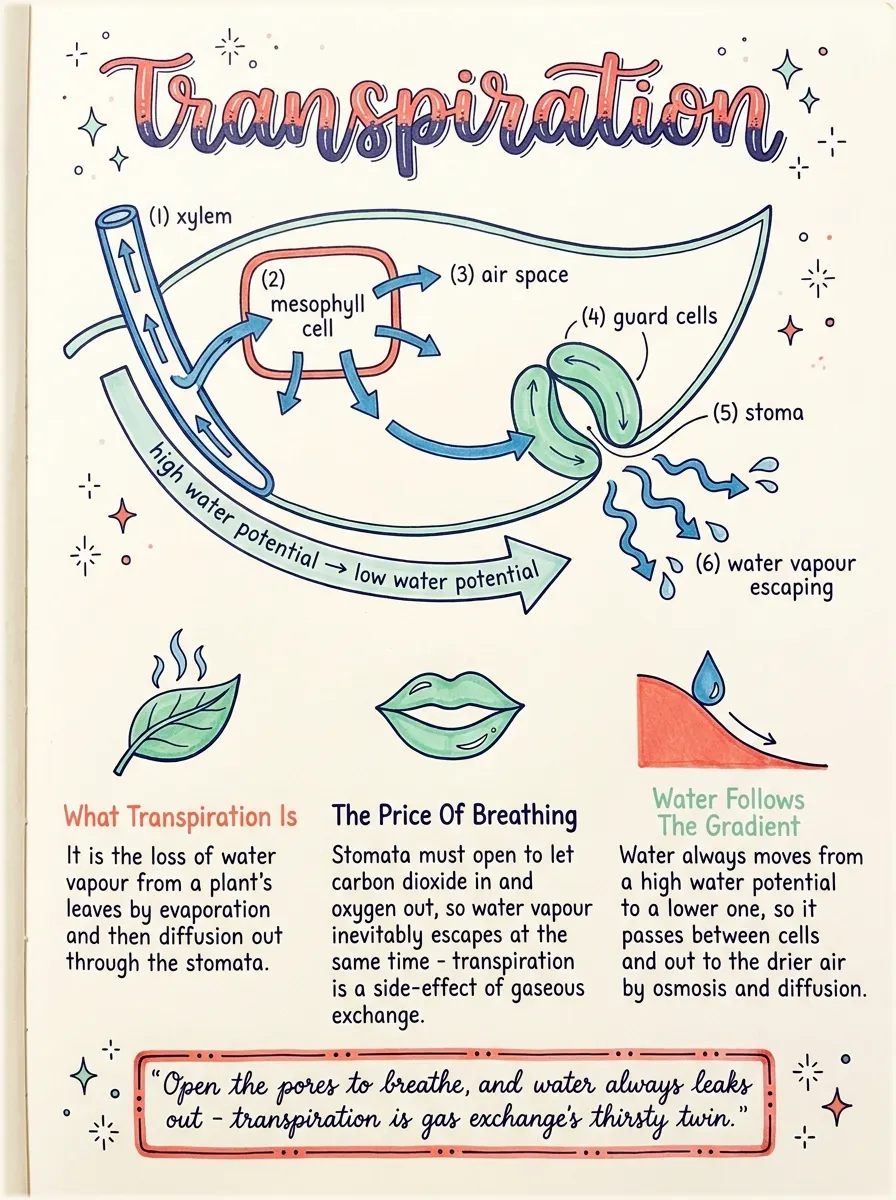
A bunch of cut flowers left on a sunny windowsill droops within an hour, yet the same bunch stays perky for days once popped in the fridge. Both scenarios come down to one process — transpiration — and grasping what's really going on inside a leaf lets you work out the answer to any exam scenario instead of memorising a list of separate facts.
Why Leaves Constantly Lose Water
A plant loses water vapour mainly through microscopic pores dotted across its leaves, and that process happens in two separate stages rather than one. Moisture sitting on the cell walls deep inside the leaf turns into vapour first — this needs no effort from the plant, since any damp surface releases molecules into unsaturated air on its own. Only afterwards does that vapour drift outward through open pores into the surrounding air, moving toward wherever vapour is less crowded.
Every exam-style factor you'll meet works by tweaking one of these two stages. Give water molecules extra energy, or keep a wide gap between how crowded the vapour is inside versus outside, and the rate climbs; do the opposite and it falls. Master that single mechanism and you can reason through a brand-new scenario instead of recalling four disconnected rules.
Worked Example — Reasoning Through Two Changes At Once
- Setup: an orchid grower raises a nursery's temperature from 19°C to 29°C and, at the same moment, turns on ceiling fans that sweep air past every leaf.
- Effect of the temperature rise: the extra warmth gives molecules on the leaf's inner surfaces more energy to escape into vapour, so that first stage speeds up.
- Effect of the fans: moving air constantly clears away the damp layer building up just outside each pore, so the gap between inside and outside stays wide instead of shrinking.
- Combine both effects: since neither one opposes the other, expect the water-loss rate to jump by more than either change would produce on its own.
The same underlying mechanism also explains humidity, wind, brightness, and how a plant can wilt in soil that's perfectly wet — plus how water gets pulled all the way up from the roots to replace what's lost. That full picture, with a listen-along audio walkthrough and a practice worksheet, is waiting in the full lesson below.
Keep going — unlock the whole topic
Notes, audio and the worksheet for this topic, plus every other topic in the subject.
Claim a free seat →