Turning Effects Of Forces — study notes
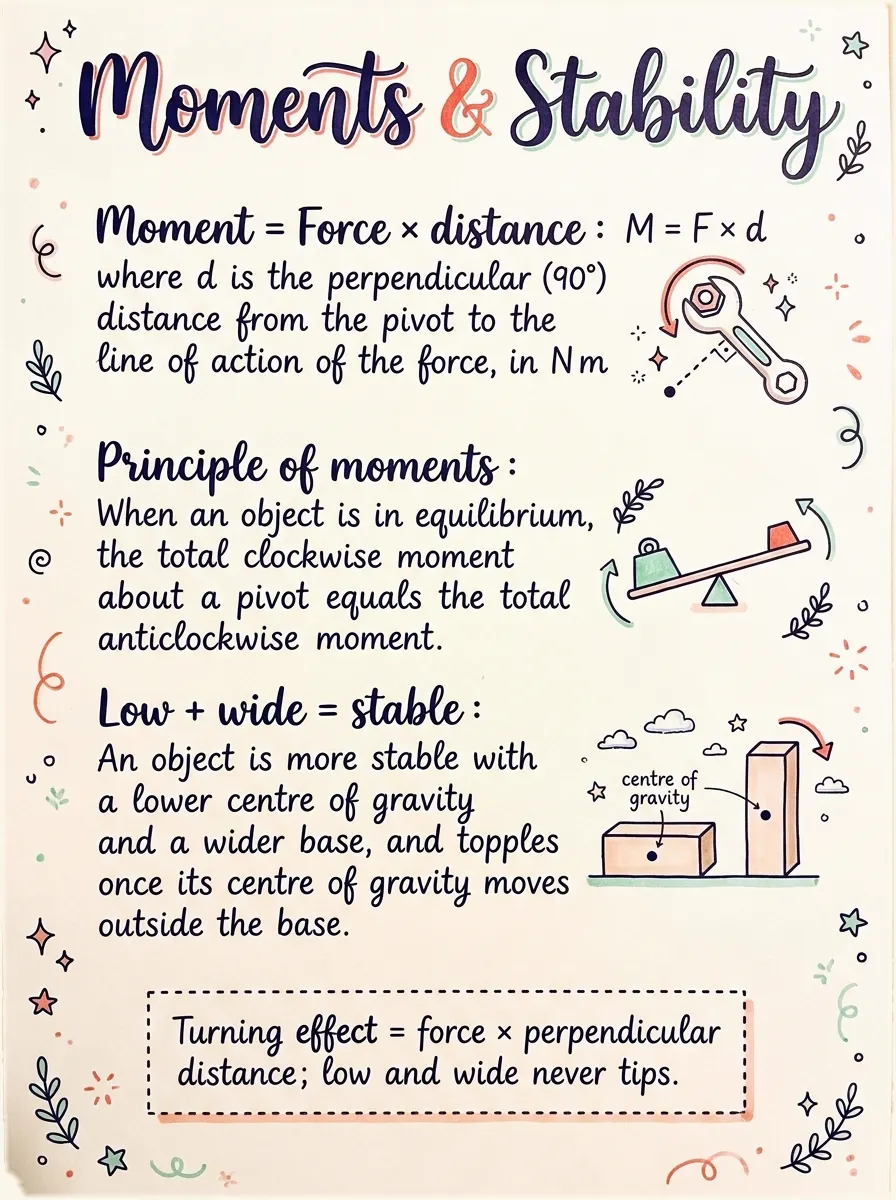
Loosen a stubborn bolt with a short stubby wrench and your hand aches before anything budges; swap in a wrench with a longer handle and the very same effort turns it with ease. Nothing about the bolt changed — only where you gripped changed — and that single idea has a name in physics: a moment.
How a Moment Is Calculated
Whenever a force acts on an object that can rotate about a fixed point, that fixed point is called the pivot. The turning effect the force produces about the pivot is its moment, and it depends on two things only: how large the force is, and how far from the pivot it acts — measured at right angles to the direction of the push, not along a slanted line to it. Combine the two by multiplying, giving the rule every O-Level question in this topic is built around:
That right-angle gap has an exam name — the perpendicular distance — and the rule is M = F × d, with M in newton-metres (N m), F in newtons (N) and d, the perpendicular distance, in metres (m).
Increase either ingredient — push harder, or push further from the pivot — and the moment grows. That's the whole reason gripping the end of a long wrench beats gripping close to the nut — the distance term has grown while the force stayed identical. Watch for questions that draw the force at a slant rather than straight along the handle: only the part of the distance that meets the force at 90° counts, so a slanted arrow is a signal to find that perpendicular distance first, not to plug in the handle's full length.
Worked Example — Turning a Stiff Tap
- A plumber grips a tap handle 0.2 m from its centre and pushes at right angles to the handle with a force of 45 N. Start by writing the rule before touching any numbers: M = F × d.
- Substitute the values straight from the question, units included: M = 45 N × 0.2 m.
- Multiply, keeping the unit that a force-times-distance quantity demands: M = 9 N m.
Every mark in a moments question comes from exactly this sequence — formula, substitution, answer with the right unit — so a slower, written-out method scores just as well as a fast one, and recovers more marks when a number goes wrong.
The full lesson below builds on this with the principle of moments for balanced objects, how to locate an object's centre of gravity, and why a low, wide base resists toppling — plus the remaining worked examples, a listen-along audio walkthrough and a worksheet to practise every step yourself.
Keep going — unlock the whole topic
Notes, audio and the worksheet for this topic, plus every other topic in the subject.
Claim a free seat →