Variation — Study Notes
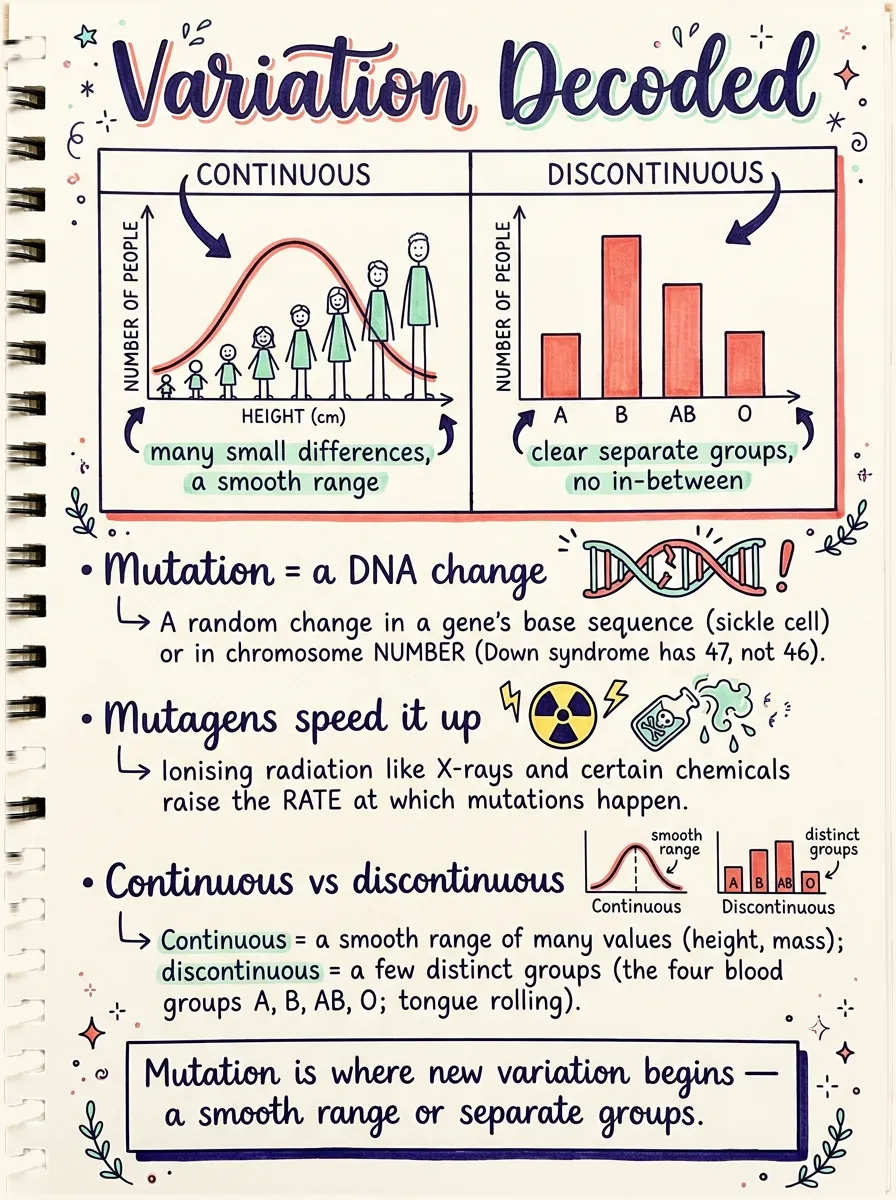
Every organism in a species looks a little different from the next, but the differences don't all behave the same way once you try to measure them. Spotting which pattern a trait follows — and knowing whether the cause is genes alone or genes plus surroundings — is the skill hiding behind almost every exam question on this topic.
Two Very Different Patterns of Difference
A trait is continuous when it can land anywhere along an unbroken scale, with every value between two extremes technically achievable — picture measuring a row of plants and never once hitting a gap in the readings. Because so many separate genes usually contribute a small nudge each toward a trait like this, and outside factors such as diet or sunlight can shift the outcome further still, continuous traits end up shaped by genes working alongside the surroundings an organism grows up in.
A trait is discontinuous when individuals sort cleanly into a handful of fixed groups, with nothing valid sitting in the gaps between them — no organism can land halfway between one category and the next. These traits usually trace back to a single gene, or a tiny number of genes, with only a limited set of possible outcomes, so surroundings have almost no power to move an individual out of whatever category its genotype already assigned it.
To sort an unfamiliar trait fast, ask one question: is a reading strictly between two categories physically achievable? A "yes" points to continuous; a "no" points to discontinuous.
Worked Example — Classifying shell colour in snails
- A student surveys forty garden snails from one hedge and records shell colour as either brown, pink, or yellow — no snail shows a blend of two colours. Apply the sorting question: could a shell sit halfway between brown and pink?
- No — every shell in the sample matches exactly one of the three named colours, with no intermediate shade recorded anywhere in the survey.
- Because the readings fall into a small number of fixed, separate groups rather than a smooth spread, shell colour here is discontinuous — and since it sorts so cleanly with nothing shading between the groups, the underlying cause is almost certainly a single gene rather than growing conditions such as diet or sunlight.
The full lesson below builds on this test — walking through where brand-new genetic differences actually come from, how a change confined to one gene compares with a change in the total chromosome count, plus a listen-along audio walkthrough and a practice worksheet.
Keep going — unlock the whole topic
Notes, audio and the worksheet for this topic, plus every other topic in the subject.
Claim a free seat →