Differentiation and Integration — Study Notes
Differentiation and Integration
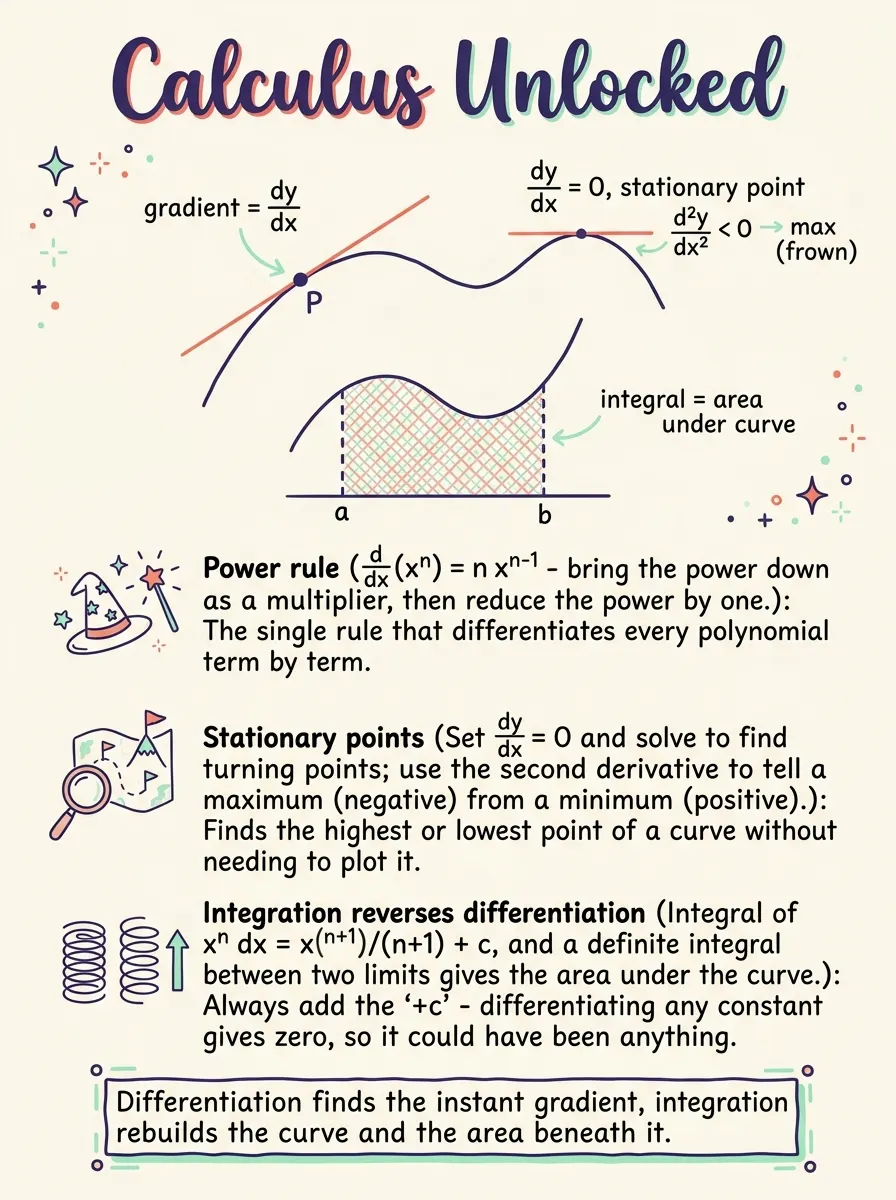
Look at a car's speedometer. At any instant it shows one number — how fast the car is going right now, not its average speed for the whole trip. Differentiation is the maths tool that finds that "right now" number for any curve: the rate at which one quantity is changing at a single point. Integration does the reverse job — it rebuilds the original quantity from its rate of change, and along the way it also measures the area under a curve. Together they are the two halves of calculus, and they are exact opposites of each other.
What a derivative actually means
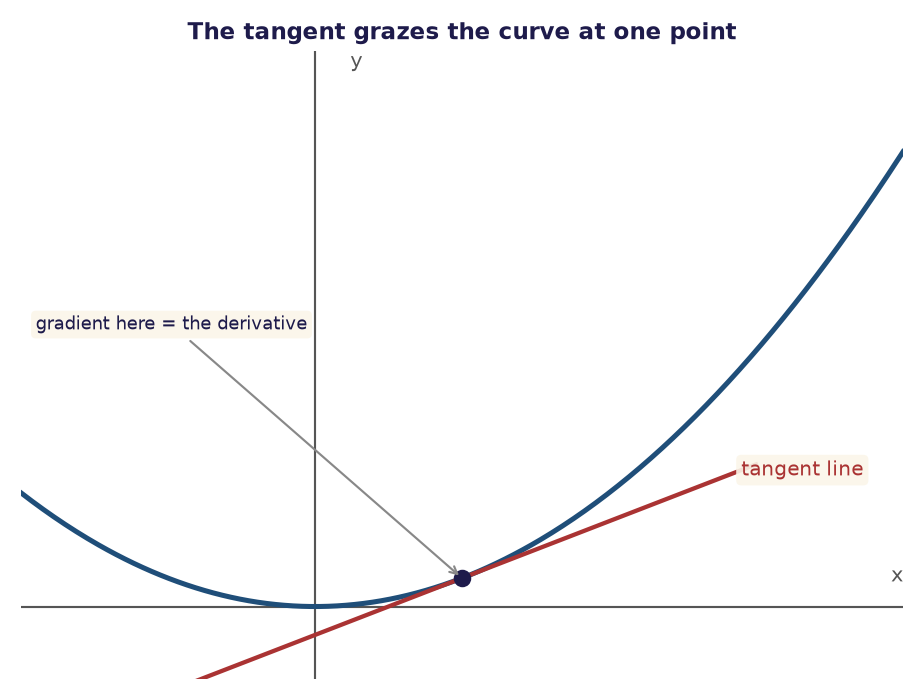
Picture the graph of a curve. At any point on it you can draw a straight line that just grazes the curve there, touching it at that one point without crossing through it, in the usual case — the tangent. The derivative of the curve at that point is simply the gradient (steepness) of that tangent line.
- A steep tangent → the curve is changing quickly at that point.
- A flat tangent → the curve is barely changing there.
That is also why a derivative is called a rate of change: if $y$ is distance and $x$ is time, the derivative tells you speed. If $y$ is temperature and $x$ is time, the derivative tells you how fast something is heating up or cooling down.
Notation. We write the derivative of $y$ — its rate of change as $x$ varies — as $\frac{dy}{dx}$ — read "d y by d x". If the curve is written as a function $f(x)$, the derivative is $f'(x)$, said "f dash x". Doing it a second time — differentiating the derivative itself — gives the second derivative, written $\frac{d^2y}{dx^2}$ or $f''(x)$. It tells you how the gradient itself is changing (whether the curve is bending upward like a smile or downward like a frown) — you'll use that fact soon, to tell a maximum turning point from a minimum without needing to look at a picture.
Your turn. Two points, $P$ and $Q$, sit on the same curve. The tangent at $P$ is steep and sloping upward left-to-right; the tangent at $Q$ is nearly flat. At which point is the derivative larger, and is it positive or negative at $P$? Hint (only if stuck): "larger" here means further from zero — a steep upward slope is a large positive number, a flat slope is close to zero.
Answer - have a real go first. The derivative is larger (further from zero) at $P$, and it is positive there, because an upward-sloping tangent means $y$ is increasing as $x$ increases. A common mix-up is treating "steep" and "large positive" as unrelated ideas — but steepness is the size of the derivative, and the direction of the slope (up or down) is its sign.
The power rule
Straight lines are the one curve you can already differentiate without any new rule: $y = mx + c$ has gradient $m$ everywhere, because a straight line's steepness never changes. The power rule is what lets you find the gradient at any point of a curved graph, not just a straight one — and every term of the form $x^n$ obeys it:
$$\frac{d}{dx}\left(x^n\right) = n x^{n-1}$$
In words: bring the power down in front as a multiplier, then reduce the power by one. Check it agrees with what you already know: for a plain $x$ (that is, $x^1$), the rule gives $1 \times x^0 = 1$ — matching the fact that $y = x$ is a straight line with gradient $1$. It works term by term, so a sum of powers of $x$ is differentiated one term at a time, and any constant multiplier just carries along for the ride. (A lone constant number has gradient zero — it's a flat, horizontal line, so it disappears entirely. A very common slip is to leave a constant unchanged instead of turning it into $0$ — a constant is not "$x^0$ times itself", it's already the whole term, and it has no steepness at all.)
Worked example 1. Differentiate $y = x^3 - 4x + 1$.
- $x^3 \to 3x^2$: power rule with $n=3$ — bring the $3$ down, reduce the power to $2$.
- $-4x \to -4$: here $n=1$, so $-4x^1 \to 1\times(-4)x^0 = -4$; the power rule still applies, it's just easy to forget that a bare $x$ is secretly $x^1$.
- $1 \to 0$: a constant has zero gradient, as explained above.
$$\frac{dy}{dx} = 3x^2 - 4$$
Your turn. Differentiate $y = x^4 - 5x + 7$. Hint (only if stuck): apply the power rule to each term on its own, and remember what a lone constant differentiates to.
Answer - have a real go first. $\dfrac{dy}{dx} = 4x^3 - 5$. Each term follows the power rule on its own — $x^4 \to 4x^3$, $-5x \to -5$ — and the constant $7$ vanishes to $0$. The usual slip is dragging the $+7$ into the answer as if it survives differentiation (writing "$4x^3 - 5 + 7$"); a constant term never appears in the derivative at all.
Powers in disguise: negative and fractional indices
Exam questions rarely stay in the tidy $x^n$ form you've just practised — they hide powers inside fractions and roots instead, like $\dfrac{4}{x^2}$ or $\sqrt{x}$. The power rule still works on these, because any index $n$ is allowed — negative, fractional, whatever — as long as you first rewrite the expression as $x^n$ before differentiating. Two rewriting facts you already know from indices work the trick:
$$\frac{1}{x^n} = x^{-n} \qquad\qquad \sqrt[k]{x^m} = x^{m/k}$$
So $\dfrac{1}{x^2} = x^{-2}$, and $\sqrt{x} = x^{1/2}$.
Worked example 2. Differentiate $y = \dfrac{4}{x^2} + \sqrt{x}$.
Rewrite each term as a power of $x$ first:
$$y = 4x^{-2} + x^{1/2}$$
Now the power rule applies exactly as before — bring the power down, reduce it by one:
$$\frac{dy}{dx} = 4\times(-2)x^{-3} + \tfrac{1}{2}x^{-1/2} = -8x^{-3} + \tfrac{1}{2}x^{-1/2}$$
Written back in root/fraction form, that's $\dfrac{dy}{dx} = -\dfrac{8}{x^3} + \dfrac{1}{2\sqrt{x}}$. Notice the negative power's own power drops by one further into the negatives ($-2 \to -3$, not $-2 \to -1$) — reducing by $1$ still means subtracting $1$, even when you're already negative.
Your turn. Differentiate $y = \dfrac{3}{x} - 2\sqrt{x}$. Hint (only if stuck): rewrite as $3x^{-1} - 2x^{1/2}$ first, then apply the power rule term by term.
Answer - have a real go first. $\dfrac{dy}{dx} = -3x^{-2} - x^{-1/2}$, which is $-\dfrac{3}{x^2} - \dfrac{1}{\sqrt x}$. Each rewritten term follows the ordinary power rule. The usual slip is trying to differentiate $\dfrac{3}{x}$ or $\sqrt{x}$ directly without rewriting first, which leaves you with nowhere to apply the rule — always convert fractions and roots into index form before you touch the power rule.
Stationary points: where the curve turns
A stationary point is a point where the curve momentarily stops rising or falling — the tangent there is flat, so its gradient is zero. Since the derivative is the gradient (the idea from the very first section), finding a stationary point is just solving $\frac{dy}{dx} = 0$: differentiate, then set the result equal to zero and solve.
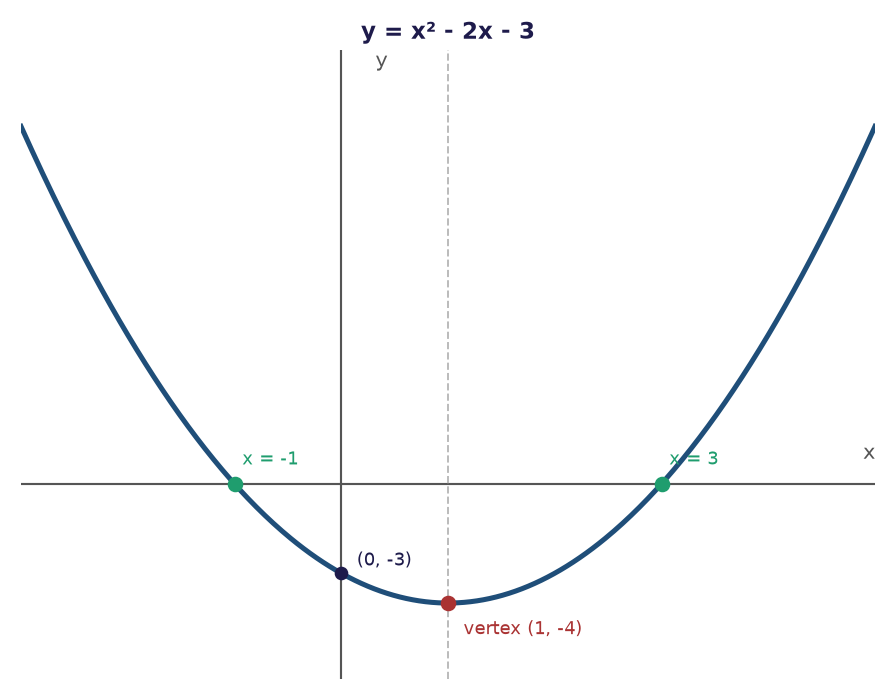
The parabola above has exactly one stationary point — its vertex — at $(1, -4)$, and because it opens upward that point is a minimum turning point. A more complicated curve can have several stationary points, and each one needs classifying separately as a maximum, a minimum, or a stationary point of inflexion — a rarer case where the curve flattens for an instant but keeps going the same way, and where, unusually, the tangent actually crosses the curve rather than just touching it. You'll rarely need to identify one of these at this stage; the two turning-point cases below cover almost everything you'll meet.
Worked example 3. Find the stationary points of $y = x^3 - 3x^2 - 9x + 5$.
- Differentiate: $\frac{dy}{dx} = 3x^2 - 6x - 9$.
- Set it to zero (that's what "stationary" means) and simplify by dividing through by $3$: $3x^2 - 6x - 9 = 0 \;\Rightarrow\; x^2 - 2x - 3 = 0$.
- Factorise: $(x-3)(x+1) = 0$, so $x = 3$ or $x = -1$ — a product is zero only when one of its factors is zero.
Substituting each $x$ back into the original $y$ (not the derivative) gives the points $(3, -22)$ and $(-1, 10)$.
Your turn. Find the $x$-coordinate(s) of the stationary point(s) of $y = x^2 - 4x + 1$. Hint (only if stuck): differentiate, set the result to zero, and solve the resulting linear equation.
Answer - have a real go first. $\dfrac{dy}{dx} = 2x - 4$; setting this to zero gives $2x-4=0$, so $x=2$. That's the one place the tangent is flat because the derivative — the gradient — equals zero there and nowhere else on this parabola. A common slip is stopping at the derivative $2x-4$ and calling that "the stationary point" — the stationary point is a value of $x$ (and $y$), not the derivative expression itself.
Classifying them — the second-derivative test. Knowing where the curve is flat isn't the whole story — an exam question almost always also wants to know whether it's a peak or a trough. Differentiate a second time: $\frac{d^2y}{dx^2} = 6x - 6$ (for the cubic above). Recall from the very first section that the second derivative tells you how the gradient itself is changing — smile-shaped curving means a minimum, frown-shaped curving means a maximum.
- At $x = 3$: $\frac{d^2y}{dx^2} = 12 > 0$ → this is a minimum turning point.
- At $x = -1$: $\frac{d^2y}{dx^2} = -12 < 0$ → this is a maximum turning point.
Rule of thumb: positive second derivative means the curve is curving upward like a smile (minimum); negative means it's curving downward like a frown (maximum).
Your turn. The curve $y = x^3 - 12x$ has a stationary point at $x = 2$. Is it a maximum or a minimum? Hint (only if stuck): find $\frac{d^2y}{dx^2}$ and check its sign at $x=2$.
Answer - have a real go first. $\dfrac{dy}{dx} = 3x^2-12$, so $\dfrac{d^2y}{dx^2}=6x$; at $x=2$ this is $12>0$, so it's a minimum. The usual slip is testing the sign of the first derivative's value (which is $0$ by definition at a stationary point, so it tells you nothing about max/min) instead of the second derivative — only the second derivative's sign classifies the point.
Tangents and normals
Because the derivative is the gradient of the tangent, once you know $\frac{dy}{dx}$ at a point you already have everything you need to write the tangent's equation — you're just plugging that gradient into the point-gradient line formula you already know, $y - y_1 = m(x - x_1)$.
Worked example 4. Find the equations of the tangent and the normal to $y = x^2 - 3x + 2$ at $x = 2$.
First, the gradient function:
$$\frac{dy}{dx} = 2x - 3$$
At $x = 2$: the gradient is $2(2) - 3 = 1$, and the point on the curve is $(2, 0)$ (check: $2^2 - 3(2) + 2 = 0$). So the tangent has gradient $1$ through $(2, 0)$:
$$y - 0 = 1(x - 2) \quad\Rightarrow\quad y = x - 2$$
The normal is the line perpendicular to the tangent at the same point. Perpendicular gradients multiply to $-1$ — a fact you already know from coordinate geometry — so the normal's gradient is $-\frac{1}{1} = -1$, giving $y = -x + 2$.
Your turn. Find the equations of the tangent and the normal to $y = x^2 + 2x$ at $x = 1$. Hint (only if stuck): differentiate to get the gradient at $x=1$, find the point on the curve, then use $y-y_1=m(x-x_1)$ for the tangent and gradient $-\frac1m$ for the normal.
Answer - have a real go first. $\dfrac{dy}{dx}=2x+2$, so at $x=1$ the gradient is $4$ and the point is $(1,3)$. Tangent: $y-3=4(x-1) \Rightarrow y=4x-1$. Normal: gradient $-\frac14$, so $y-3=-\frac14(x-1) \Rightarrow y=-\frac14x+\frac{13}{4}$. The usual slip is using the curve's gradient ($4$) for the normal instead of flipping and negating it to $-\frac14$ — the normal is perpendicular, not parallel, to the tangent.
Differentiating sin, cos and $e^x$ (the short list)
Not every curve is built from powers of $x$. Something that swings back and forth, like the height of a seat on a Ferris wheel over time, needs a different short list of results — still examinable, still worth knowing by heart, since (unlike the power rule) there's no way to derive them on the spot:
$$\frac{d}{dx}(\sin x) = \cos x \qquad \frac{d}{dx}(\cos x) = -\sin x \qquad \frac{d}{dx}\left(e^x\right) = e^x$$
(The sine and cosine results hold when $x$ is measured in radians — the standard unit for calculus, not degrees; using degrees here silently gives a wrong gradient, so if a question doesn't say otherwise, assume radians. The $e^x$ result needs no such condition, since there $x$ is just a number.)
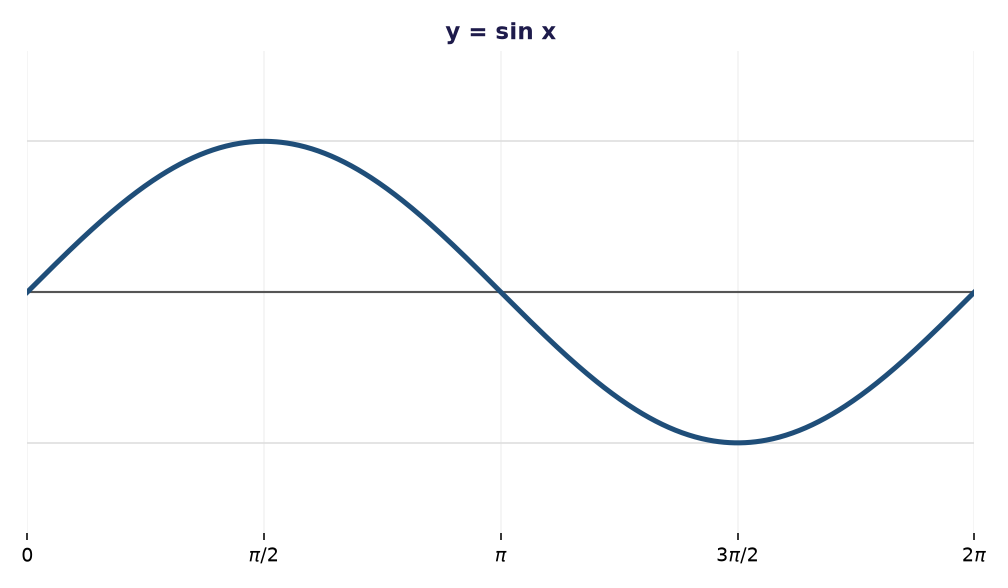
Quick check. At $x = 0$: the gradient of $\sin x$ is $\cos 0 = 1$. That matches the picture below — right at the origin the sine curve is climbing as steeply as it ever does.
Notice $e^x$ is its own derivative — differentiate it as many times as you like and it never changes. That's what makes the exponential function special.
Your turn. Differentiate $y = 3\sin x - 2\cos x + e^x$. Hint (only if stuck): apply each of the three standard results term by term, and watch the sign on the cosine term carefully.
Answer - have a real go first. $\dfrac{dy}{dx} = 3\cos x + 2\sin x + e^x$. The $-2\cos x$ term differentiates to $-2\times(-\sin x) = +2\sin x$ — two minus signs make a plus. The usual slip is stopping at "$-2\sin x$", forgetting that $\cos x$'s own derivative already carries a minus sign that then combines with the $-2$ out front.
Integration: running differentiation backward
Sometimes you're handed the rate something is changing at and asked to rebuild the original quantity — knowing a car's speed at every instant and wanting its position, say. Integration is exactly that: differentiation run backwards. Worked example 1 showed that differentiating $x^3 - 4x + 1$ gives $3x^2 - 4$ — so integrating $3x^2 - 4$ should hand you back $x^3 - 4x$.
Worked example 5 — reversing worked example 1.
$$\int \left(3x^2 - 4\right)\,dx = x^3 - 4x + c$$
There is one thing to add: differentiating any constant gives zero, so when we integrate we can never be sure which constant was there originally — $x^3-4x$, $x^3-4x+1$, and $x^3-4x+100$ all differentiate to the same $3x^2-4$. We show that uncertainty with a "$+c$", the constant of integration — it is easy to forget, so it is worth saying out loud every time you integrate, and an exam answer missing it loses marks even if everything else is right.
The power rule runs in reverse too:
$$\int x^n \, dx = \frac{x^{n+1}}{n+1} + c \qquad (n \neq -1)$$
In words: raise the power by one, then divide by the new power (not the old one — a common slip is dividing by $n$ instead of $n+1$).
Worked example 6. Integrate $2x + 1$.
- $2x \to \dfrac{2x^2}{2} = x^2$: raise the power from $1$ to $2$, divide by the new power $2$.
- $1$, thought of as $x^0$, $\to \dfrac{x^1}{1} = x$: raise the power from $0$ to $1$, divide by $1$.
$$\int (2x + 1)\, dx = x^2 + x + c$$
Your turn. Integrate $\int (4x-3)\,dx$. Hint (only if stuck): apply the reversed power rule to each term, and don't forget the $+c$.
Answer - have a real go first. $\int(4x-3)\,dx = 2x^2 - 3x + c$. $4x=4x^1$ raises to $4\cdot\frac{x^2}{2}=2x^2$, and $-3$ (as $-3x^0$) raises to $-3x$. The usual slip is dropping the $+c$ once the "main" terms look finished — every indefinite integral needs it, with no exceptions.
Rewriting before you integrate: negative and fractional powers
Exactly like differentiation, integration needs the same rewriting trick when the integrand is a fraction or a root instead of a plain power of $x$: convert $\frac{1}{x^n}$ or $\sqrt[k]{x^m}$ into $x^n$-form first, then apply the reversed power rule.
Worked example 7. Integrate $\int \left(\dfrac{1}{x^3} + \sqrt{x}\right) dx$.
Rewrite first:
$$\int \left(x^{-3} + x^{1/2}\right) dx$$
Raise each power by one and divide by the new power:
$$= \frac{x^{-2}}{-2} + \frac{x^{3/2}}{3/2} + c = -\frac{1}{2x^2} + \frac{2}{3}x^{3/2} + c$$
Your turn. Integrate $\int \left(\dfrac{2}{x^2} - \sqrt{x}\right) dx$. Hint (only if stuck): rewrite as $2x^{-2} - x^{1/2}$ first, then raise each power by one and divide by the new power.
Answer - have a real go first. $\int(2x^{-2}-x^{1/2})\,dx = -2x^{-1} - \frac23x^{3/2} + c$, which is $-\dfrac{2}{x} - \dfrac{2}{3}\sqrt{x^3} + c$. Dividing by the new power $-1$ turns $2x^{-2}$'s coefficient $2$ into $-2$ — the usual slip is forgetting that dividing a positive by a negative power flips the sign, and writing "$+2x^{-1}$" instead.
The definite integral: area under a curve
A definite integral has limits — a start value and an end value for $x$ — and it gives a number: the area trapped between the curve and the $x$-axis over that stretch. Find the antiderivative, then substitute in the top limit and subtract the value at the bottom limit.
$$\int_a^b f(x)\, dx = \Big[F(x)\Big]_a^b = F(b) - F(a)$$
Worked example 8. Evaluate $\displaystyle\int_1^3 (2x+1)\, dx$, the area under $y = 2x+1$ between $x=1$ and $x=3$.
Using the antiderivative from worked example 6, $F(x) = x^2 + x$:
$$F(3) - F(1) = (3^2 + 3) - (1^2 + 1) = 12 - 2 = 10$$
So the area is $10$ square units, and here that's the whole story: $y=2x+1$ stays above the $x$-axis for the entire stretch from $x=1$ to $x=3$, so one subtraction gives the true area directly.
The exam trap: when the curve crosses the axis. That single-subtraction shortcut only works while the curve stays on one side of the $x$-axis throughout $[a,b]$. If it crosses the axis somewhere inside the interval, the positive area above and the negative "area" below partially cancel out when you integrate straight across — so the number you get is not the true shaded area. Watch it fail: for $y=x$ over $[-1,1]$, $\int_{-1}^{1} x\,dx = \left[\frac{x^2}{2}\right]_{-1}^{1} = \frac12-\frac12=0$, even though there's plainly a triangle of area above the axis and an equal one below it — they haven't vanished, they've just cancelled in the sum. The fix: find where the curve crosses zero, split the integral there, and take the size (ignore the sign) of each piece separately before adding them.
Your turn. Evaluate $\int_0^3 (x-1)\,dx$ directly using $F(x)=\frac{x^2}{2}-x$. Then say whether that number equals the true shaded area between $y=x-1$ and the $x$-axis on $[0,3]$. Hint (only if stuck): check whether $y=x-1$ crosses zero somewhere inside $[0,3]$.
Answer - have a real go first. $F(3)-F(0) = (4.5-3)-0 = 1.5$ — but this is not the true shaded area, because $y=x-1$ crosses zero at $x=1$, inside the interval. Splitting: $|F(1)-F(0)|=|-0.5|=0.5$ and $|F(3)-F(1)|=|1.5-(-0.5)|=2.0$, giving a true area of $0.5+2.0=2.5$ square units. The usual slip is reporting the direct answer, $1.5$, as "the area" without first checking for a sign change — the direct integral only equals the true area when the curve doesn't cross the axis.
Kinematics: displacement, velocity, acceleration
Differentiation and integration link the three quantities that describe a particle travelling along a straight line — displacement, velocity and acceleration are each the derivative of the one before it:
- Differentiate displacement $s$ to get velocity: $v = \frac{ds}{dt}$.
- Differentiate velocity $v$ to get acceleration: $a = \frac{dv}{dt}$.
- Going the other way, integrate acceleration to recover velocity, and velocity to recover displacement.
Worked example 9. A particle's displacement is $s = t^3 - 6t^2 + 9t$. Find its velocity function.
$$v = \frac{ds}{dt} = 3t^2 - 12t + 9$$
Differentiate once more and you'd get the acceleration, $a = \frac{dv}{dt} = 6t - 12$. Go the other way — integrate acceleration to get velocity, integrate velocity to get displacement — and you're using worked examples 5 and 6's idea, just with $t$ in place of $x$.
The exam catch: integrating loses the constant, so a condition must pin it back down. Because integrating always leaves a "$+c$" behind, integrating acceleration to find velocity (or velocity to find displacement) only gives you the shape of the function — you need one known value, at one known time, to nail down exactly which constant applies to this particular particle.
Worked example 10. A particle has acceleration $a = 6t - 4$. Given that $v = 3$ when $t = 0$, find $v$ in terms of $t$.
Integrate the acceleration:
$$v = \int (6t-4)\,dt = 3t^2 - 4t + c$$
Now use the given condition to find $c$: substitute $t=0, v=3$.
$$3 = 3(0)^2 - 4(0) + c \;\Rightarrow\; c = 3$$
$$v = 3t^2 - 4t + 3$$
Your turn. A particle has acceleration $a = 4t + 2$. Given that $v=5$ when $t=0$, find $v$ in terms of $t$. Hint (only if stuck): integrate first, then substitute the given $t$ and $v$ values to solve for $c$.
Answer - have a real go first. $v=\int(4t+2)\,dt = 2t^2+2t+c$; substituting $t=0,v=5$ gives $c=5$, so $v=2t^2+2t+5$. The usual slip is leaving "$+c$" unresolved in the final answer, or forgetting the condition was ever given — every integrated velocity or displacement in a kinematics question needs its constant pinned down by a stated condition, exactly like solving for the unknown in an equation.
The chain rule: differentiating a function inside a function
A composite function is one function wrapped inside another — a "function of a function". Examples: $(2x+3)^5$ (something raised to a power, where the "something" is itself an expression), or $\sin(3x)$, or $e^{x^2}$. Trying to use the power rule directly on $(2x+3)^5$ would ignore the $2x+3$ inside, and that inside part changes at its own rate. The chain rule accounts for both layers.
If $y$ is a function of $u$, and $u$ is a function of $x$, then
$$\frac{dy}{dx} = \frac{dy}{du} \times \frac{du}{dx}$$
The practical recipe most students find easiest: differentiate the outer function (leaving the inside untouched), then multiply by the derivative of the inside. People call the second part the "$\times$ derivative of the inside" step, and forgetting it is the single most common slip in the whole topic. (If the "inside" is just plain $x$ — like $x^5$ on its own — its derivative is $1$, so multiplying by it changes nothing; that's why the ordinary power rule is really just the chain rule in its simplest, invisible case.)
Worked example 11. Differentiate $y = (2x + 3)^5$.
Name the inside: $u = 2x + 3$, so $y = u^5$.
- Outer: $\dfrac{dy}{du} = 5u^4 = 5(2x+3)^4$ (power rule on $u^5$, inside left as it is).
- Inside: $\dfrac{du}{dx} = 2$.
Multiply — this is what the chain rule says you must always do, not an optional extra:
$$\frac{dy}{dx} = 5(2x+3)^4 \times 2 = 10(2x+3)^4$$
Your turn. Differentiate $y = (3x-2)^4$. Hint (only if stuck): name the inside $u=3x-2$, differentiate the outer power leaving the inside untouched, then multiply by $\frac{du}{dx}$.
Answer - have a real go first. $\dfrac{dy}{dx} = 4(3x-2)^3 \times 3 = 12(3x-2)^3$. The outer power rule gives $4(3x-2)^3$; the inside's derivative, $3$, multiplies on. The usual slip is stopping at $4(3x-2)^3$ and forgetting the $\times 3$ — that missing factor is exactly the "derivative of the inside" step the chain rule exists for.
Negative and fractional powers need the chain rule too — and the same rewriting trick from before. Something like $\dfrac{1}{(2x+3)^3}$ or $\sqrt{5x-1}$ is still a composite function; rewrite it as a power first, exactly as you did for plain $x$, then apply the chain rule as usual.
Worked example 12. Differentiate $y = \sqrt{5x-1}$.
Rewrite as a power: $y = (5x-1)^{1/2}$. Name the inside: $u = 5x-1$.
- Outer: $\dfrac{dy}{du} = \tfrac12 u^{-1/2} = \tfrac12(5x-1)^{-1/2}$.
- Inside: $\dfrac{du}{dx} = 5$.
$$\frac{dy}{dx} = \tfrac12(5x-1)^{-1/2}\times 5 = \frac{5}{2\sqrt{5x-1}}$$
Your turn. Differentiate $y = (4x+1)^{-2}$. Hint (only if stuck): treat the $-2$ exactly like a positive power — bring it down, reduce by one — then multiply by the derivative of the inside.
Answer - have a real go first. $\dfrac{dy}{dx} = -2(4x+1)^{-3}\times 4 = -8(4x+1)^{-3}$, i.e. $-\dfrac{8}{(4x+1)^3}$. The outer power rule on a negative index works exactly as it did for differentiation earlier ($-2\to-3$), then the chain rule's $\times$(derivative of inside) step still applies. The usual slip is trying to differentiate $\sqrt{\,}$ or a negative-power fraction directly without rewriting it as $(\ldots)^n$ first — always rewrite before you differentiate.
Trig functions get the same treatment when the angle itself is an expression in $x$.
Worked example 13. Differentiate $y = \sin(3x)$.
The inside is $3x$, whose derivative is $3$. Differentiate the outer $\sin$ to $\cos$, keep the inside, then multiply by that $3$:
$$\frac{dy}{dx} = \cos(3x) \times 3 = 3\cos(3x)$$
Your turn. Differentiate $y = \cos(4x)$. Hint (only if stuck): differentiate the outer $\cos$ to $-\sin$, keep the inside untouched, then multiply by the derivative of the inside.
Answer - have a real go first. $\dfrac{dy}{dx} = -\sin(4x)\times4 = -4\sin(4x)$. The outer derivative of $\cos$ carries its own minus sign; forgetting it (writing $4\sin(4x)$) is the usual slip, alongside the separate slip of forgetting to multiply by $4$ at all.
The product rule: differentiating one function times another
The power rule alone cannot handle something like $y = x^2 \sin x$, because that is two functions multiplied together — a power of $x$ times a trig function. A common wrong instinct is to differentiate each part separately and multiply the answers. That does not work. Instead we use the product rule. Intuitively: if both factors are changing at the same time, the product's total rate of change has two contributions — one from each factor changing while the other is momentarily held fixed — which is why the rule below has two terms, one for each factor's own rate.
If $y = u\,v$, where $u$ and $v$ are both functions of $x$, then
$$\frac{dy}{dx} = u\,\frac{dv}{dx} + v\,\frac{du}{dx}$$
In words: (first) times (derivative of the second), plus (second) times (derivative of the first). Say that rhythm out loud a few times — it is the whole rule.
Worked example 14. Differentiate $y = x^2 \sin x$.
Split it into the two factors and differentiate each on its own:
- $u = x^2 \;\Rightarrow\; \dfrac{du}{dx} = 2x$
- $v = \sin x \;\Rightarrow\; \dfrac{dv}{dx} = \cos x$
Now slot them into the rule:
$$\frac{dy}{dx} = u\frac{dv}{dx} + v\frac{du}{dx} = x^2 \cos x + \sin x \,(2x)$$
$$\frac{dy}{dx} = x^2 \cos x + 2x \sin x$$
There is usually nothing more to simplify — an answer in two clear terms is the finished answer.
Your turn. Differentiate $y = x^3 \cos x$. Hint (only if stuck): identify $u$ and $v$, differentiate each separately, then apply "(first) $\times$ (derivative of second) + (second) $\times$ (derivative of first)".
Answer - have a real go first. With $u=x^3$ ($\frac{du}{dx}=3x^2$) and $v=\cos x$ ($\frac{dv}{dx}=-\sin x$): $\dfrac{dy}{dx} = x^3(-\sin x) + \cos x(3x^2) = -x^3\sin x + 3x^2\cos x$. The usual slip is dropping the minus sign that comes from differentiating $\cos x$, or swapping which term gets which factor.
When one factor is itself composite — the realistic exam case. So far $u$ and $v$ have both been simple to differentiate. Often one of them needs the chain rule you just learned.
Worked example 15. Differentiate $y = x(2x+1)^3$.
- $u = x \;\Rightarrow\; \dfrac{du}{dx} = 1$
- $v = (2x+1)^3$ is composite, so differentiate it with the chain rule: $\dfrac{dv}{dx} = 3(2x+1)^2 \times 2 = 6(2x+1)^2$
Apply the product rule:
$$\frac{dy}{dx} = x\times 6(2x+1)^2 + (2x+1)^3\times 1 = 6x(2x+1)^2 + (2x+1)^3$$
Both terms share the factor $(2x+1)^2$ — factor it out for the tidy exam-ready form:
$$\frac{dy}{dx} = (2x+1)^2\big[6x + (2x+1)\big] = (2x+1)^2(8x+1)$$
Your turn. Differentiate $y = x^2(3x-1)^4$, then factor your answer. Hint (only if stuck): $v$ needs the chain rule to differentiate; once you have both terms, look for the highest common bracket power to factor out.
Answer - have a real go first. With $u=x^2$ ($\frac{du}{dx}=2x$) and $v=(3x-1)^4$ ($\frac{dv}{dx}=12(3x-1)^3$ by the chain rule): $\dfrac{dy}{dx} = 12x^2(3x-1)^3 + 2x(3x-1)^4 = 2x(3x-1)^3\big[6x+(3x-1)\big] = 2x(3x-1)^3(9x-1)$. The usual slip is differentiating $(3x-1)^4$ as if it were a simple power of $x$, giving $4(3x-1)^3$ with no $\times 3$ — the chain rule's "derivative of the inside" step is still required even when it's happening inside a product rule.
The quotient rule: differentiating one function over another
When one function sits on top of another as a fraction — like $y = \dfrac{x}{x+1}$ — we use the quotient rule. It looks busier than the product rule, but the top follows the same "cross" pattern; the extra step is dividing by the bottom squared.
If $y = \dfrac{u}{v}$, then
$$\frac{dy}{dx} = \frac{v\,\dfrac{du}{dx} - u\,\dfrac{dv}{dx}}{v^2}$$
Two things trip people up, so guard against both:
- The order on top matters because of the minus sign. It is (bottom $\times$ derivative of top) $-$ (top $\times$ derivative of bottom) — bottom first. Swapping them flips the sign of the whole answer.
- The denominator is $v^2$, the original bottom squared — not its derivative.
Worked example 16. Differentiate $y = \dfrac{x}{x+1}$.
- $u = x \;\Rightarrow\; \dfrac{du}{dx} = 1$
- $v = x+1 \;\Rightarrow\; \dfrac{dv}{dx} = 1$
Apply the rule:
$$\frac{dy}{dx} = \frac{(x+1)(1) - (x)(1)}{(x+1)^2} = \frac{x + 1 - x}{(x+1)^2} = \frac{1}{(x+1)^2}$$
The two $x$ terms on top cancel, leaving a tidy $\dfrac{1}{(x+1)^2}$. Whenever the numerator collapses like this, it is a good sign you applied the rule correctly.
Your turn. Differentiate $y = \dfrac{x+2}{x-1}$. Hint (only if stuck): identify $u$ and $v$, then apply "(bottom $\times$ derivative of top) $-$ (top $\times$ derivative of bottom), all over bottom squared" — keep the order.
Answer - have a real go first. With $u=x+2$ ($\frac{du}{dx}=1$) and $v=x-1$ ($\frac{dv}{dx}=1$): $\dfrac{dy}{dx} = \dfrac{(x-1)(1)-(x+2)(1)}{(x-1)^2} = \dfrac{x-1-x-2}{(x-1)^2} = \dfrac{-3}{(x-1)^2}$. The usual slip is subtracting in the wrong order (top-minus-bottom instead of bottom-minus-top), which would flip the sign to $+3$ instead of $-3$.
A useful alternative, and a note on realistic exam questions. Since $\dfrac{u}{v}$ can always be rewritten as $u\,v^{-1}$, some students prefer differentiating it with the product rule and chain rule instead of memorising the quotient rule separately — both routes give the same answer, so use whichever you trust more as a check. And exactly like the product rule, quotient-rule questions often have a composite $u$ or $v$ (e.g. $(2x+1)^3$ in the numerator) — differentiate that part with the chain rule first, then slot the result into the quotient rule as normal; the two rules combine constantly in exam questions.
Increasing and decreasing intervals: reading the sign of the derivative
The derivative does more than give a single gradient — its sign tells you which way the curve is heading over a whole stretch:
- Where $\dfrac{dy}{dx} > 0$, the tangent slopes uphill, so the function is increasing (rising as $x$ grows).
- Where $\dfrac{dy}{dx} < 0$, the tangent slopes downhill, so the function is decreasing (falling as $x$ grows).
- Where $\dfrac{dy}{dx} = 0$, the curve is momentarily flat — a stationary point, the boundary between the two.
So the method is: differentiate, find where the derivative is zero (these are the borders), and then test the sign of the derivative on each side to see whether the function climbs or falls there.
Worked example 17. Find where $y = x^2 - 6x + 5$ is increasing and where it is decreasing.
Differentiate and locate the border:
$$\frac{dy}{dx} = 2x - 6 = 0 \;\Rightarrow\; x = 3$$
Now test either side of $x = 3$:
- Take $x = 2$: $\dfrac{dy}{dx} = 2(2) - 6 = -2 < 0$, so the function is decreasing for $x < 3$.
- Take $x = 4$: $\dfrac{dy}{dx} = 2(4) - 6 = 2 > 0$, so the function is increasing for $x > 3$.
This matches the picture of an upward parabola: it falls into its minimum at $x = 3$, then climbs back out. (A curve with two stationary points — a typical cubic — splits the number line into three intervals instead of two; the same test-the-sign method still applies, just with one more region to check than the number of borders you found.)
Your turn. Find the values of $x$ for which $y = 8 - 2x - x^2$ is increasing. Hint (only if stuck): differentiate, set to zero to find the border, then test a value on each side — don't assume which side is which without checking, since this curve opens downward, unlike the worked example.
Answer - have a real go first. $\dfrac{dy}{dx}=-2-2x=0 \Rightarrow x=-1$. Testing $x=-2$: $\frac{dy}{dx}=-2-2(-2)=2>0$ (increasing); testing $x=0$: $\frac{dy}{dx}=-2<0$ (decreasing). So $y$ is increasing for $x<-1$. The usual slip is assuming every quadratic decreases-then-increases like the worked example — whether it's increasing-then-decreasing or the reverse depends on the shape of the curve (here it opens downward), so always test, never assume.
Connected rates of change: linking two changing quantities
Sometimes two quantities are tied together by a formula, and both are changing over time. If you know how fast one is changing, the chain rule you already learned lets you find how fast the other is. This is the connected rates of change idea, and it is really just the chain rule wearing a real-world hat:
$$\frac{dA}{dt} = \frac{dA}{dr} \times \frac{dr}{dt}$$
The rate you want equals the rate you can differentiate from the formula, multiplied by the rate you were given. The skill is spotting which rate is which — reading "$\frac{dr}{dt}$" as "how fast $r$ changes per second", and so on. (The same idea chains further when a problem links three or more quantities together — just multiply as many links as you're given, always working back from the rate you want to the rate you were told.)
Worked example 18. A circular oil spill grows so that its radius increases at $\dfrac{dr}{dt} = 2$ cm/s. How fast is its area growing at the instant the radius is $r = 5$ cm?
The area of a circle is $A = \pi r^2$, which links $A$ to $r$. Differentiate that link:
$$\frac{dA}{dr} = 2\pi r$$
Now chain the two rates together:
$$\frac{dA}{dt} = \frac{dA}{dr} \times \frac{dr}{dt} = 2\pi r \times 2 = 4\pi r$$
Finally put in the moment we care about, $r = 5$:
$$\frac{dA}{dt} = 4\pi (5) = 20\pi \approx 62.8 \text{ cm}^2/\text{s}$$
So at that instant the spill's area is growing by about $62.8$ square centimetres every second. Notice the rate is not constant — it depends on $r$, so the answer is always tied to a specific moment.
Your turn. A spherical balloon is inflated so that its radius increases at $\dfrac{dr}{dt}=0.5$ cm/s. Using $V=\frac43\pi r^3$, find the rate of increase of its volume at the instant $r=3$ cm. Hint (only if stuck): find $\frac{dV}{dr}$ first, then chain it with the given $\frac{dr}{dt}$, and only substitute $r=3$ at the very last step.
Answer - have a real go first. $\dfrac{dV}{dr}=4\pi r^2$, so $\dfrac{dV}{dt}=4\pi r^2\times0.5=2\pi r^2$; at $r=3$, $\dfrac{dV}{dt}=2\pi(9)=18\pi\approx56.5$ cm³/s. The usual slip is substituting $r=3$ before finishing the differentiation and chaining, which turns $r$ into a fixed number too early and breaks the calculus step.
Maximum and minimum problems: optimisation in the real world
Optimisation means finding the biggest or smallest possible value of something — the largest volume, the cheapest cost, the shortest distance. The plan reuses the stationary-point machinery from earlier: build a formula, differentiate it, set the derivative to zero, and solve. The extra work is usually setting the formula up and confirming whether you have found a maximum or a minimum.
The reliable four-step routine:
- Write the quantity you want to optimise as a formula. If it has two variables, use a second piece of information (a fixed perimeter, a fixed volume) to eliminate one, so everything is in terms of a single variable.
- Differentiate and set the derivative equal to zero.
- Solve for the variable.
- Check with the second derivative — negative means a maximum, positive means a minimum — and answer the question that was actually asked.
Worked example 19. A farmer has $40$ m of fencing to make a rectangular pen against a wall, so only three sides need fencing. What dimensions give the largest area?
Let the two sides perpendicular to the wall be $x$ each, and the side parallel to the wall be $y$. The fencing used is
$$2x + y = 40 \;\Rightarrow\; y = 40 - 2x$$
The area to maximise is $A = x y$. Substitute to get it in terms of $x$ alone:
$$A = x(40 - 2x) = 40x - 2x^2$$
Differentiate and set to zero:
$$\frac{dA}{dx} = 40 - 4x = 0 \;\Rightarrow\; x = 10$$
Check it is a maximum:
$$\frac{d^2A}{dx^2} = -4 < 0 \quad \checkmark \text{ (maximum)}$$
So $x = 10$ m, and $y = 40 - 2(10) = 20$ m. The largest area is
$$A = 10 \times 20 = 200 \text{ m}^2$$
The negative second derivative confirms this really is the maximum, not the minimum — a step worth writing down, because full marks usually depend on it.
Your turn. A rectangle has a perimeter of $24$ m (all four sides fenced, unlike the worked example). Find the dimensions that give the maximum area. Hint (only if stuck): let the sides be $x$ and $y$, use $2x+2y=24$ to eliminate $y$, then apply the same four-step routine.
Answer - have a real go first. $2x+2y=24 \Rightarrow y=12-x$; $A=xy=x(12-x)=12x-x^2$; $\frac{dA}{dx}=12-2x=0 \Rightarrow x=6$, so $y=6$. Checking, $\frac{d^2A}{dx^2}=-2<0$, a maximum. The maximum area is a $6\text{ m}\times6\text{ m}$ square, area $36\text{ m}^2$. The usual slip is reusing the worked example's constraint ($2x+y=40$, only three sides) instead of reading that this question fences all four sides — always build the constraint equation from the actual geometry described, not from memory of the last problem.
Integrating the standard functions
Just as the short list of derivatives had to be learned by heart, integration has its own short list — each one is simply a derivative rule read backwards. Adding the derivative of $\tan x$ (which is $\sec^2 x$) gives us four standard results:
$$\int \cos x \, dx = \sin x + c \qquad \int \sin x \, dx = -\cos x + c$$
$$\int \sec^2 x \, dx = \tan x + c \qquad \int e^x \, dx = e^x + c$$
Two easy-to-miss details:
- $\int \sin x\,dx = -\cos x + c$ carries a minus sign. It comes from reversing $\dfrac{d}{dx}(\cos x) = -\sin x$; integrating $\sin x$ therefore hands back $-\cos x$. The cosine integral, by contrast, is clean and positive.
- Every one of these still needs the $+c$, exactly like the power rule.
Worked example 20. Integrate $y = \cos x + 2e^x$.
Integrate term by term, using $\int \cos x\,dx = \sin x$ and $\int e^x\,dx = e^x$:
$$\int \left(\cos x + 2e^x\right) dx = \sin x + 2e^x + c$$
Your turn. Integrate $\int (4\sin x - \sec^2 x)\,dx$. Hint (only if stuck): use $\int\sin x\,dx=-\cos x$ and $\int\sec^2x\,dx=\tan x$, term by term.
Answer - have a real go first. $\int(4\sin x-\sec^2x)\,dx = -4\cos x - \tan x + c$. The usual slip is forgetting the sign flip on the sine integral (writing $+4\cos x$ instead of $-4\cos x$) — or forgetting the $+c$ altogether.
Integrating linear composites by "linear substitution"
The standard results above only cover a plain $x$ inside the function. But you will meet integrals like $\int (2x+1)^4\,dx$ or $\int \cos(3x)\,dx$, where the inside is a linear expression $ax+b$ — a first-power expression in $x$. These reverse the chain-rule examples from earlier: because differentiating the inside $ax+b$ produced a factor of $a$, integrating must undo that by dividing by $a$. The four patterns:
$$\int (ax+b)^n \, dx = \frac{(ax+b)^{n+1}}{a\,(n+1)} + c \qquad (n \neq -1)$$
$$\int \sin(ax+b)\, dx = -\frac{1}{a}\cos(ax+b) + c \qquad \int \cos(ax+b)\, dx = \frac{1}{a}\sin(ax+b) + c$$
$$\int e^{ax+b} \, dx = \frac{1}{a}e^{ax+b} + c$$
The single new idea across all four is the $\div a$: integrate as if the inside were a plain $x$, then divide by the coefficient of $x$. Miss that division and the answer is out by a factor. This shortcut only works because the inside is linear — its derivative, $a$, is a constant. It would not work on something like $(x^2+1)^4$, because the derivative of $x^2+1$ is $2x$, which isn't a fixed number, so there's nothing constant to divide by; that case needs a technique beyond this syllabus.
Worked example 21. Integrate $\int (2x + 1)^4 \, dx$.
Here $a = 2$, $b = 1$, $n = 4$. Raise the power by one to $5$, divide by the new power and by $a = 2$:
$$\int (2x+1)^4 \, dx = \frac{(2x+1)^{5}}{2 \times 5} + c = \frac{(2x+1)^{5}}{10} + c$$
Quick check by differentiating back. Using the chain rule on $\dfrac{(2x+1)^5}{10}$ gives $\dfrac{5(2x+1)^4 \times 2}{10} = (2x+1)^4$ — the original integrand, so the answer is correct. Differentiating your integral to confirm it is a habit worth keeping.
Worked example 22. Integrate $\int \cos(3x) \, dx$.
Here $a = 3$. Integrate $\cos$ to $\sin$, then divide by $3$:
$$\int \cos(3x)\, dx = \frac{1}{3}\sin(3x) + c$$
Your turn. Integrate $\int (4x-1)^3\,dx$. Hint (only if stuck): raise the power to $4$, then divide by the new power AND by the coefficient of $x$ inside the bracket.
Answer - have a real go first. $\int(4x-1)^3\,dx = \dfrac{(4x-1)^4}{4\times4}+c = \dfrac{(4x-1)^4}{16}+c$. The usual slip is dividing only by the new power ($4$) and forgetting the extra $\div4$ for the coefficient — that gives an answer four times too big.
Key formulas
- Power rule (differentiation): $\frac{d}{dx}(x^n) = nx^{n-1}$, for any index $n$ — rewrite fractions and roots as $x^n$ first.
- Stationary point: set $\frac{dy}{dx} = 0$ and solve; use $\frac{d^2y}{dx^2}$ to tell a maximum ($<0$) from a minimum ($>0$).
- Tangent: use the gradient from $\frac{dy}{dx}$ in $y - y_1 = m(x-x_1)$; the normal uses gradient $-\frac{1}{m}$.
- Standard derivatives: $\frac{d}{dx}(\sin x)=\cos x$, $\frac{d}{dx}(\cos x)=-\sin x$, $\frac{d}{dx}(e^x)=e^x$ (sin/cos need radians).
- Chain rule: $\frac{dy}{dx}=\frac{dy}{du}\times\frac{du}{dx}$ — differentiate the outer, keep the inside, multiply by the inside's derivative.
- Product rule: $\frac{dy}{dx}=u\frac{dv}{dx}+v\frac{du}{dx}$.
- Quotient rule: $\frac{dy}{dx}=\dfrac{v\frac{du}{dx}-u\frac{dv}{dx}}{v^2}$ (bottom first on top, bottom squared underneath).
- Increasing/decreasing: $\frac{dy}{dx}>0$ increasing, $\frac{dy}{dx}<0$ decreasing — test the sign either side of each stationary point.
- Connected rates: $\frac{dA}{dt}=\frac{dA}{dr}\times\frac{dr}{dt}$, chaining as many links as given.
- Optimisation: eliminate to one variable, differentiate, set to $0$, solve, check with the second derivative.
- Integration reverses differentiation and always needs a "$+c$"; its power rule is $\int x^n\,dx = \frac{x^{n+1}}{n+1} + c$ ($n\neq-1$).
- Standard integrals: $\int\cos x\,dx=\sin x+c$, $\int\sin x\,dx=-\cos x+c$, $\int\sec^2x\,dx=\tan x+c$, $\int e^x\,dx=e^x+c$.
- Linear substitution: for a linear inside $ax+b$, integrate as if it were plain $x$, then divide by $a$.
- A definite integral $\int_a^b f(x)\,dx = F(b)-F(a)$ gives the area under the curve between $x=a$ and $x=b$ — split at any zero-crossing and take the size of each piece to get the true shaded area.
- In kinematics, differentiate displacement to get velocity, differentiate again for acceleration — integrate to go back the other way, using a given condition to pin down each "$+c$".
Common mistakes
- Leaving a constant unchanged instead of differentiating it to $0$, or dragging a "+constant" back into a derivative where it never appears.
- Trying to apply the power rule to a fraction or root without rewriting it as $x^n$ first — always convert $\frac{1}{x^n}$ and $\sqrt[k]{x^m}$ into index form before differentiating or integrating.
- Testing the sign of the first derivative (which is always $0$ at a stationary point) to classify max/min, instead of using the second derivative's sign.
- Using the curve's own gradient for the normal, instead of flipping and negating it to $-\frac1m$.
- Using degrees instead of radians for $\sin x$ and $\cos x$ derivatives/integrals.
- Forgetting the "$\times$ derivative of the inside" step in the chain rule — the most common slip in the whole topic.
- Differentiating a composite factor inside a product or quotient rule as if it were a simple power of $x$, forgetting it needs its own chain rule step.
- Getting the order wrong in the quotient rule's numerator (top-minus-bottom instead of bottom-minus-top), which flips the sign of the whole answer.
- Applying the direct definite-integral formula across a sign change without splitting at the crossing point — this silently cancels area instead of adding it.
- Leaving "$+c$" unresolved in a kinematics answer when a condition was given to pin it down.
- Dividing only by the new power in linear substitution, forgetting the extra $\div a$ for the coefficient of $x$ inside the bracket.
- Forgetting the "$+c$" on any indefinite integral — it costs marks even when everything else is correct.
Exam tips
- Whenever you see a fraction or a root involving $x$, rewrite it as $x^n$ (including negative or fractional $n$) before differentiating or integrating.
- After finding a stationary point, always classify it with the second-derivative test — "find" and "classify" are two separate steps, both usually marked.
- Before applying $\int_a^b f(x)\,dx$ as "the area", check whether the curve crosses the $x$-axis inside $[a,b]$; if it does, split the integral there and add the sizes of the pieces.
- In kinematics, look for a stated condition (a value of $s$ or $v$ at a given $t$) — that's what lets you solve for the constant of integration.
- If a product or quotient rule question involves a bracket raised to a power, expect to need the chain rule for that factor's own derivative — and factor the final answer if the question says "simplify" or "hence".
- Double-check a chain-rule or linear-substitution integral by differentiating your answer back — it should return exactly the original expression.
- In an optimisation problem, read the geometry carefully before writing the constraint equation — don't assume it matches the last problem you saw.
📝 Listening worksheet
Print this (or keep it open) and fill in the blanks as the podcast reaches each idea. Answers are at the bottom for self-check.
Download worksheet (PDF)