Pythagoras' Theorem and Trigonometry — Study Notes
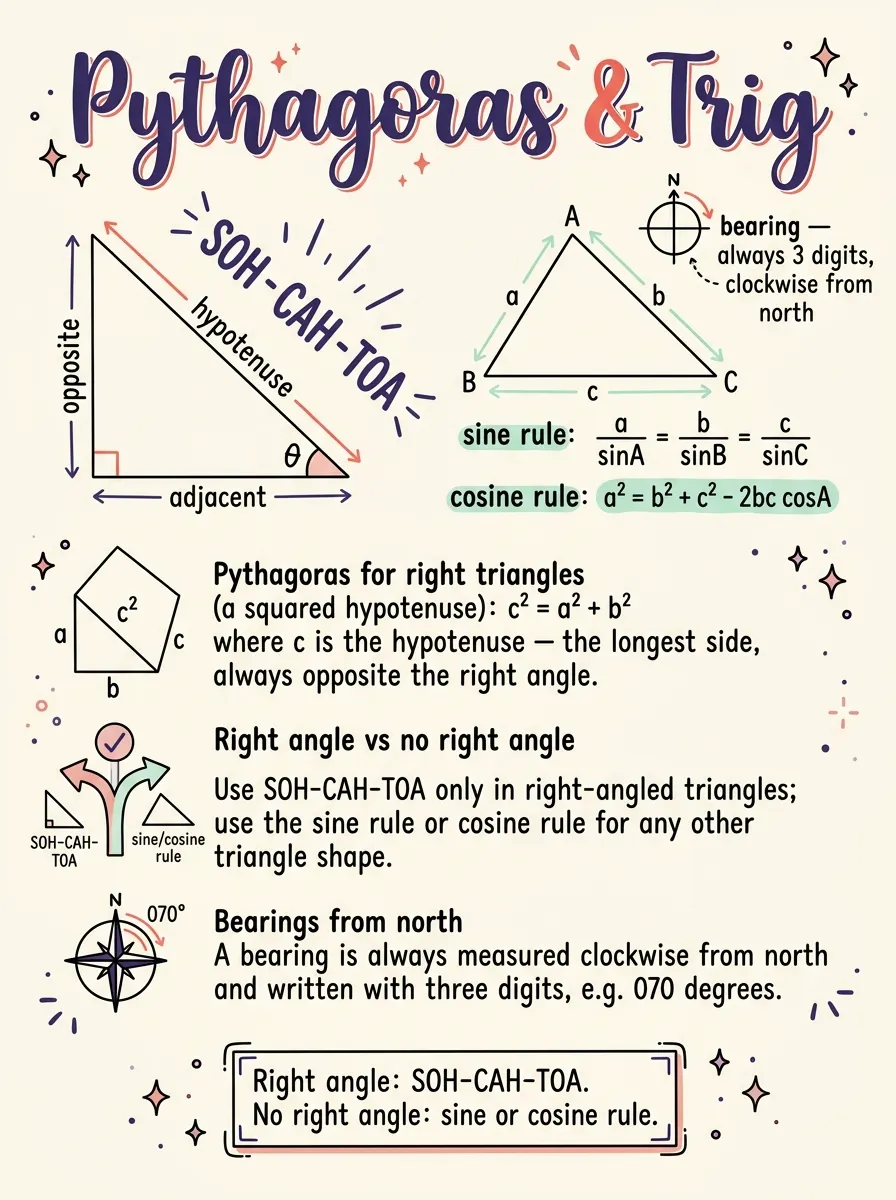
Pythagoras' Theorem and Trigonometry
A ladder leaning against a wall, a zip line strung between two towers, a plane climbing away from a runway — every one of these hides a triangle, and once you know how to measure a triangle you can answer real questions about all of them: how high, how far, which direction. This topic builds that toolkit in stages, each stage growing out of the one before it. You already know how to square a number and undo a square with a square root — Pythagoras' theorem turns that into a way of finding a missing side of a right-angled triangle. From there, SOH-CAH-TOA lets you find a side or an angle even when you only know one side and one angle. Then, because not every triangle in an exam question is kind enough to have a right angle in it, the sine rule, the cosine rule and a triangle-area formula extend the same ideas to triangles of any shape. The topic finishes with the real-world settings these tools get used in: elevation, depression, bearings, and problems in 3D.
Pythagoras' theorem: finding a missing side
Why this works at all. Take any right-angled triangle and build a square on each of its three sides, using the side length as the square's edge. The two smaller squares — the ones sitting on the two shorter sides — always have areas that add up exactly to the area of the big square sitting on the longest side. That's not a coincidence; it's a fixed fact of right angles. Since the area of a square is (side length)$^2$, "the two smaller areas add up to the big one" is the same statement as the equation below, just written in symbols instead of pictures. The hypotenuse — the side opposite the right angle, always the longest side in the triangle — is the one that plays the "big square" role:
$$c^2 = a^2 + b^2$$
Here $c$ is the hypotenuse, and $a$ and $b$ are the other two sides. Because $c$ is a length, once you've found $c^2$ you still need to undo the square by taking a square root to get $c$ itself — that last step is easy to forget under exam pressure, so build the habit of asking "have I actually found the length, or just its square?" before you write down a final answer.
Worked example 1. Find the hypotenuse of a right-angled triangle with the other two sides $6$ and $8$.
Both given sides are legs (neither is the hypotenuse, since the hypotenuse is the unknown here), so they go on the right-hand side of the formula and get added:
$$c^2 = 6^2 + 8^2 = 36 + 64 = 100$$
$$c = \sqrt{100} = 10$$
Your turn. Find the hypotenuse of a right-angled triangle with the other two sides $9$ and $12$. Hint (only if stuck): square both, add them, then don't forget the final square root.
Answer - have a real go first. $c^2 = 9^2+12^2 = 81+144 = 225$, so $c = \sqrt{225} = 15$. If you stopped at $225$ and wrote that down as the answer, that's the classic slip: $225$ is the square of the hypotenuse, not the hypotenuse itself — always finish with the square root.
Finding a shorter side instead. Sometimes the hypotenuse is one of the sides you're given, and a shorter side is the unknown. The formula is the same equation, just rearranged: to isolate $a^2$ or $b^2$ algebraically, you move the other known square to the other side of the equals sign by subtracting it — the opposite of what you did to find the hypotenuse. This makes sense from the picture too: the hypotenuse-square is the total, so a leg-square must be the total minus the other leg-square.
Worked example 2. A right-angled triangle has hypotenuse $13$ and one other side $5$. Find the remaining side.
Here $13$ is the hypotenuse (the biggest side is given, not unknown), so rearrange to make the shorter side the subject and subtract:
$$b^2 = c^2 - a^2 = 13^2 - 5^2 = 169 - 25 = 144$$
$$b = \sqrt{144} = 12$$
Your turn. A right-angled triangle has hypotenuse $17$ and one other side $8$. Find the remaining side. Hint (only if stuck): identify which given number is the hypotenuse first — that's the one you subtract from, never the one you subtract.
Answer - have a real go first. $b^2 = 17^2 - 8^2 = 289 - 64 = 225$, so $b = \sqrt{225} = 15$. The usual slip is adding instead of subtracting (giving $\sqrt{289+64}$) — that only happens when you're finding the hypotenuse itself; here the hypotenuse was already given, so you must subtract.
The converse: testing whether a triangle is right-angled
Pythagoras' theorem, as stated above, assumes you already know the triangle is right-angled. But the same relationship also runs backwards: if you're given three side lengths and don't know whether there's a right angle, you can use the equation itself as a test. Square each of the three sides. If the square of the longest one equals the sum of the squares of the other two, those three lengths can only fit together as a right-angled triangle — there's no other shape they could form — and the right angle sits opposite that longest side. If the two totals don't match, no right angle exists anywhere in the triangle.
Worked example 3. Is a triangle with sides $9$, $12$ and $15$ right-angled?
Identify the longest side first ($15$), since that's the one that must equal the sum of the squares of the other two if a right angle exists:
$$9^2 + 12^2 = 81 + 144 = 225$$
$$15^2 = 225$$
The two totals match, so the triangle is right-angled, with the right angle opposite the side of length $15$.
Your turn. Is a triangle with sides $7$, $24$ and $25$ right-angled? Hint (only if stuck): square the two shorter sides and add them, then compare with the square of the longest side.
Answer - have a real go first. $7^2+24^2 = 49+576 = 625$, and $25^2 = 625$ — they match, so yes, this triangle is right-angled, with the right angle opposite the side of length $25$. A common mistake here is squaring and adding the wrong pair — always pick out the longest side first and test the other two against it, not just whichever two numbers come first in the question.
Trig ratios in a right-angled triangle: SOH-CAH-TOA
Pythagoras' theorem needs two known sides before it can find the third. But plenty of exam triangles give you only one side and one angle instead — a ladder's length and the angle it leans at, say. For that situation you need a tool that connects a side, an angle, and another side, all in one relationship: that's what the three trig ratios do.
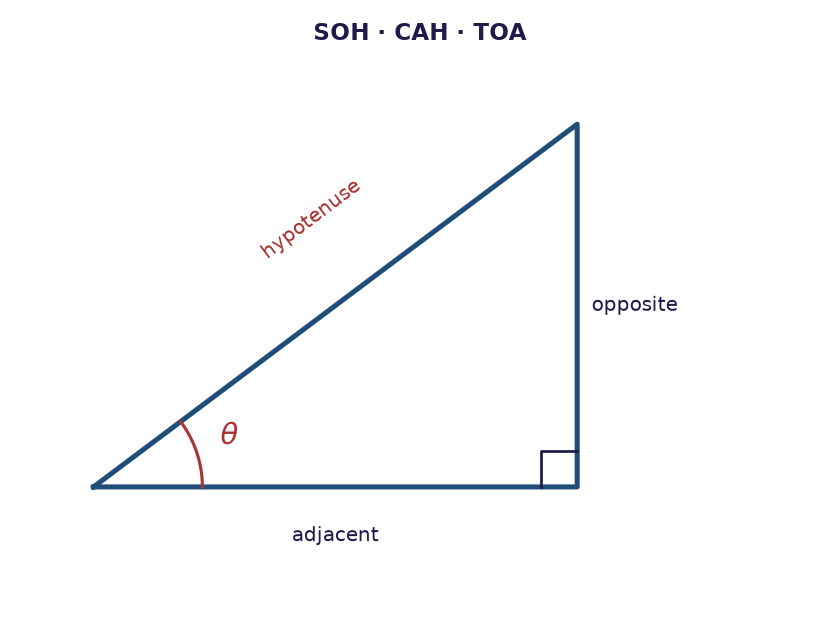
For a marked angle $\theta$ in a right-angled triangle, "opposite" is the side across from $\theta$, "adjacent" is the side next to $\theta$ that is not the hypotenuse, and "hypotenuse" is always the longest side, same as before. The one thing that trips people up: "opposite" and "adjacent" are not fixed labels belonging to particular sides — they depend on which angle you've marked. If a question marks the other non-right angle instead, the two sides that were "opposite" and "adjacent" swap roles. Always re-identify opposite and adjacent fresh for whichever angle the question is actually using, rather than reusing labels from a previous part of the question.
Three ratios connect the marked angle to the sides:
$$\sin\theta = \frac{\text{opposite}}{\text{hypotenuse}}$$
$$\cos\theta = \frac{\text{adjacent}}{\text{hypotenuse}}$$
$$\tan\theta = \frac{\text{opposite}}{\text{adjacent}}$$
The mnemonic SOH-CAH-TOA keeps them straight: Sine is Opposite over Hypotenuse, Cosine is Adjacent over Hypotenuse, Tangent is Opposite over Adjacent. Which ratio to use is decided entirely by which two sides are involved in the question — one of them is always the unknown, so look at what you're given and pick the ratio that links those two sides to $\theta$.
Worked example 4. A right-angled triangle has hypotenuse $10$ and a marked angle of $30^\circ$. Find the side opposite that angle.
The two sides involved are "opposite" (unknown) and "hypotenuse" (given), so SOH applies. Starting from $\sin\theta = \frac{\text{opposite}}{\text{hypotenuse}}$, multiply both sides by the hypotenuse to isolate "opposite":
$$\text{opposite} = 10 \times \sin30^\circ = 10 \times 0.5 = 5$$
Your turn. A right-angled triangle has hypotenuse $14$ and a marked angle of $60^\circ$. Find the side adjacent to that angle. Hint (only if stuck): "adjacent" and "hypotenuse" together — which letter of SOH-CAH-TOA uses that pair?
Answer - have a real go first. $\text{adjacent} = 14 \times \cos60^\circ = 14 \times 0.5 = 7$. A common mistake is reaching for sine out of habit — check which two sides the question actually mentions ("adjacent" and "hypotenuse" here) before picking S, C, or T, rather than always defaulting to sine.
Finding an angle instead of a side. When both sides are known but the angle is the unknown, you still write the same ratio — but now you need to undo it to get $\theta$ back out. That's what the inverse functions, namely $\sin^{-1}$, $\cos^{-1}$, $\tan^{-1}$, on your calculator do: given the ratio, they hand back the angle that produced it.
Worked example 5. A right-angled triangle has an opposite side of $5\sqrt3$ and an adjacent side of $5$, either side of a marked angle $\theta$. Find $\theta$.
The two known sides are "opposite" and "adjacent", so TOA applies:
$$\tan\theta = \frac{5\sqrt3}{5} = \sqrt3$$
$$\theta = \tan^{-1}(\sqrt3) = 60^\circ$$
Your turn. A right-angled triangle has an opposite side of $9$ and a hypotenuse of $15$, either side of a marked angle $\theta$. Find $\theta$. Hint (only if stuck): "opposite" and "hypotenuse" — which ratio, and which inverse function undoes it?
Answer - have a real go first. $\sin\theta = \frac{9}{15} = 0.6$, so $\theta = \sin^{-1}(0.6) = 36.9^\circ$ (1 d.p.). If you used $\tan^{-1}$ instead of $\sin^{-1}$ — the usual slip when a hypotenuse is involved — you'd be treating the hypotenuse as if it were the adjacent side; re-check which two sides SOH-CAH-TOA actually names before choosing the inverse function.
Extending sine and cosine beyond 90 degrees
SOH-CAH-TOA only makes sense inside a right-angled triangle, so it only ever deals with angles up to $90^\circ$ (an angle can't be $90^\circ$ or more and still sit inside a right-angled triangle alongside another positive angle). But once you meet the sine rule and cosine rule later in this topic, you'll need to work with triangles that have an obtuse angle in them — and sine and cosine (though not tangent, in this syllabus) are defined for those angles too, all the way up to $180^\circ$. The rule for extending them uses a reference angle, $180^\circ - \theta$:
$$\sin\theta = \sin(180^\circ - \theta)$$
$$\cos\theta = -\cos(180^\circ - \theta)$$
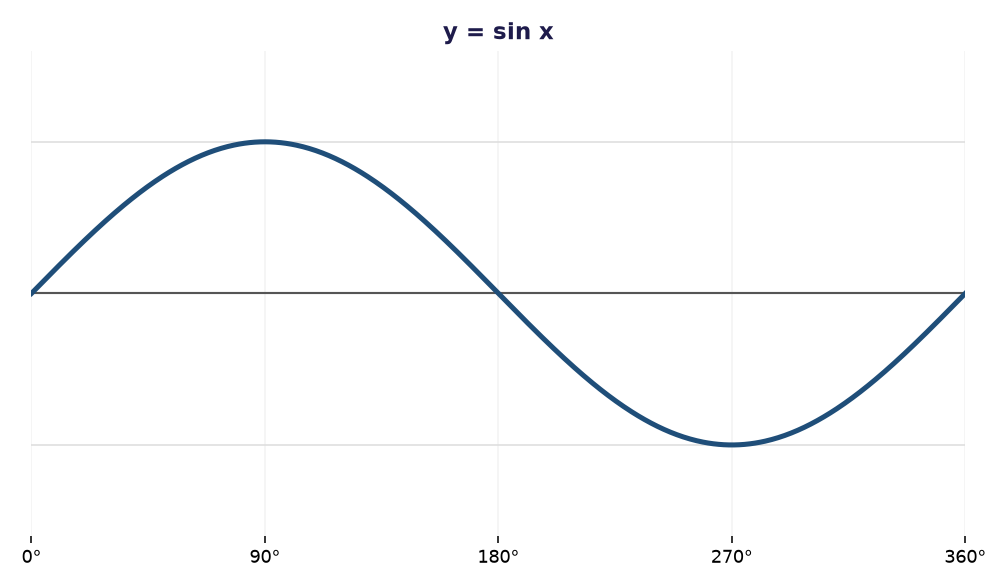
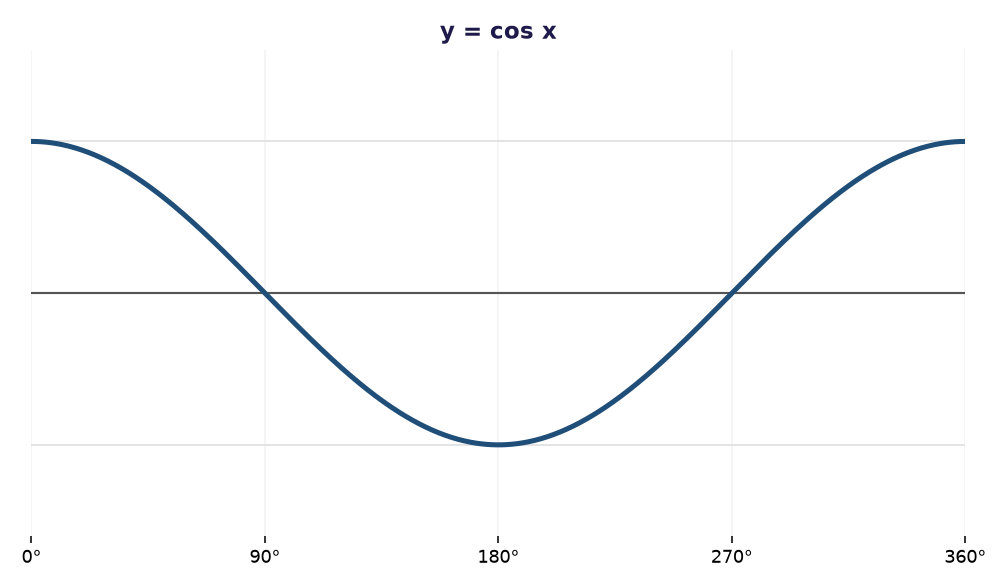
In words: to evaluate sine or cosine of an obtuse angle, first find its reference angle by subtracting it from $180^\circ$ — that reference angle is always acute, so your calculator's usual SOH-CAH-TOA sense of it still applies. Sine of the obtuse angle then equals sine of the reference angle, no sign change. Cosine is the one to watch: cosine of the obtuse angle equals negative cosine of the reference angle. That minus sign is not optional decoration — it reflects a genuine fact (cosine really is negative for every obtuse angle) — and forgetting it is the single most common error in this whole topic. Put another way: sine stays positive all the way from $0^\circ$ to $180^\circ$; cosine starts positive, crosses zero at exactly $90^\circ$, and is negative for every angle beyond that.
The two curves below plot a full turn, $0^\circ$ to $360^\circ$ — this syllabus only needs the part up to $180^\circ$, but seeing the whole curve makes the positive/negative pattern easier to read at a glance.
Worked example 6. Evaluate $\sin150^\circ$.
The reference angle is $180^\circ - 150^\circ = 30^\circ$, and sine of an obtuse angle equals sine of its reference angle (no sign change):
$$\sin150^\circ = \sin(180^\circ - 150^\circ) = \sin30^\circ = \frac{1}{2}$$
Worked example 7. Evaluate $\cos120^\circ$.
The reference angle is $180^\circ - 120^\circ = 60^\circ$, and cosine of an obtuse angle equals negative cosine of its reference angle:
$$\cos120^\circ = -\cos(180^\circ - 120^\circ) = -\cos60^\circ = -\frac{1}{2}$$
Your turn. Evaluate $\cos135^\circ$. Hint (only if stuck): find the reference angle first, then don't forget the sign that cosine picks up past $90^\circ$.
Answer - have a real go first. Reference angle $= 180^\circ - 135^\circ = 45^\circ$, so $\cos135^\circ = -\cos45^\circ = -\frac{\sqrt2}{2} \approx -0.707$. The near-universal slip is dropping the minus sign and writing $+0.707$ — remember cosine is negative for every angle past $90^\circ$, with no exceptions, so an obtuse-angle cosine answer without a minus sign should immediately look wrong to you.
Area of a triangle from two sides and the included angle
The area formula you already know, $\text{Area} = \frac{1}{2} \times \text{base} \times \text{height}$, needs the perpendicular height — which is awkward to find if all you're given is two sides and the angle between them. Here's the fix: drop a perpendicular from one vertex to the opposite side to create the height, and that perpendicular is itself just "side $\times \sin(\text{angle})$" inside the little right-angled triangle it creates. Substitute that into the familiar base-height formula and the height cancels out of the problem entirely, leaving a formula built only from two sides and the angle between them:
$$\text{Area} = \frac{1}{2}ab\sin C$$
Here $a$ and $b$ are two sides, and $C$ is the angle included between them — meaning the angle has to be the one actually trapped between the two sides you're using, not some other angle of the triangle. (This formula is given on the exam formula sheet — you don't need to memorise it, just recognise when to reach for it: two sides and the angle between them, no height in sight.)
Worked example 8. Find the area of a triangle with two sides $8$ and $10$, and an included angle of $30^\circ$.
$$\text{Area} = \frac{1}{2} \times 8 \times 10 \times \sin30^\circ = 40 \times 0.5 = 20$$
Your turn. Find the area of a triangle with two sides $6$ and $9$, and an included angle of $150^\circ$. Hint (only if stuck): $\sin150^\circ$ is the same as $\sin30^\circ$ — reference angle.
Answer - have a real go first. $\text{Area} = \frac{1}{2}\times6\times9\times\sin150^\circ = 27\times0.5 = 13.5$. Notice the area still comes out positive even with an obtuse included angle — that's because sine (unlike cosine) stays positive all the way to $180^\circ$, so this formula never needs a sign check the way the cosine rule below does.
The sine rule and the cosine rule: solving any triangle
SOH-CAH-TOA and the area formula above both still lean on a right angle being somewhere in the picture (SOH-CAH-TOA needs one directly; the area-formula derivation used one to build the height). Plenty of exam triangles have no right angle at all — so two general-purpose formulas, both given on the exam formula sheet, are needed to solve any triangle, right-angled or not.
The sine rule links each side to the sine of its opposite angle:
$$\frac{a}{\sin A} = \frac{b}{\sin B} = \frac{c}{\sin C}$$
Every side is paired with the angle directly across from it — side $a$ opposite angle $A$, and so on. Use the sine rule when you know one complete angle–side pair (an angle and the side opposite it) plus one more angle or side: that matching pair is what lets you set up the equation in the first place, since one side of the equation needs to be a complete, known fraction.
The cosine rule links all three sides to one angle:
$$a^2 = b^2 + c^2 - 2bc\cos A$$
This is really Pythagoras' theorem with a correction term bolted on: when $A = 90^\circ$, $\cos A = 0$ and the extra term vanishes, leaving exactly $a^2 = b^2+c^2$ — so the cosine rule is a strict generalisation of Pythagoras, not a replacement for it. Use the cosine rule when you know all three sides, or two sides and the angle included between them (the same "included" idea as the area formula). Rearranged to make $\cos A$ the subject, it also finds an angle from three known sides:
$$\cos A = \frac{b^2+c^2-a^2}{2bc}$$
Worked example 9 (sine rule, a side). In a triangle, angle $A = 30^\circ$ with opposite side $a = 6$, and angle $B = 90^\circ$. Find side $b$.
$A$ and $a$ form the known angle–side pair, so cross-multiply that against $B$:
$$b = \frac{a\sin B}{\sin A} = \frac{6 \times \sin90^\circ}{\sin30^\circ} = \frac{6 \times 1}{0.5} = 12$$
This particular triangle happens to be right-angled ($B = 90^\circ$), which is a handy check, not a requirement — it lets us confirm the sine rule gives the same answer SOH-CAH-TOA would, but the sine rule works just as well on triangles that have no right angle at all.
Your turn. In a triangle, angle $P = 40^\circ$ with opposite side $p = 8$, and angle $Q = 65^\circ$. Find side $q$. Hint (only if stuck): $P$ and $p$ are your known pair — cross-multiply against $Q$.
Answer - have a real go first. $q = \frac{p\sin Q}{\sin P} = \frac{8\times\sin65^\circ}{\sin40^\circ} \approx \frac{8\times0.9063}{0.6428} \approx 11.3$. A common slip is cross-multiplying with the wrong pair — always check that the angle and side you divide by ($P$ and $p$ here) genuinely belong together (one directly opposite the other) before you touch the calculator.
Using the sine rule to find an angle — and why two answers can both be "right". Rearranging the sine rule to make an angle the subject works the same way as for a side, but there's a snag: sine gives the same value for an angle and its reference-angle partner ($\sin\theta = \sin(180^\circ-\theta)$, from the section above). That means your calculator's $\sin^{-1}$ always hands back the acute possibility, even when the real answer in the triangle is obtuse — so after finding $\sin^{-1}$, you must actively check whether the obtuse alternative ($180^\circ$ minus that answer) is the one the question actually wants, using whatever the question tells you (for example, that the angle is obtuse, or a rough sketch showing which angle looks bigger).
Worked example 9b (sine rule, an angle, obtuse case). A triangle has $a = 5$, $A = 30^\circ$, and $b = 9$. Given that angle $B$ is obtuse, find $B$.
$$\sin B = \frac{b\sin A}{a} = \frac{9\times\sin30^\circ}{5} = \frac{9\times0.5}{5} = 0.9$$
A calculator's $\sin^{-1}(0.9)$ gives the acute answer, $64.2^\circ$ (1 d.p.) — but we were told $B$ is obtuse, so that's not our answer; we want the other angle with the same sine:
$$B = 180^\circ - 64.2^\circ = 115.8^\circ \text{ (1 d.p.)}$$
Your turn. A triangle has $a = 6$, $A = 25^\circ$, and $b = 10$. Given that angle $B$ is obtuse, find $B$. Hint (only if stuck): find $\sin^{-1}$ first — that gives the acute angle — then subtract it from $180^\circ$.
Answer - have a real go first. $\sin B = \frac{10\times\sin25^\circ}{6} \approx 0.7044$, so $\sin^{-1}(0.7044) \approx 44.8^\circ$; since $B$ is obtuse, $B = 180^\circ - 44.8^\circ = 135.2^\circ$ (1 d.p.). If you stopped at $44.8^\circ$, that's the acute twin of the real answer — your calculator can never tell you by itself which one the triangle actually needs, only the question's wording (here, "$B$ is obtuse") can.
Worked example 10 (cosine rule, a side). A triangle has $b = 8$, $c = 5$, and the included angle $A = 60^\circ$. Find side $a$.
$b$, $c$, and $A$ are two sides and their included angle, so this fits the cosine rule directly:
$$a^2 = 8^2 + 5^2 - 2 \times 8 \times 5 \times \cos60^\circ = 64 + 25 - 40 = 49$$
$$a = \sqrt{49} = 7$$
Your turn. A triangle has $b = 9$, $c = 4$, and the included angle $A = 120^\circ$. Find side $a$. Hint (only if stuck): $\cos120^\circ$ is negative — subtracting a negative number makes $a^2$ bigger, not smaller.
Answer - have a real go first. $a^2 = 9^2+4^2-2\times9\times4\times\cos120^\circ = 81+16-72\times(-0.5) = 97+36 = 133$, so $a = \sqrt{133} \approx 11.5$. The usual slip is treating $-2bc\cos A$ as always making the answer smaller — with an obtuse included angle, $\cos A$ is negative, so that term actually adds to $b^2+c^2$ rather than subtracting from it.
Worked example 11 (cosine rule, an angle). A triangle has sides $a = 7$, $b = 8$, $c = 5$. Find angle $A$.
All three sides are known and no angle is given, so use the rearranged form to find $\cos A$ directly:
$$\cos A = \frac{8^2+5^2-7^2}{2 \times 8 \times 5} = \frac{64+25-49}{80} = \frac{40}{80} = 0.5$$
$$A = \cos^{-1}(0.5) = 60^\circ$$
Unlike the sine-rule case above, there's no ambiguity to check here: cosine only takes each value once between $0^\circ$ and $180^\circ$ (it's the sign-and-size change past $90^\circ$ from the earlier section that makes this possible), so whatever $\cos^{-1}$ gives you is the one true angle — no second obtuse alternative to consider.
Your turn. A triangle has sides $a = 6$, $b = 5$, $c = 9$. Find angle $C$. Hint (only if stuck): rearrange the cosine rule so the side opposite $C$ (that's $c$) is the one being subtracted.
Answer - have a real go first. $\cos C = \frac{a^2+b^2-c^2}{2ab} = \frac{36+25-81}{60} = \frac{-20}{60} \approx -0.333$, so $C = \cos^{-1}(-0.333) \approx 109.5^\circ$ (1 d.p.). The usual slip is plugging $c$ into the wrong slot of the formula — remember the side you're solving for the angle of is always the one being subtracted at the end (matching $-c^2$, $-a^2$, or $-b^2$), never one of the sides being squared and added.
Elevation, depression, bearings, and problems in 3D
Two everyday angles turn up constantly in these problems:
- The angle of elevation is the angle up from the horizontal to an object above you.
- The angle of depression is the angle down from the horizontal to an object below you.
Picture a horizontal line drawn out from the observer's eye, and a sloped line up (or down) to the object; the angle between the two, measured from the horizontal line, is the angle of elevation (or depression). A useful fact that questions sometimes lean on: because the two horizontal lines (one at the top, one at the bottom of the sloped line of sight) are parallel, the angle of elevation seen from the ground up to a point equals the angle of depression seen from that same point looking back down — they're alternate angles on parallel lines, so you can freely swap one for the other if a question gives you one and asks about the other.
A bearing measures a direction as an angle turned clockwise from north, always written as three digits — for example, a bearing of $070^\circ$ is $70^\circ$ clockwise from north, and a bearing of $005^\circ$ is written with the leading zeros kept.
Worked example 12 (bearing). A ship sails $8$ km on a bearing of $070^\circ$. Find how far east it has travelled.
The bearing angle is measured from the north line, so picture a right-angled triangle with a vertical side pointing north, a horizontal side pointing east, and the ship's $8$ km path as the sloped hypotenuse, with the $70^\circ$ marked at the top, between north and the path. "East" is the side opposite that $70^\circ$ angle, so this is a plain sine-ratio step:
$$\text{east distance} = 8 \times \sin70^\circ \approx 8 \times 0.940 \approx 7.5 \text{ km}$$
Your turn. A plane flies $12$ km on a bearing of $050^\circ$. Find how far north it has travelled. Hint (only if stuck): "north" is the side adjacent to the bearing angle, measured from the north line.
Answer - have a real go first. $\text{north distance} = 12\times\cos50^\circ \approx 12\times0.643 \approx 7.7$ km. If you used sine instead of cosine — the usual slip carried over from the east-distance example — remember "north" sits next to the bearing angle (adjacent), while "east" sits across from it (opposite); which ratio you need flips depending on which direction the question asks for.
Reversing a bearing. Sometimes a question gives the bearing of $B$ from $A$ and asks for the bearing of $A$ from $B$ instead — the same direction, looked at from the other end. Picture standing at $A$ facing $B$: turning right around to face back the other way (from $B$ towards $A$) is a half turn, $180^\circ$. So the reverse bearing is always the original bearing plus or minus $180^\circ$, whichever keeps the result inside the $0^\circ$–$360^\circ$ range (add $180^\circ$ if the original is under $180^\circ$; subtract $180^\circ$ if it's $180^\circ$ or over).
Worked example. The bearing of $B$ from $A$ is $070^\circ$. Find the bearing of $A$ from $B$.
$070^\circ$ is under $180^\circ$, so add $180^\circ$:
$$\text{bearing of } A \text{ from } B = 070^\circ + 180^\circ = 250^\circ$$
Your turn. The bearing of $D$ from $C$ is $310^\circ$. Find the bearing of $C$ from $D$. Hint (only if stuck): $310^\circ$ is already $180^\circ$ or more, so which of add/subtract keeps you inside $0^\circ$–$360^\circ$?
Answer - have a real go first. $310^\circ$ is $180^\circ$ or more, so subtract: bearing of $C$ from $D = 310^\circ - 180^\circ = 130^\circ$. The usual slip is always adding $180^\circ$ out of habit; if the original bearing is already large, adding $180^\circ$ overshoots past $360^\circ$ — when that happens, subtract $180^\circ$ instead.
Worked example 13 (elevation, 2D). A tower is $40$ m tall. A surveyor stands $30$ m from its base on level ground. Find the angle of elevation to the top of the tower.
The tower's height ($40$ m, opposite the angle) and the ground distance ($30$ m, adjacent to the angle) are both known, with the angle itself unknown, so this is TOA:
$$\tan\theta = \frac{40}{30} = \frac{4}{3}$$
$$\theta = \tan^{-1}\left(\frac{4}{3}\right) \approx 53.1^\circ$$
Your turn. A kite is flying directly above a point $20$ m from where a student stands on level ground, at a height of $35$ m. Find the angle of elevation from the student to the kite. Hint (only if stuck): height is opposite the angle, ground distance is adjacent — same ratio as the tower example.
Answer - have a real go first. $\tan\theta = \frac{35}{20} = 1.75$, so $\theta = \tan^{-1}(1.75) \approx 60.3^\circ$ (1 d.p.). A common mix-up is swapping which number goes on top — always match "height above the ground" to "opposite" and "distance along the ground" to "adjacent," not just whichever number the question states first.
Worked example 14 (3D). A cuboid has a rectangular base $6$ m by $8$ m and height $3$ m. Find the angle between the diagonal running from one bottom corner up to the opposite top corner, and the base.
Picture the cuboid resting on a table, and label its corners so you can hold the shape in your head without a photograph. Going around the base rectangle, call the corners $A$, $B$, $C$ and $D$ in order, so edge $AB = 6$ m and edge $BC = 8$ m. Each top corner sits directly above the base corner with the same letter, marked with a dash: $A'$ is straight above $A$, $C'$ is straight above $C$, and so on. The diagonal we want runs from base corner $A$ up to $C'$ — the top corner diagonally opposite $A$, not the one straight above it.
That diagonal $AC'$ is the hypotenuse of a flat right-angled triangle standing up inside the cuboid: - one side is the base diagonal $AC$, running straight across the rectangular base from $A$ to $C$; - the other side is the vertical edge $CC'$, of length $3$ m, running straight up from $C$ to $C'$; - the right angle sits at $C$, where the vertical edge meets the base diagonal; - $\theta$, the angle we want, sits at corner $A$, between the base diagonal $AC$ and the sloped diagonal $AC'$.
The reason this reduction works is that a vertical edge is always perpendicular to the flat base it stands on, so $CC'$ and $AC$ genuinely meet at $90^\circ$ — which is exactly the condition SOH-CAH-TOA needs. First find the base diagonal $AC$, using Pythagoras' theorem in the horizontal plane (this is why Pythagoras from the start of this topic keeps reappearing — 3D problems almost always need it to manufacture the first side of a flat triangle before trigonometry can take over):
$$AC = \sqrt{6^2+8^2} = \sqrt{100} = 10$$
The vertical edge $CC' = 3$ and the base diagonal $AC = 10$ now form the right-angled triangle described above, right-angled at $C$, so:
$$\tan\theta = \frac{CC'}{AC} = \frac{3}{10} = 0.3$$
$$\theta = \tan^{-1}(0.3) \approx 16.7^\circ$$
Every 3D problem reduces this way: find a flat right-angled triangle hiding inside the solid — usually by first finding a diagonal with Pythagoras' theorem — then apply SOH-CAH-TOA exactly as before.
Your turn. A cuboid has a rectangular base $5$ m by $12$ m and height $4$ m. Find the angle between the diagonal running from one bottom corner to the opposite top corner, and the base. Hint (only if stuck): find the base diagonal with Pythagoras first, then use that diagonal and the height in a tangent ratio.
Answer - have a real go first. Base diagonal $= \sqrt{5^2+12^2} = \sqrt{169} = 13$ m. Then $\tan\theta = \frac{4}{13} \approx 0.3077$, so $\theta \approx 17.1^\circ$ (1 d.p.). If you used the height and one of the base edges (like $5$ or $12$) instead of the full base diagonal, that's the usual slip — the flat right-angled triangle needs the diagonal running underneath the sloped line, not just one wall of the base.
Key formulas
- Pythagoras' theorem, $c^2 = a^2 + b^2$: $c$ is the hypotenuse, the longest side. Add to find the hypotenuse; subtract to find a shorter side.
- Converse: if (longest side)$^2$ equals the sum of the squares of the other two, the triangle is right-angled.
- SOH-CAH-TOA (right-angled triangles only): $\sin\theta = \frac{\text{opp}}{\text{hyp}}$, $\cos\theta = \frac{\text{adj}}{\text{hyp}}$, $\tan\theta = \frac{\text{opp}}{\text{adj}}$.
- Obtuse angles: sine stays positive up to $180^\circ$; cosine turns negative past $90^\circ$. Use the reference angle $180^\circ - \theta$.
- Area $= \frac{1}{2}ab\sin C$; sine rule $\frac{a}{\sin A}=\frac{b}{\sin B}=\frac{c}{\sin C}$; cosine rule $a^2=b^2+c^2-2bc\cos A$ (rearranged: $\cos A = \frac{b^2+c^2-a^2}{2bc}$) — all given on the exam formula sheet.
- Elevation is measured up from the horizontal, depression down from the horizontal (the two are equal as alternate angles on the same sloped line); a bearing is measured clockwise from north, always three digits; a reverse bearing is the original $\pm 180^\circ$.
- In 3D, find a hidden flat right-angled triangle (often via a diagonal from Pythagoras' theorem), then apply SOH-CAH-TOA as usual.
Common mistakes
- Forgetting the final square root after Pythagoras' theorem, and stopping at the squared value.
- Adding instead of subtracting (or vice versa) — check first whether the unknown is the hypotenuse (add the two legs) or a shorter side (subtract from the hypotenuse).
- Re-using "opposite" and "adjacent" labels from a different marked angle — always re-identify them for whichever angle the question is actually using.
- Dropping the minus sign on $\cos\theta$ for an obtuse angle — cosine is negative for every angle past $90^\circ$, with no exceptions.
- Using the wrong side/angle pairing in the sine or cosine rule — the sine rule needs a matching opposite pair; the cosine rule needs the angle genuinely included between the two sides used.
- Taking a sine-rule angle straight from $\sin^{-1}$ without checking whether the obtuse alternative ($180^\circ$ minus that value) is the one the triangle actually needs.
- Mixing up which direction (north/east, or elevation/depression) is opposite versus adjacent to the given angle — sketch the right-angled triangle first, every time.
- In 3D problems, using a base edge instead of the base diagonal when the sloped line runs to the diagonally opposite corner.
Exam tips
- Sketch the triangle before calculating anything — most marks are lost from mislabelling a side or angle, not from arithmetic errors.
- Identify whether the unknown is the hypotenuse or a shorter side before choosing add or subtract in Pythagoras' theorem.
- With SOH-CAH-TOA, write down which two sides (or side and angle) you actually have before picking S, C, or T — don't guess from memory.
- When a sine-rule question asks for an angle, always check whether the obtuse alternative fits the given information, rather than accepting your calculator's first answer automatically.
- For bearings, always sketch north as a vertical line at each point mentioned, and mark the angle clockwise from it — this makes it obvious which trig ratio (and which reverse-bearing adjustment) you need.
- For 3D problems, redraw the one flat right-angled triangle you actually need in 2D, labelling only the three lengths/angle relevant to that step — trying to work directly off the 3D sketch is where most errors creep in.
📝 Listening worksheet
Print this (or keep it open) and fill in the blanks as the podcast reaches each idea. Answers are at the bottom for self-check.
Download worksheet (PDF)